
Govt submits climate, energy strategy to Parliament
Published : 01 Jul 2022, 02:10
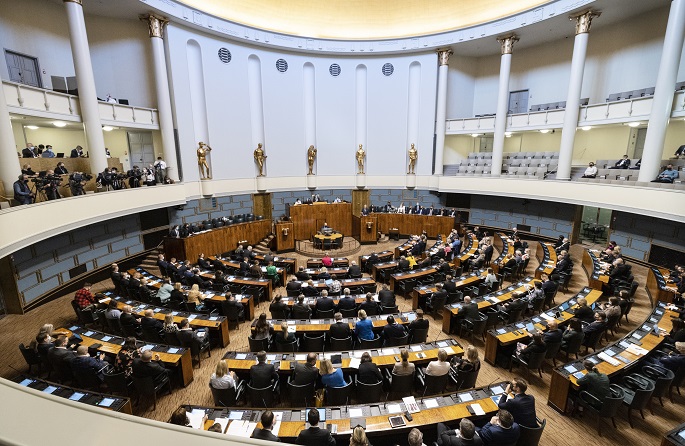
The government on Thursday submitted its national climate and energy strategy to Parliament as a report, said the Ministry of Economic Affairs and Employment in a press release.
The strategy covers all greenhouse gas emissions in the emissions trading, effort sharing and land use sectors as well as the carbon sinks of land use and other sectors.
The strategy focuses on the green transition and the phasing-out of Russian fossil energy, the import of which has already ceased almost completely.
It includes policies on security of supply drawn up by the Ministerial Working Group on Preparedness.
Other key elements of energy policy include the security and continuity of energy supply and competitive energy prices, which are essential for both energy users and economic growth.
According to the strategy, Finland can achieve its climate target by 2030 (a 60% reduction in total greenhouse gas emissions compared to 1990 level) and carbon neutrality by 2035 (emissions will not exceed the amount of emissions absorbed by carbon sinks).
Finland is likely to achieve the objective of generating at least 51% of the final energy consumption from renewable sources by 2030. However, the EU’s new proposed target for Finland to reduce its end consumption of energy to no more than 250 TWh by 2030, is still open.
Three quarters of the greenhouse gases that warm the climate originate from energy production and consumption, including transport.
Energy and climate policies are therefore closely linked, particularly as regards the promotion of energy efficiency and clean energy sources. To reduce the energy system’s dependency on carbon, investments in clean solutions have already been made in Finland for quite some time.
The emissions trading system and a predictable long-term climate and energy policy are key steering instruments of the strategy. A stable operating environment is important for investments, as are investments in new technologies. Companies make the investments, but public administration can facilitate them by improving operating conditions with clear and easy licencing rules and financial incentives.
The strategy includes reviews in line with the five dimensions of the EU Energy Union: low-carbon economy, including renewable energy; energy efficiency; energy markets; energy security; and research, innovation and competitiveness.
The strategy addresses cross-cutting themes that play a key role in reducing emissions. These include:
electrification and use of system integration, which helps reduce emissions in sectors where this is otherwise difficult, promoting non-combustion heat production, tax treatment of waste heat (including data centres) and industrial-sized heat pumps, increased market-based generation of land-based wind energy, offshore wind power demonstrations and investments in them, use of leased water areas in Finland’s territorial waters, updating the 2020 sectoral low-carbon roadmaps in 2023, as applicable.
Belarus to close embassy in Finland
15 to face trial for producing, selling cannabis in Helsinki
Russian reconnaissance aircraft suspected of violating Finnish airspace
Finland supports aviation safety in Indonesia
Misuse of funds, info most common suspected corruption cases in Finland: study
Espoo, Vantaa cities´ massive job cut moves put services at risk: JHL

Editor-in-Chief Ofiul Hasnat
Published by Finnish News Network (FNN)
Heporinne 4 B 45
01200 Vantaa, Finland.
E-mails : [email protected]