
Deficit regains high
Govt forecasts 1.6% GDP growth this year, 1.8% next year
Published : 21 Sep 2026, 12:00
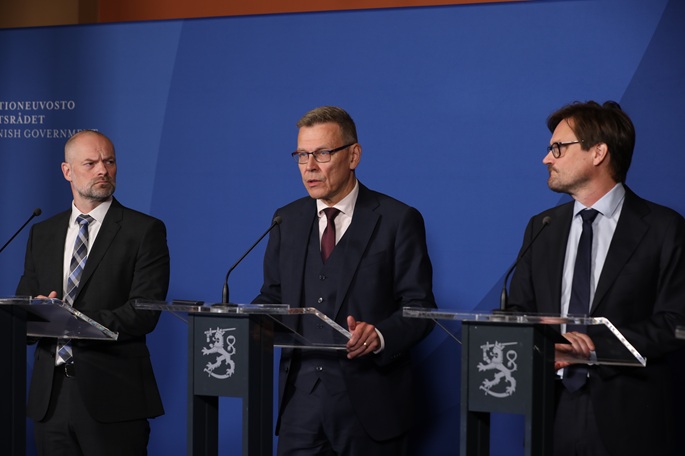
The Finnish economy has been growing more rapidly than expected but the upturn will not be sufficient to correct the structural imbalance affecting general government finances, according to the economic forecast published by the Finnish Ministry of Finance on Monday.
Gross domestic product (GDP) is expected to grow by 1.6 per cent in 2026, 1.8 per cent in 2027 and 1.5 per cent in 2028.
Revised figures published in June also led to more upbeat estimates of economic growth and work productivity in 2024 and 2025. The economic recovery is reflected in many sectors of the economy, and the outlook has brightened in both companies and households.
Despite the more rapid growth, the picture of the Finnish economy is not uniformly positive. The number of employed persons is still declining, and there are no signs yet of any recovery in the housing market and housing construction.
“It would seem that the brake that prevented demand and output growing last year has lost some of its effect, and the prerequisites for genuine economic growth are now in place. At the same time, the upturn in general government finances is expected to remain weak because the economic recovery will be insufficient to correct the structural imbalance in general government finances,” said Director General Mikko Spolander.
The forecast has been prepared for the government’s budget session, and it therefore does not contain any details of Google’s data centre projects, which would boost investments even more than projected in 2027 and 2028.
At the same time, oil prices are now substantially higher than assumed in the forecast, which will have a negative impact on growth this year and in 2027.
The positive risks of the forecast are primarily associated with faster-than-expected growth in domestic demand. Negative risks are associated with weaker-than-expected growth in the global economy.
The global economy has grown more rapidly than expected. Thus far, the negative impacts of the US trade policy and the crisis in the Middle East have remained less severe than feared.
Finnish exports are growing, and the upturn in demand is reflected in export companies’ order books. However, imports are growing at a more rapid rate, as the deliveries of the F-35 fighter jets and investments in data centres require large quantities of imported items.
Mainly driven by rising energy prices, inflation has picked up speed this year. Otherwise, price pressures will remain moderate, and consumer prices will increase at an annual rate of about two per cent throughout the outlook period.
Growth in households’ purchasing power has been slowed by the weak employment situation and the rise in prices and interest rates. Purchasing power will increase next year as the employment rate recovers, and agreed pay increases boost wages and salaries. Households remain cautious, which is still slowing consumption, and the saving rate will remain higher than in recent years.
Growth in investments will be driven by data centres and the deliveries of the multirole fighters.
Data centre projects now in progress will boost construction, investments in machinery and equipment, and immaterial investments. The industrial energy transition will also support investments throughout the outlook period.
Driven by business and industrial construction, data centres and energy projects, the drawn-out downturn in building construction is gradually receding.
At the same time, there is still no sign of a turnaround in housing construction, and the housing market has actually contracted. However, there is a lot of pent-up demand in the sector, and housing construction is expected to recover in 2027.
There has been a further fall in the number of employed persons during the first half of 2026, and unemployment is now higher than at any point during the first two decades of this century.
Unemployment is expected to reach 10.3 per cent in 2026, and it will then fall to under ten per cent. The employment rate (age group 20–64) will be 75.5 per cent this year.
More rapid output growth is expected to put employment growth on an upward trajectory by the end of the year.
However, the employment forecast has not been revised to the same extent as the GDP forecast, as the updated forecasts concern work productivity rather than labour input.
The economic upturn and more rapid growth will only have a minor impact on the bleak outlook for Finland’s general government finances.
Boosted by substantial increases in defence materiel purchases, the general government deficit will reach 4.2 per cent of GDP this year.
Driven mainly by a widening imbalance between revenue and expenditure in local government, the deficit will reach 4.5 per cent in 2027. According to the revised figures published in the summer, the deficit for 2025 was 3.8 per cent of GDP, or 0.4 percentage points higher than the preliminary data.
The general government deficit will also remain high in the long term: boosted by growth in defence spending and interest expenses, it will still stand at 4.4 per cent of GDP in 2030.
Although the economic upturn will boost indirect tax revenue this year, the weak employment situation will slow growth in earned income tax revenue.
Tax revenue growth will also be slowed by the cuts in earned income taxation that entered into force at the start of the year, and in 2027, revenue growth will be slowed by cuts in the corporation tax rate. The substantial general government deficit is of a structural nature.
General government debt will reach 90 per cent of GDP this year. The debt-to-GDP ratio will grow more slowly this year and in 2027 due to economic growth and the one-off transfer from the State Pension Fund in 2027. However, the growth will accelerate again from 2028 onwards. The debt ratio will be close to 98 per cent in 2030.
The Economic Survey is the Ministry of Finance’s independent economic forecast and is published four times a year: in the spring, summer, autumn and winter.
The forecast examines key economic variables, such as the development of gross domestic product, inflation and interest rate outlooks, employment and investment rates, and the general government deficit and debt.
Finnish economy to grow 1.7% in 2026 due to exports, investment: Etla
Payment transaction delay disrupts operation of companies : survey
Building costs go up by 3.5% in August Y-on-Y
Number of bankruptcies rises in Finland in Aug
Inflation stands at 2.2% in August as fuel prices go up
Real estate maintenance costs rise by 3.3% in Q2

Editor-in-Chief Ofiul Hasnat
Published by Finnish News Network (FNN)
Heporinne 4 B 45
01200 Vantaa, Finland.
E-mails : [email protected]