
Finland´s rank slips to 5th in Press Freedom Index
Published : 03 May 2022, 15:08
Updated : 03 May 2022, 15:12
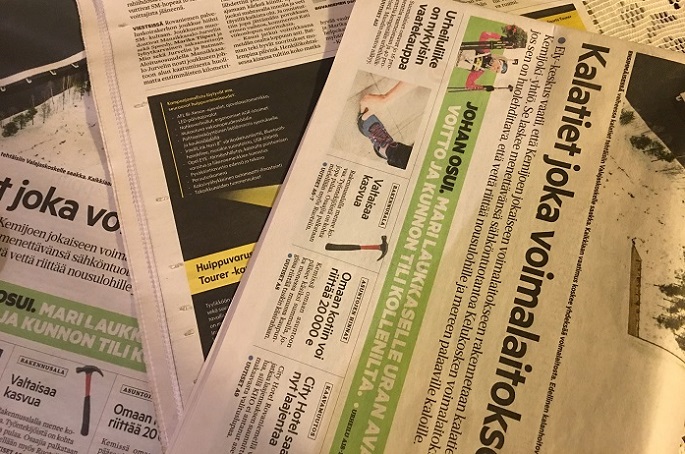
Finland ranked fifth in the 2022 World Press Freedom Index published by Reporters Sans Borders (RSF) on Tuesday.
Earlier, Finland ranked second in the 2021 World Press Index for the third consecutive year.
Norway has topped the index like in last years followed by Denmark, Sweden and Estonia.
North Korea has ended up at the bottom of the list of 180 countries, followed by Eritrea, Iran, Turkmenistan and Myanmar.
Finland is one of the few countries where the media is truly free, said the RSF, adding that the freedom of the press has been continuously strengthened ever since the first legislation banning censorship was adopted – under Swedish rule – as the first in the world in 1766.
In spite of a relative gender equality in the society, female journalists are overrepresented as victims of online harassment and intimidation in comparison to their male colleagues, said the report.
Physical violence against journalists is rare. Still, self-censorship risks to increase. Also, ethnic minorities are underrepresented in media staff, which constrains journalistic work and pluralism in media content, it added.
“Psychological stress and harm is caused not only by harassment through social media but also intimidation by legal means (Strategic Lawsuits Against Public Participation, SLAPPs), to which the legal system is yet to respond appropriately,” said RSF, adding especially freelance journalists are in a vulnerable position and a support fund has been established by the Union of journalists in Finland to cover for loss of income, psychotherapy and other related expenses.
The 20th World Press Freedom Index published by RSF revealed a two-fold increase in polarisation amplified by information chaos – that is, media polarisation fuelling divisions within countries, as well as polarisation between countries at the international level.
The invasion of Ukraine (106th) by Russia (155th) at the end of February reflected this process, as the physical conflict was preceded by a propaganda war.
“Margarita Simonyan, the Editor in Chief of RT (the former Russia Today), revealed what she really thinks in a Russia One TV broadcast when she said, ‘no great nation can exist without control over information.’ The creation of media weaponry in authoritarian countries eliminates their citizens’ right to information but is also linked to the rise in international tension, which can lead to the worst kind of wars. Domestically, the ‘Fox News-isation’ of the media poses a fatal danger for democracies because it undermines the basis of civil harmony and tolerant public debate. Urgent decisions are needed in response to these issues, promoting a New Deal for Journalism, as proposed by the Forum on Information and Democracy, and adopting an appropriate legal framework, with a system to protect democratic online information spaces,” RSF Secretary-General Christophe Deloire said.
In the 180 countries and territories ranked by RSF, indicators are assessed on the basis of a quantitative survey of press freedom violations and abuses against journalists and media, and a qualitative study based on the responses of hundreds of press freedom experts selected by RSF (journalists, academics and human rights defenders) to a questionnaire with 123 questions.
Belarus to close embassy in Finland
15 to face trial for producing, selling cannabis in Helsinki
Russian reconnaissance aircraft suspected of violating Finnish airspace
Finland supports aviation safety in Indonesia
Misuse of funds, info most common suspected corruption cases in Finland: study
Espoo, Vantaa cities´ massive job cut moves put services at risk: JHL

Editor-in-Chief Ofiul Hasnat
Published by Finnish News Network (FNN)
Heporinne 4 B 45
01200 Vantaa, Finland.
E-mails : [email protected]