
Fight rising anti-Semitism, racism: Niinistö
Published : 06 Feb 2020, 01:59
Updated : 06 Feb 2020, 10:21
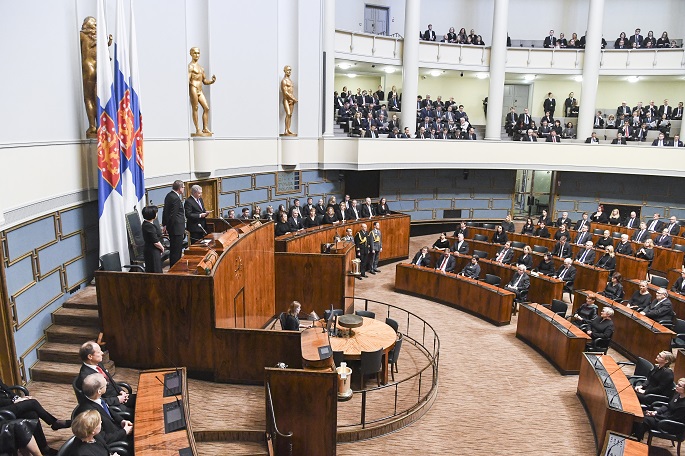
President Sauli Niinistö on Wednesday said there are signs of rising anti-Semitism and racism and emphasised opposing them resolutely.
His call comes at a time when US President Donald Trump’s National Security Adviser Robert O'Brien said anti-Semitism in Europe and other places around the world sped up the release of a plan for the Israeli-Palestinian dispute.
In his address at the opening of the parliament, President Niinistö said, “There are signs of anti-Semitism and racism being on the rise, unfortunately also in Finland. We must be resolute in opposing them. They do not deserve any foothold in our society,”.
He said during the past few weeks, the world has been commemorating the liberation of the Auschwitz-Birkenau concentration camp 75 years ago.
“I, as many other heads of state and government, attended holocaust remembrance events both in Poland and Israel,” he said, adding that showing respect to the memory of the victims – and survivors – of this mass destruction of unimaginable proportions is important for its own sake. But recalling this historic tragedy also gives food for thought in the present day. He also surmised that “Human nature has not become immune to hate over a few generations.”
Niinistö said ultimately, racism means denying another person’s worth because of his or her descent. In its targets, it evokes a myriad of emotions, from shame to hatred.
“We talk a lot about hate speech. Where does it come from? It has very similar roots: denying another person’s worth because of his opinions or actions. Hate speech, too, generates a myriad of emotions in its targets, from shame to hatred,” he added
The president said heavy labelling of other people should not be done lightly, from one direction or the other.
He also pointed out that “As individuals, we must all be able to enjoy similar protection, also against labelling, irrespective of whether we represent some majority or some minority. If baseless name-calling becomes commonplace, the effect is dissipated. As a result, also the phenomenon we wish to oppose may become commonplace and begin to seem normal.”
IAEA team visits Finland to evaluate radiation emergency preparedness
Finland to redefine ties with Russia after Ukraine war ends: Stubb
Birth rate remains lower than death in Finland in Jan-July period
Online illegal wildlife trade poses risks to biodiversity: study
Finland to host Arctic summit of EU leaders in September
Woman killed in road mishap in Helsinki

Editor-in-Chief Ofiul Hasnat
Published by Finnish News Network (FNN)
Heporinne 4 B 45
01200 Vantaa, Finland.
E-mails : [email protected]