
US launches Artemis II crewed Moon mission
Published : 02 Apr 2026, 04:26
Updated : 02 Apr 2026, 11:25
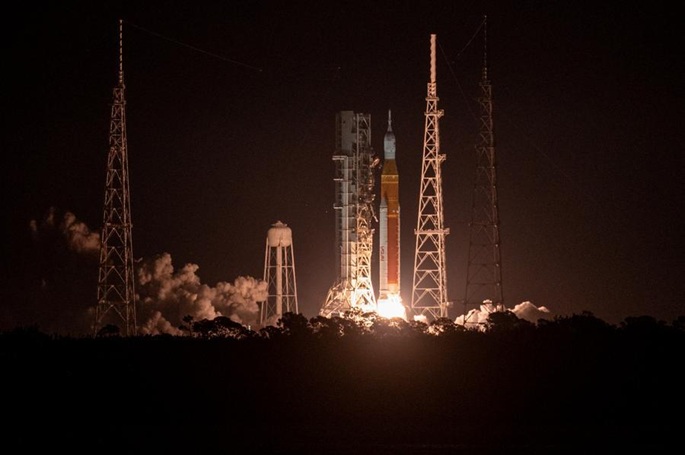
NASA's Artemis II moon mission lifted off from the U.S. state of Florida on Wednesday, carrying four astronauts on the first crewed flight around the Moon in more than 50 years,reported Xinhua.
The Space Launch System rocket, topped by the Orion spacecraft, launched from NASA's Kennedy Space Center at 6:35 p.m. Eastern Time (2235 GMT), sending the crew on a historic 10-day journey around the Moon.
It is NASA's first crewed mission under the Artemis program. The four-member crew consists of NASA astronauts Reid Wiseman, Victor Glover, Christina Koch, and Canadian Space Agency astronaut Jeremy Hansen.
The launch countdown was briefly paused at the T-10 minute mark before resuming several minutes later.
About eight minutes after liftoff, NASA confirmed the main engine cutoff of the SLS core stage and the successful separation of the core stage from both the interim cryogenic propulsion stage (ICPS) and the Orion spacecraft. This marked the conclusion of the first major propulsion phase of the mission and the transition to ICPS operations.
Approximately 24 minutes after launch, NASA confirmed the Orion spacecraft's solar array wings had fully deployed and begun generating power. Each wing contains 15,000 solar cells that convert sunlight into electricity.
The next major milestones are the perigee raise maneuver and apogee raise burn, which will increase the lowest and highest points of Orion's orbit and prepare the spacecraft for deep-space operations, according to NASA.
The Artemis II mission will demonstrate a broad range of capabilities needed on deep space missions. It aims to validate Orion's life-support systems and allow astronauts to practice operations critical to the success of Artemis III and subsequent lunar missions, according to NASA.
The crew will travel about 7,400 km beyond the far side of the Moon before returning home. The mission will carry astronauts farther from Earth and nearer to the Moon than any humans have traveled in over half a century.
7 Palestinians killed in Israeli attacks across Gaza
9 killed in shooting in US Pennsylvania
Abbas postpones Palestinian presidential, legislative elections to Sept. 11, 2027
12 killed, 309 injured in attack on Riyadh airport
Opposition leader announces INDIA bloc protest against CEC on Oct 12
Trump suggests ´new President´ for Ukraine, day after diesel deal with Russia

Editor-in-Chief Ofiul Hasnat
Published by Finnish News Network (FNN)
Heporinne 4 B 45
01200 Vantaa, Finland.
E-mails : [email protected]