
NATO chief to visit Washington
Trump calls NATO ´paper tiger,´ considers withdrawal
Published : 01 Apr 2026, 23:22
Updated : 02 Apr 2026, 02:48
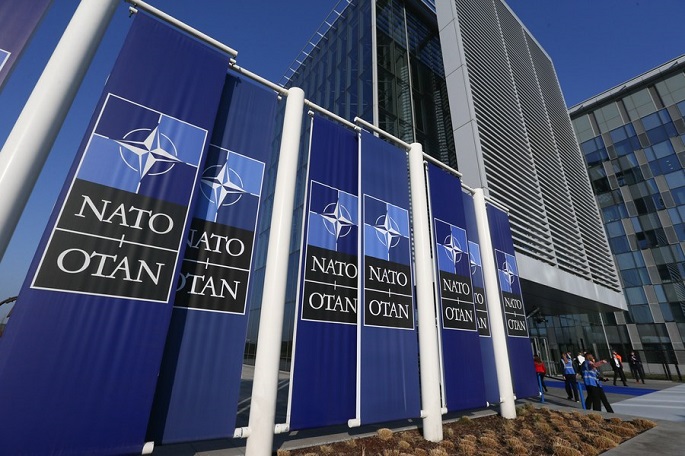
U.S. President Donald Trump said he is strongly considering pulling the United States out of the North Atlantic Treaty Organization (NATO) after the alliance failed to join the attacks on Iran, The Telegraph reported on Wednesday, said Xinhua.
When asked if he would reconsider America's membership in the alliance after the conflict, he said the question is "beyond reconsideration," adding: "I was never swayed by NATO. I always knew they were a paper tiger."
Trump also expressed dissatisfaction with NATO for "not being there," saying it was "actually hard to believe."
Singling out Britain, he said the country has "aircraft carriers that didn't work," suggesting that the British navy is inadequate for the task.
U.S. Secretary of State Marco Rubio has said before the interview that the United States would have to "re-examine" its NATO membership after the conflict, the report said.
"If NATO is just about us defending Europe if they're attacked, but them denying us basing rights when we need them, that's not a very good arrangement. That's a hard one to stay engaged in," the report quoted Rubio as saying.
Trump told The Telegraph he was "glad" about Rubio's comments.
Following Trump's criticism, British Prime Minister Keir Starmer said he is not changing his position on the war.
Multiple European countries have kept their distance from the conflict with Iran. Starmer on Monday said his country will not get dragged into the conflict "whatever the pressure and whoever it's coming from," while Spain on Monday closed its airspace to all flights related to the U.S. and Israeli military strikes on Iran.
Meanwhile, NATO Secretary General Mark Rutte is scheduled to visit US President Donald Trump in Washington next week, according to a White House official, reported ANI.
As reported by CNN, the upcoming meeting follows renewed suggestions from the President that the United States is considering exiting the alliance, a move that would necessitate congressional approval.
The relationship between Rutte and Trump has historically been described as friendly, which may serve to "smooth things over" as the President continues to lash out at allies for their perceived reluctance to engage in the ongoing war with Iran.
Despite the timing, a NATO spokeswoman told The Wall Street Journal, the first to report the news, that the visit is a "long-planned trip."
According to CNN, diplomats from NATO member states are not currently displaying over-the-top concern regarding the President's threats to withdraw from the defensive bloc.
One European official described the recurring nature of these warnings as "Groundhog Day," noting that the alliance has navigated similar rhetoric from the Trump administration in the past.
However, sources speaking to CNN indicated that discounting the President's remarks entirely remains unrealistic. Because his policy decisions can "move swiftly," an air of concern persists among some diplomatic circles.
Some senior European diplomats interpret the threats as a tactical "effort by the president" to pressure European nations into committing resources for "reopening the Strait of Hormuz."
Other officials believe the tension is more deeply rooted in the President's "genuine reflection of his frustrations."
A NATO diplomat told CNN that these frustrations stem from certain allies refusing to provide "overflight support and basing" to US forces during the conflict with Iran.
During a mid-March phone call with Rutte, Trump reportedly aired his grievances regarding the lack of support in the Iran war.
Sources familiar with the discussion suggested the President implied that the US could "withdraw continued support for Ukraine" if allies did not increase their commitment to securing the critical waterway.
Following that tense exchange, Rutte moved quickly to urge member states to issue a statement of support.
On March 19, nations including the UK, France, and Germany expressed their "readiness to contribute to appropriate efforts to ensure safe passage through the Strait [of Hormuz]."
While only a small number of countries were initially involved in the coalition's efforts at the time of that statement, CNN reports that at least 35 nations are now participating in the operations to secure the strategic passage.
7 Palestinians killed in Israeli attacks across Gaza
9 killed in shooting in US Pennsylvania
Abbas postpones Palestinian presidential, legislative elections to Sept. 11, 2027
12 killed, 309 injured in attack on Riyadh airport
Opposition leader announces INDIA bloc protest against CEC on Oct 12
Trump suggests ´new President´ for Ukraine, day after diesel deal with Russia

Editor-in-Chief Ofiul Hasnat
Published by Finnish News Network (FNN)
Heporinne 4 B 45
01200 Vantaa, Finland.
E-mails : [email protected]