
Israel strikes Iranian chemical weapons, Houthis claim new missile attacks on Israel
Iran rejects Trump's ceasefire claim as false, baseless
Published : 02 Apr 2026, 03:18
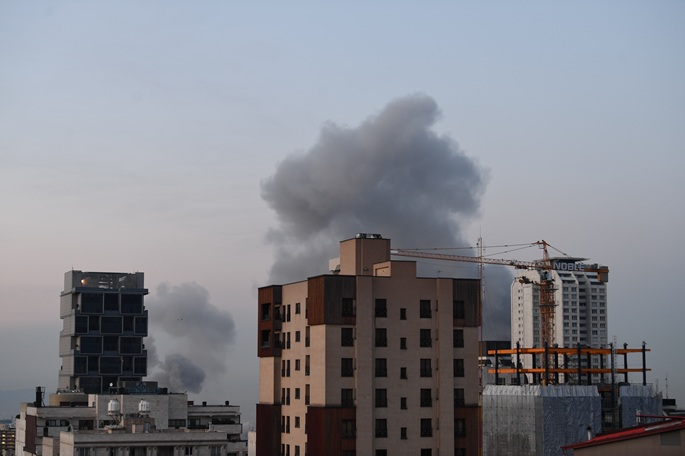
The Israel Defense Forces (IDF) on Wednesday said it struck a factory that transferred chemical substances to an Iranian facility designated for developing chemical weapons, reported Xinhua.
The IDF said in a statement that it struck the factory, owned by the Tofiq Daru Company, on Tuesday. The factory, presenting itself as a civilian business, functions as a main supplier of fentanyl to the Organization of Defense Innovation and Research (SPND), which is responsible for the development of chemical weapons in Iran.
Fentanyl in high doses is considered a highly lethal substance. The Tofiq Daru Company knowingly and systematically supplied the substance to the SPND organization, said the IDF, noting the strike impaired the Iranian government's chemical weapons production capabilities.
Also on Wednesday, the IDF said its air force on Tuesday killed Mahdi Vafaei, a senior engineering officer in the Quds Force of Iran's Islamic Revolutionary Guard Corps, in Mahallat of central Iran.
The Israeli military Vafaei led the efforts to establish underground infrastructure sites for Hezbollah and the Assad government in Syria, and managed dozens of underground projects in Lebanon utilized for the storage of advanced weapons.
Meanwhile, Yemen's Houthi armed group said on Wednesday it had launched a fresh round of ballistic missile attacks targeting "vital sites" in southern Israel.
In a statement aired by the group's al-Masirah television, Houthi military spokesperson Yahya Sarea said the strike was part of continued support for allied forces in the region, including those in Iran, Iraq, Lebanon and Palestine.
He said the operation, involving a barrage of ballistic missiles, was carried out in coordination with allied groups and had achieved its intended objectives.
Sarea warned that continued escalation against what he described as allied fronts would prompt further Houthi action until hostilities cease.
The statement comes amid rising regional tensions, with the group recently warning it could intervene militarily, particularly if the Red Sea is used as a staging ground for operations against Iran.
Last week, the group also signaled it was prepared to respond if additional forces joined those of the United States and Israel.
Houthi leader Abdul-Malik al-Houthi has reiterated the group's readiness to take military action in line with developments in the wider Middle East conflict, underscoring its close ties with Iran.
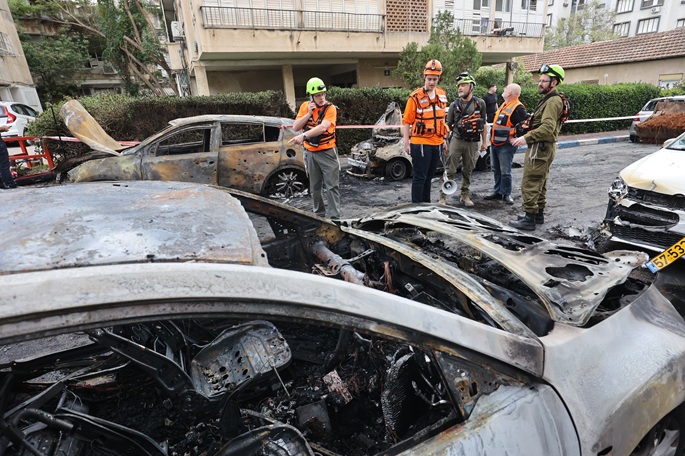
Meanwhile, Iran's Foreign Ministry on Wednesday dismissed U.S. President Donald Trump's remarks about Iran seeking a ceasefire as "false and baseless," according to state-run Press TV.
Foreign Ministry spokesman Esmaeil Baghaei pushed back against Trump's remarks on social media platform Truth Social that the Iranian president "has just asked the United States of America for a ceasefire."
Trump added, "We will consider when the Hormuz Strait is open, free, and clear. Until then, we are blasting Iran into oblivion or, as they say, back to the Stone Ages!"
Seyyed Mehdi Tabatabaei, deputy for communications at the Iranian president's office, also dismissed Trump's claim in a post on social media platform X.
"Iran's position regarding the patriotic defense of the country's integrity against the aggression of the evil forces, and the preconditions for ending the imposed war has not changed at all, and no attention is paid to the criminals' delusions and lies," Tabatabaei said, adding that, "The Iranian nation, determined, steadfast, and united, is defending the integrity of its homeland."
Trump has repeatedly claimed in recent days that Iran is seeking negotiations to end the war.
Iranian Foreign Minister Seyed Abbas Araghchi acknowledged that messages have been exchanged between Iran and the United States through intermediaries over the past few days, but stressed that no negotiations have taken place.
US doubles A-10 "Warthog" warplanes in Mideast
The U.S. military is doubling its deployment of A-10 attack planes to the Middle East to support advancing ground troops in the war against Iran, The New York Times reported Wednesday.
The U.S. Air Force is dispatching another 18 A-10 "Warthog" planes to join roughly a dozen already operating in the region, said the report, citing two Pentagon officials.
The slow-moving A-10 "Warthog" planes, which fly at low altitudes and slow speeds to loiter over targets on land and at sea, are reportedly to be used to help U.S. ground forces seize territory near the Strait of Hormuz, the crucial waterway that Iran has effectively closed, or Kharg Island, Iran's oil export hub, said the report.
The move comes as U.S. President Donald Trump said Tuesday he expected the war with Iran to end in two to three weeks.
Israeli airstrikes kill 14 in S. Lebanon
Israeli airstrikes killed at least 14 people in southern Lebanon on Wednesday, according to Lebanon's National News Agency, while Hezbollah announced a series of attacks on Israeli military sites and settlements.
In a series of statements, Hezbollah said its fighters launched attacks on several Israeli sites and targeted gatherings of Israeli soldiers and vehicles, using rockets, drones, and artillery shells.
Lebanese Interior and Municipalities Minister Ahmad al-Hajjar said that Lebanon is being subjected to destructive Israeli attacks as part of a war imposed on it, expressing hope for support from Arab countries and the international community to stop the war and back the Lebanese government's decision to extend its authority over all its territory using its own forces.
Lebanon's Health Ministry said in its daily report that the total death toll since March 2 has risen to 1,318, with 3,935 people wounded.
Cross-border fighting between Hezbollah and Israel has continued along the Lebanon-Israel border since March 2, when Hezbollah launched rockets toward Israel for the first time since a ceasefire took effect on Nov. 27, 2024, triggering intensified Israeli airstrikes across southern and eastern Lebanon.
Iran-launched missile hits tanker in Qatar's waters
A missile, launched from Iran, struck a fuel tanker chartered by QatarEnergy in Qatar's territorial waters early Wednesday, the Ministry of Defense said.
In a statement, the ministry said Qatar was targeted by three cruise missiles launched from Iran, noting that two were successfully intercepted, while one hit the tanker.
The ministry added that the tanker was carrying 21 crew members, all of whom were safely evacuated following coordinated emergency procedures.
In a separate statement, QatarEnergy confirmed that the tanker, identified as Aqua 1, was attacked in the country's northern territorial waters, causing no injuries or environmental impact.
The incident comes amid heightened regional tensions and ongoing exchanges of attacks involving Iran, the United States and Israel.
Iraqi paramilitary commander killed in U.S.-Israeli airstrikes
Iraq's paramilitary Popular Mobilization Forces (PMF) said Wednesday that one of its commanders and another member were killed in U.S.-Israeli airstrikes in Iraq's northern province of Nineveh.
A PMF statement said that Yassin Mohammed Sadiq, commander of the commando battalion of the 53rd Brigade, was killed in an airstrike targeting their positions in the Tal Afar area, some 70 km west of Nineveh's provincial capital, Mosul.
Two strikes resulted in the deaths of the commander and a PMF member, while four others were wounded, according to the statement.
Over the past month, dozens of PMF members have been killed in what the group said were U.S.-Israeli strikes.
The strikes came amid heightened regional tensions following joint U.S.-Israeli strikes on Iran starting on Feb. 28, to which Iran and its regional allies responded with attacks on Israeli and U.S. interests across the Middle East.
Israeli army kills senior Hezbollah commander in Beirut
The Israel Defense Forces (IDF) said in a statement on Wednesday that Hajj Yusuf Ismail Hashem, commander of Hezbollah's Southern Front, was killed by the Israeli Navy in a strike in Beirut.
According to the statement, Hashem, a senior commander with more than 40 years of experience, was responsible for the Hezbollah units that engaged in combat against IDF soldiers in southern Lebanon.
The IDF added that Hashem led Hezbollah's rehabilitation and commanded its rocket launches and drone attacks against Israel.
"His elimination constitutes a significant blow to Hezbollah's ability to carry out terrorist operations against Israeli civilians and to manage ongoing combat against IDF soldiers in southern Lebanon," said the statement.
Cross-border fighting has continued along the Lebanon-Israel border since March 2, when Hezbollah launched rockets toward Israel for the first time since a ceasefire agreed on Nov. 27, 2024, triggering intensified Israeli airstrikes across southern and eastern Lebanon.
US military loses 16 MQ-9 Reaper drones in war with Iran
The U.S. military has lost 16 MQ-9 Reaper drones since the United States and Israel launched joint military strikes on Iran on Feb. 28, CBS News reported Wednesday, citing two U.S. officials speaking on condition of anonymity.
Iranian state media reported Monday that Iran's Islamic Revolutionary Guard Corps has "intercepted and destroyed" a U.S. MQ-9 over Isfahan.
The MQ-9 Reaper is a remotely piloted aircraft used for intelligence, surveillance and reconnaissance missions, but it can also be used to carry out precision strikes.
Depending on the variant of Reaper drone, a single aircraft can cost upwards of 30 million U.S. dollars, according to the CBS News report.
U.S. President Donald Trump and Defense Secretary Pete Hegseth have repeatedly claimed that Iran's air defenses and missile launch capabilities have been virtually wiped out during the monthlong U.S.-Israeli strikes.
10 missiles fired from Iran at Israel ahead of Jewish holiday eve
At least 10 missiles were fired from Iran toward wide areas across Israel within about 45 minutes on Wednesday, as many families were heading to the traditional Passover dinner "Seder" on the eve of the Jewish holiday, according to the Israel Defense Forces.
Israel's national emergency service Magen David Adom said that fragments from the missiles fell in several locations, but no casualties were reported.
Air defense sirens sounded multiple times following the launches, sending millions of people rushing to seek shelter. Loud explosions were heard across many parts of the country.
Separately, sirens were also triggered by simultaneous rocket fire from Hezbollah in Lebanon into northern Israel, with no casualties reported either.
Iranians attend funeral ceremony for IRGC Navy commander
Iranians gathered in Tehran on Wednesday to attend a funeral ceremony for Alireza Tangsiri, chief commander of the Navy of the Islamic Revolution Guards Corps (IRGC), and other armed forces personnel killed in recent U.S. and Israeli strikes.
The IRGC on Monday confirmed that Tangsiri died after sustaining severe injuries while performing his duties.
Mourners escorted the caskets, which also carried the body of Jamshid Es'haqi, advisor to the chief of staff of the Iranian armed forces, in a march from the Enghelab Square to Me'raj-e Shohada (Hall of Martyrs) in southern Tehran, a resting place for the country's martyrs ahead of burial.
The crowd, waving Iran's flags and holding pictures of Iran's late Supreme Leader Ali Khamenei, chanted slogans against the United States and Israel.
According to the semi-official Mehr News Agency, Tangsiri will be laid to rest in the southwestern city of Abadan on Friday.
Iran could end war with guarantees against further aggression
Iran is willing to end the war if guarantees are provided against repeated aggression, Iranian President Masoud Pezeshkian said on Tuesday.
In a phone call with European Council President Antonio Costa, Pezeshkian blamed "hostile and aggressive" actions by the United States and Israel for regional tensions and the situation in the Strait of Hormuz, stressing that ceasing attacks is the only way to normalize conditions, according to a statement published by his office.
He criticized the European Union's "biased positions" toward U.S. and Israeli aggression, calling it a violation of the rule of law and EU-stated principles.
He noted that Iran was negotiating constructively when it was attacked again by the United States, proving that Washington "does not believe in diplomacy and seeks to solely dictate its demands." Pezeshkian underlined Iran's "inherent" right to legitimate self-defense, saying it respects its neighbors' sovereignty but faced attacks from U.S. bases on their soil.
He emphasized that the Strait of Hormuz is closed only to "aggressors and their supporters," warning that any foreign intervention would have "dangerous" consequences. He urged Europe to adopt constructive, law-based policies toward Iran.
Costa stressed the need to end the war and tension in West Asia, expressing concern over the political and economic consequences of the conflict.
European states have never supported the "aggression" against Iran and consider it a violation of international law, while also calling for a negotiated solution to the conflict, Costa said.
Iran's president says Iranians harbor no enmity toward American people
Iran's President Masoud Pezeshkian said on Wednesday Iranian people harbor no enmity toward American people, accusing the U.S. administration of fighting Iran as a "proxy for Israel."
He made the remarks in a letter addressed to the American people while elaborating on Iran's positions regarding the ongoing war with the United States and Israel.
"The Iranian people harbor no enmity toward other nations, including the people of America, Europe, or neighboring countries," Pezeshkian said, adding, "Even in the face of repeated foreign interventions and pressures throughout their proud history, Iranians have consistently drawn a clear distinction between governments and the peoples they govern."
Pezeshkian said Iran "has never, in its modern history, chosen the path of aggression, expansion, colonialism, or domination" despite having suffered occupation, invasion, and pressure by global powers.
He said casting Iran as a threat is a narrative manufactured by Israel "to divert global attention away from its crimes toward the Palestinians."
Pezeshkian pointed to the U.S. military buildup and bases around Iran, emphasizing that the ongoing U.S. "aggressions" launched from those bases "have demonstrated how threatening such a military presence truly is."
In response to U.S. President Donald Trump's threats of conducting large-scale strikes on Iranian energy facilities in the coming days, he said attacking the country's vital infrastructure directly targets the Iranian people, stressing that such actions constitute "war crimes" and involve consequences extending beyond Iran's borders.
Pezeshkian said the United States has entered the war with Iran as a "proxy for Israel" and under its influence, adding Israel seeks to fight Iran "to the last American soldier and the last American taxpayer dollar" in pursuit of its "illegitimate interests."
He added that the world is currently "standing at a crossroads," having to choose between confrontation and engagement.
Iran's supreme leader urges people to plant saplings in honor of war victims
Iran's Supreme Leader Mojtaba Khamenei has called on Iranian people to plant saplings in honor of those killed in the U.S.-Israeli strikes and as a symbol of prosperity, hope and a national response to the "enemies."
He made the remarks in a Wednesday message to commemorate the 47th anniversary of the establishment of the Islamic Republic of Iran, and ahead of the traditional occasion of "Sizdah Bedar" or "Nature Day," which marks the end of the Nowruz holidays, falling on April 2, according to the official news agency IRNA.
Khamenei praised Iranian people for their heroism in the fight against the United States and Israel, saying the "ruthless enemies" know no bounds in their brutality and have even damaged Iran's nature and environment in their attacks.
He urged people in all Iranian cities and villages to, in cooperation with the relevant state-run institutes, continue planting saplings from the Nature Day until the end of spring, falling on June 21.
7 Palestinians killed in Israeli attacks across Gaza
9 killed in shooting in US Pennsylvania
Abbas postpones Palestinian presidential, legislative elections to Sept. 11, 2027
12 killed, 309 injured in attack on Riyadh airport
Opposition leader announces INDIA bloc protest against CEC on Oct 12
Trump suggests ´new President´ for Ukraine, day after diesel deal with Russia

Editor-in-Chief Ofiul Hasnat
Published by Finnish News Network (FNN)
Heporinne 4 B 45
01200 Vantaa, Finland.
E-mails : [email protected]