
Human distress in Afghanistan worries Niinistö
Published : 24 Aug 2021, 16:39
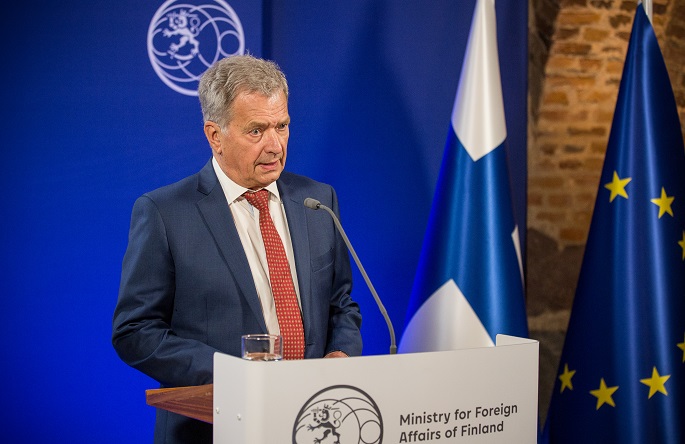
President Sauli Niinistö on Tuesday expressed concern over the acute human distress in Afghanistan following takeover of the country power by Taliban.
He also said that the constellation in Afghanistan will inevitably reflect the great-power competition as well.
“The foremost thing is, of course, the acute human distress and concern for what will happen next within the borders of Afghanistan. There is a great concern over the situation of women and girls and other groups in a vulnerable position in particular,” said Niinistö in his speech at the Ambassadors’ Conference.
The Heads of Finnish Missions abroad convened virtually for their annual meeting from 23 to 25 August.
“In Afghanistan, what collapsed extends well beyond the government in Kabul. What has happened forces the whole western world to face even broader, fundamental questions. If, after two decades of massive efforts, the outcome is this, what will be the future of big international crisis management operations, particularly of the kind of operations aimed at building nations and transforming societies in a larger scale? What kind of capacity does the West have to promote its values worldwide? Or is there even a will to do so anymore? Furthermore, what will all this mean for the world order?” said the President.
Pointing out the inevitably reflection of the great-power competition, he said, It is unlikely that anyone, neither China nor Russia, would want Islamic extremists to seize power in an area near them.
“Furthermore, regional stability is not an insignificant matter to them either. But both Beijing and Moscow have surely come to the conclusion that what happened in Afghanistan showed that neither the United States nor the Western world as a whole can succeed in exporting their set of values. Whether the interpretation of the West being weak is right or wrong, the shadow of a doubt is difficult to shed,” said Niinistö.
He said that the US also examines the world through the lens of great power competition.
“When US President Biden visited Europe in June, having a series of meetings, the priority given to China was conspicuous. The US hopes and requires that the allies and partners would now make bigger contributions in this respect, too,” said the President, adding, another sign that the main opponent of the US has changed was the relatively constructive spirit in which the meeting between Biden and President Putin seems to have been held.
Niinistö said that in Europe, the rapid and rather unilateral withdrawal of the US troops from Afghanistan has raised questions.
“But have we noticed how invisible the EU has been during the crisis over the past few weeks? For a long time, I have been highlighting my concern over the erosion of Europe’s status by the side of other centres of power,” he added.
He also said that at the moment, the EU is preparing a document called the Strategic Compass to serve as a guideline for the EU security and defence activities.
“It is certainly necessary to discuss the role of Europe in the world,” said the President.
He said that now, it is good to focus on sounding what kind of responses this idea evokes in general.
“An open dialogue will gradually give us an idea of what different parties consider possible and what they consider impossible. A positive response would provide foundations for advancing to the next level. And even before that: the more we talk about the Helsinki Spirit, the closer we get to realising it,” said Niinistö.
“Combating climate change is one of the weightiest human responsibilities we have. That challenge we also have to address under the Helsinki Spirit. We were given an important reminder of the facts we are already very well aware of in the recent report of the Intergovernmental Panel on Climate Change. The man-made climate change has spread extensively, is advancing rapidly and is getting increasingly stronger. It is no longer possible to fully stop the development, but we cannot continue like this. We need to take immediate action,” he said.
He said that defending human rights has been an essential part of Finnish foreign policy for a long time. It seems clear that Finland will be elected as a member of the UN Human Rights Council for the next three years in the election to be held in October.
“If provides us with a platform we must use wisely. It is easy to draw up strictly worded declarations, but it is much harder to achieve real change. Succeeding in the latter is the real indicator of the success of our human rights policy,” said the President.
“Recently, the conflicting pressures of human rights and migration have made me go back to the speech I gave at the opening of Parliament in 2016. Back then, not many people liked my reference to the dilemma deeply related to our set of values – to the question whether the old treaties and agreements are applicable to totally different circumstances. Our standards are being tested to the utmost. We cannot blame any individual migrants for this,” he added.
He said that the dilemma is once again going to become more acute as there are clear signs of migration picking up from areas other than Afghanistan as well.
“In addition, we have recently been forced to witness the very cynical way in which Belarus exploits migration as a means of putting pressure on Lithuania and the whole of Europe. Led by Germany and France, the discussion has already begun on how we could this time avoid the kind of development that generated the crisis in 2015. Finland should also take active part in this debate. We must find a satisfactory balance between our principles and realities. A perfect balance is impossible to find,” said the President.
Online illegal wildlife trade poses risks to biodiversity: study
Finland to host Arctic summit of EU leaders in September
Woman killed in road mishap in Helsinki
Man to face charges for hoisting Swastika flag in yard
Belarus to close embassy in Finland
15 to face trial for producing, selling cannabis in Helsinki

Editor-in-Chief Ofiul Hasnat
Published by Finnish News Network (FNN)
Heporinne 4 B 45
01200 Vantaa, Finland.
E-mails : [email protected]