
Finland extends entry restrictions until 9 Feb
Published : 07 Jan 2021, 23:28
Updated : 08 Jan 2021, 10:32
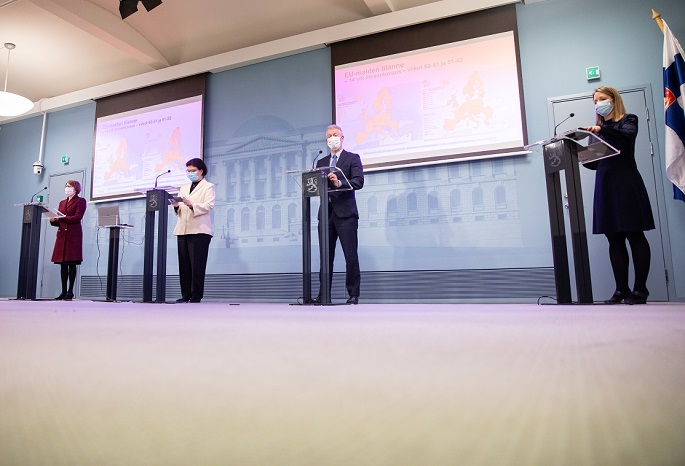
In the backdrop of an increasing trend in the coronavirus outbreak, The government on Thursday decided to extend the restrictions on entry into the country until 9 February 2021.
The COVID-19 epidemic is still clearly growing globally, and the number of infections is increasing in most countries more sharply than in Finland, said a joint press release of the Ministry of Social Affairs and Health and the Ministry of the Interior.
The decision has been taken based on the limit value of a maximum of 25 new cases of the disease per 100,000 persons in the previous 14 days. It applies to the Schengen countries, the non-Schengen EU countries, and the United Kingdom.
Internal border traffic refers to traffic between Finland and other Schengen countries. Restrictions on internal border traffic are in force for traffic between Finland and Austria, Belgium, the Czech Republic, Denmark, Estonia, France, Germany, Greece, Hungary, Iceland, Italy, Latvia, Liechtenstein, Lithuania, Luxembourg, Malta, the Netherlands, Norway, Poland, Portugal, Slovakia, Slovenia, Spain, Sweden, and Switzerland with the exception of leisure boating.
However, day-to-day travel is permitted for local border communities at Finland’s land border with Sweden.
Similarly, commuting and other essential travel is permitted for local border communities at the Finland’s land border with Norway. In addition, people can come to work in Finland from Sweden and Estonia without a 10-day self-isolation period.
Crossing the internal border between Finland and Sweden and between Finland and Norway is also permitted on ice-covered border rivers, but going ashore to the territory of another state is not allowed.
In addition, residents of border areas and the Saami people may cross the land border between Finland and Sweden and between Finland and Norway (including lakes) and border rivers, too, at places other than border crossing points.
However, the above-mentioned right does not permit them to cross the border with a motor vehicle, with the exception of off-road vehicles.
At the internal borders, the restrictions on entry allow only return traffic to Finland, transit traffic, work-related travel, and travel for other essential reasons, apart from the above-mentioned exceptions.
A 10-day period of self-isolation is recommended for travellers arriving in Finland. Travellers can shorten their self-isolation period at their discretion, if they take two voluntary COVID-19 tests.
External border traffic refers to traffic between Finland and non-Schengen countries. Restrictions on entry will also be reinstated for residents of Japan and South Korea arriving in Finland.
The change will enter into force on 11 January 2021. In all other respects, the restrictions on external border traffic will remain unchanged and be extended until 9 February 2021.
Restrictions have already been lifted for traffic arriving in Finland from the Vatican and for traffic between Finland and Australia, Rwanda, Singapore, Thailand, and New Zealand for residents of these countries.
The decision concerning lifting the restrictions for residents of China and the Hong Kong and Macao Special Administrative Regions travelling from these regions to Finland will remain unchanged, provided that reciprocity is confirmed by the Council of the European Union.
People may still come to Finland from the following European countries for work or other essential reasons: Andorra, Bulgaria, Croatia, Cyprus, Ireland, Monaco, Romania, San Marino, and the United Kingdom. A 10-day period of self-isolation is recommended for travellers arriving in Finland.
For all other non-Schengen countries, restrictions on entry permit only return traffic to Finland and other EU and Schengen countries, transit traffic at Helsinki Airport, and other essential traffic.
IAEA team visits Finland to evaluate radiation emergency preparedness
Finland to redefine ties with Russia after Ukraine war ends: Stubb
Birth rate remains lower than death in Finland in Jan-July period
Online illegal wildlife trade poses risks to biodiversity: study
Finland to host Arctic summit of EU leaders in September
Woman killed in road mishap in Helsinki

Editor-in-Chief Ofiul Hasnat
Published by Finnish News Network (FNN)
Heporinne 4 B 45
01200 Vantaa, Finland.
E-mails : [email protected]