
Govt finalises €92b budget proposal for 2027 with €13.2b deficit
Published : 23 Apr 2026, 01:33
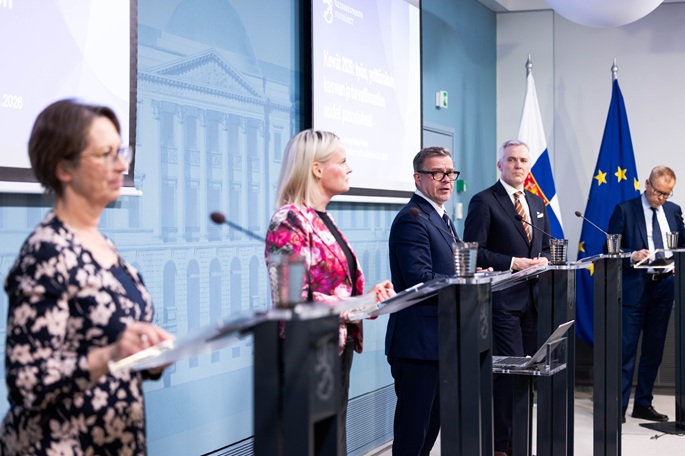
The four-party alliance government led by conservative Kansallinen Kokoomus (National Coalition Party-NCP) on Wednesday reached a decision on its budget proposal for 2027, said an official press release.
Leaders of the ruling parties finalised the proposal of the estimated EUR 92 billion budget, which is EUR 1.2 billion higher than the sum budgeted for 2026.
The factors contributing to the increase in appropriations relative to 2026 include legislative and agreement-based index adjustments in 2027 (about EUR 1.4 billion).
At the same time, expenditure will be reduced by about 0.8 billion euros through spending cuts.
Interest expenses on central government debt are estimated at EUR 3.2 billion in 2026, rising gradually to EUR 6.3 billion by 2030.
The central government on-budget deficit is expected to total EUR 13.2 billion in 2027, which is EUR 2.4 billion more than that budgeted for 2026 (including the first supplementary budget).
Over the 2027–2030 period, the deficit will average EUR 16 billion a year.
Central government debt is projected to be about EUR 214 billion at the end of 2027 or about 71.2 per cent of GDP.
The amount of central government debt is expected to grow by about EUR 63.5 billion between 2027 and 2030.
Central government debt is estimated to be about EUR 264 billion at the end of 2030, which is about 78.5 per cent of GDP.
The General Government Fiscal Plan will be approved in a government plenary session on 30 April 2026.
The budget plan continued to cut in social welfare organisations and state administration while a small intensive will be granted for the construction and housing sectors, as well as transport investments.
In the spending limits session, the government decided on savings measures that will grow to about EUR 540 million at the 2030 level.
These new savings replace, in other words reallocate, certain previously decided savings allocated to healthcare and social welfare as well as measures affecting incomes.
The most significant savings will be allocated to central government operating expenditure. The level of expenditure will be lowered and a gradually increasing reduction of appropriations will be implemented to encourage productivity starting in 2027.
This will generate savings of EUR 60 million in 2027 that will grow to EUR 166.5 million in 2030.
One growth measure that the government has agreed is fixing the pension insurance system for self-employed persons (YEL). The goal of the reform is to remedy shortcomings in the YEL system, improve the conditions for entrepreneurship and strengthen the position of low-income and middle-income earners and sole entrepreneurs in particular.
The total amount of previously decided expenditure savings will grow by about EUR 1.3 billion this year and by another EUR 0.8 billion in 2027.
The government decided in its spending limits session to increase the tax credit for household expenses so that more households would be encouraged to purchase cleaning or care services or pay for renovations.
The maximum amount of the tax credit for household expenses will be increased to EUR 2,100, and the percentage of the tax credit will be increased from 35 per cent to 40 per cent. These changes are scheduled to enter into force this year.
The situation in the Middle East has impacted fuel prices. The government will support commuters by lowering the threshold for the commuting expenses deduction to EUR 800 for 2026.
The government is taking steps to make it easier to purchase a first home more quickly. For example, the self-financing requirement for home savers’ bonus (ASP) loans will be lowered from 10 to 5 per cent.
Unemployment continues to be high. In its spending limits session, the government focused especially on measures to alleviate the situation of young people and long-term unemployed people.
The level of the index brake applied to central government transfers to local government for basic public services will be increased to 2.8 percentage points for 2027. This will generate savings of EUR 60 million.
130 to lose job, 900 to affect as S-Group starts negotiation talks
Govt to pilot special economic zone in Eastern Finland
Finnish-Egypt Trade Expo draws Finnish firms, offers trade partnerships
Inflation stands at 2.1% in July as fuel prices rise
Building costs rise by 3.3% in Finland in July
OP forecasts 2% growth of Finnish economy despite unemployment rise

Editor-in-Chief Ofiul Hasnat
Published by Finnish News Network (FNN)
Heporinne 4 B 45
01200 Vantaa, Finland.
E-mails : [email protected]