
7th World Media Summit in Beijing focuses media transformation in AI age
Published : 07 Nov 2026, 21:01
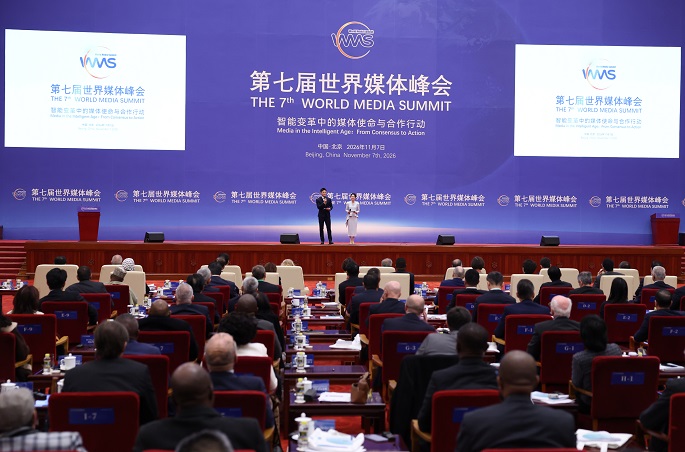
The 7th World Media Summit held its opening ceremony in Beijing on Saturday under the theme "Media in the Intelligent Age: From Consensus to Action," reported Xinhua.
Xinhua News Agency and the Beijing municipal government jointly organized this year's summit, which runs from Thursday to Monday.
It drew nearly 500 representatives from nearly 330 mainstream media outlets, think tanks and government bodies from 112 countries and regions, as well as the United Nations and other international organizations.
Li Shulei, a member of the Political Bureau of the Communist Party of China (CPC) Central Committee and head of the Publicity Department of the CPC Central Committee, delivered a keynote speech at the opening ceremony.
Yin Li, a member of the Political Bureau of the CPC Central Committee and secretary of the CPC Beijing Municipal Committee, also addressed the ceremony.
At the summit, delegates discussed the role of the media in the age of artificial intelligence (AI) and how the industry should respond to the challenges it poses. They called for closer cooperation to broaden access to advanced technologies and help media organizations worldwide develop together, while urging concrete steps to uphold journalistic ethics and safeguard the authenticity of news content as AI use expands.
INCLUSIVE DEVELOPMENT
Addressing the opening ceremony, Fu Hua, president of Xinhua News Agency, called on media professionals to share new technologies and applications, exchange experience in using them, and close gaps in AI research, development and understanding.
"We should lead the way in ensuring that all media professionals have a fair chance to benefit from AI," he said.
The 7th World Media Summit Beijing Consensus was adopted at the ceremony. It calls for joint efforts to advance the transformation and development of the global media industry in the AI era.
Recognizing AI's growing role in media development, the consensus commits to advancing the inclusive and responsible application of AI in the media sector so that advances in AI benefit media organizations at all stages of development and in every country.
AFP Chairman Fabrice Fries also stressed the need for inclusive AI development at the summit. "The benefits of this technological revolution should extend far beyond a small number of companies or countries," he said.
Fries called on media organizations, governments, businesses and universities to work together to ensure that AI helps build a healthier, more diverse global information ecosystem. In particular, AI models must be trained on datasets that reflect the diversity of human societies and perspectives, he said.
The World Media Summit was initiated in 2009 and is now a major global platform for media exchange and cooperation. The previous summit was held in 2024 in Urumqi, the capital city of northwest China's Xinjiang Uygur Autonomous Region.
For participants from Global South countries, the summit is particularly important in helping their media organizations adapt to the digital era and narrow development gaps.
Abdishakur Ali Ahmed, director of communication strategy at the Somalian Ministry of Information, Culture and Tourism, said the summit provides a platform for discussion about navigating digital transformation, which is central to Africa's development.
"The summit also offered us a chance to see China's digital transformation firsthand," he said, expressing hope that Somalia and other African countries would deepen cooperation with China to respond to shared challenges.
Luis Alves do Rosario Canhemba, senior director of the Information Office of Mozambique, said stronger international cooperation was essential for the country to facilitate its ongoing digital transformation.
He called for more exchanges on technology and joint efforts to address AI-related risks in the media industry, and expected expanded mutually beneficial cooperation between Mozambique and China as well as other Global South countries.
JOINTLY ADDRESSING RISKS
As AI is reshaping the entire chain of news production at an unprecedented speed, it has brought opportunities but also risks and challenges to the media industry, such as ethical lapses in the use of technology and the proliferation of false information, Lyu Yansong, editor-in-chief of Xinhua, said at the Summit on Saturday.
"We should take the initiative to share technological expertise, open-source models and training resources, and work together to strengthen our capacity to address risks arising from AI," he said.
On Saturday, the summit also released the Global Media Initiative for the Joint Development of AI Application Standards. Launched by Xinhua, the initiative brings together major media outlets and other professional organizations to safeguard the authenticity of information, protect data security, and uphold media ethics, thereby maintaining public trust in the media.
The first 22 participants also include Russia's TASS News Agency, the Malaysian National News Agency (Bernama), South Africa's Independent Media, and China's People's Daily and China Media Group.
Under the initiative, participants plan to work together for about two years to develop a set of standards that address different media uses of AI and are validated by media outlets. The initiative also calls for a global database of AI applications.
Dejan Jazvic, editor-in-chief of the Federal News Agency of Bosnia and Herzegovina, welcomed the summit's efforts to address AI-related challenges. "The standardization of AI applications must be established as soon as possible," he said.
"It is of crucial importance that we harness AI to improve and develop the media, rather than allowing it to serve as a replacement for media or as a tool for manipulating and deceiving the public," he said.
Mohammed Alyami, director general of the Union of News Agencies of the Organization of Islamic Cooperation, said the theme of this year's summit, "Media in the Intelligent Age: From Consensus to Action," called on media organizations to build on shared commitments by proposing practical initiatives and forging partnerships.
He proposed an international framework for responsible journalism in the AI era, grounded in transparency, reliability and information verification.
Media organizations should ensure that technological change serves people and that the media always play a role as a bridge for mutual understanding and a platform for sharing the truth, he said.
70,000 tents flooded in Gaza as civil defense declares state of maximum emergency
US-Iran tensions intensify amid regional calls for restraint
30 killed in suspected ADF attack in eastern DR Congo
Netanyahu responds to Trump's statement on ending US military aid to Israel
Confident of majority, Eisenkot outlines plan to form emergency govt
5 Palestinians, including child, killed by Israeli fire in Gaza

Editor-in-Chief Ofiul Hasnat
Published by Finnish News Network (FNN)
Heporinne 4 B 45
01200 Vantaa, Finland.
E-mails : [email protected]