
Int´l community urged to back 'struggle' for democracy
Ex Bangladesh PM vows to return in December despite execution threat
Stable Bangladesh matters for South Asia
Published : 05 Aug 2026, 21:19
Updated : 05 Aug 2026, 21:24
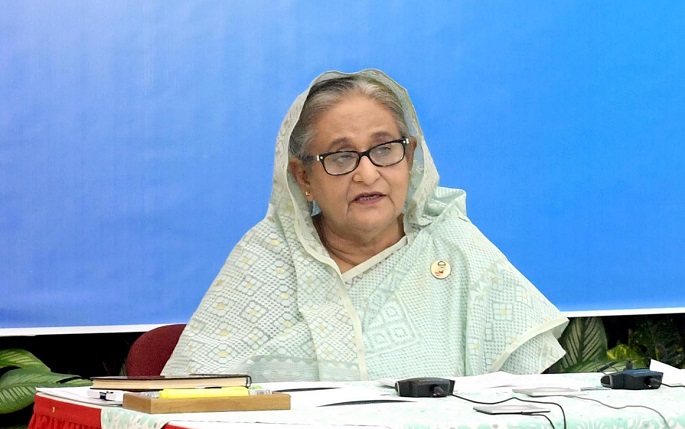
Former Bangladesh Prime Minister Sheikh Hasina on Wednesday asked the international community to back her nation's "struggle" for democracy while addressing a virtual press event organised by the Foreign Correspondents Club of South Asia in New Delhi, reported ANI.
Stressing the broader regional significance of stability in Dhaka, the former prime minister said, "A stable Bangladesh matter for South Asia, for the Bay of Bengal, for development partners, and for all countries that live in democracy, rule of law, and justice."
Asserting that the July-August 2024 unrest that led to her ouster "was not a peaceful student movement", but an organised campaign that turned a quota reform protest into a "violent political instrument" aimed at regime change, Hasina spoke via video link to media representatives in New Delhi.
Reflecting on her exile and her unbroken bond with her country, the former prime minister said, "...I speak as someone who has spent her life with the people of Bangladesh and was forced away from my country, but I was never separated from my people..."
Expressing deep anguish over the ongoing turmoil in her nation, Hasina added, "For the last two years, I watched my beloved Bangladesh suffer...This is not the Bangladesh we built, this is not the Bangladesh for which 3 million people sacrificed their lives in 1971."
Directly addressing the widespread unrest of mid-2024, Hasina maintained that her administration had initially sought to resolve the agitation peacefully before covert forces hijacked the movement.
"Let me begin with the truth about July and August 2024. It was not a peaceful student movement. From the beginning, my government tried to resolve the issue peacefully through dialogue, legal process, and patience. But behind the language of reform, organised groups were working to turn students demand into violent political instrument," she said.
Elaborating on how the demonstrations escalated, Hasina added, "The quota reform movement was turned into a one-point demand for my resignation. False propaganda was spread in a planned way. Genuine students were emotionally manipulated, while organised groups used their movement as cover for violence and regime change."
Citing statements made by the leadership of the interim administration, Hasina argued that the movement was systematically orchestrated rather than a spontaneous public uprising.
"Muhammad Yunus himself said this was a meticulously designed movement, led by a mastermind. His own words expose the truth. It was not simply a spontaneous student protest. There was no visible or responsible leadership, instructions were given invisibly; it was organised, directed and used to create a path to power outside ballot box..." she said.
Hasina highlighted that fear has now penetrated everyday life across the nation, reiterating, "The protests in July-Aug 2024 not peaceful student movement, organised groups worked to turn them to violent political instrument."
The former prime minister alleged that from July 15, 2024, the demonstrations escalated into widespread killings, arson, attacks on public infrastructure, and targeted violence against law enforcement personnel. She further claimed that following her removal, Awami League leaders and workers faced systematic political persecution, alleging thousands had been killed, disappeared, or arrested, with hundreds of thousands named in criminal cases. She also accused the interim administration led by Muhammad Yunus of halting a judicial inquiry set up by her government into the violence.
Detailing the physical and cultural toll, Hasina alleged that symbols associated with Bangladesh's 1971 Liberation War were vandalised, members of minority communities and journalists targeted, and the historic Dhanmondi 32 residence of Sheikh Mujibur Rahman demolished in an attempt to erase the legacy of the Liberation War.
Joining the interaction, Sheikh Hasina's son Sajeeb Wazed questioned the United Nations' casualty figures from the unrest while flagging legal immunities granted to protesters by the current regime.
"First of all, you have heard again and again that about the deaths during July on this protest of 2024. You have various counts on the numbers. You have the UN number of 1,400, whereas the government number is 800 something. Who are these additional 600 people? Where did the UN get those names? Our party has written to the UN. Our lawyers have written to the UN again and again. And today the UN has not provided any names. But more importantly, the UN only covers a period up to August 15 of 2024, but we know that the deaths continue, and what is most alarming, and this is something that I believe that the Press, the international Press, should really pay attention to. The Yunus regime, one of the first things they did was pass an Ordinance which became law, called the Indemnity Bill, indemnifying all the protesters, everyone, blanket immunity, protecting them from any prosecution for any killings, that includes killings of civilians, that includes killings of our party members, and that includes killings of police officers....This is unprecedented. How can you have blanket legal protection for killings by anyone, especially killing the Police officers? This is unprecedented. This is completely against all human rights, against all norms of decency," Wazed said.
"They may kill me, put me in jail': Hasina
Signalling a dramatic turn in regional politics, Hasina announced her decision to return to her homeland in December, asserting that she is prepared to face any consequences, including arrest, imprisonment, or threats to her life.
Addressing her first virtual press briefing the former prime minister emphasised that she could not remain abroad while her supporters and countrymen continued to face hardship.
"Whatever fate awaits me, I will return to my people. I cannot stay away while my beloved countrymen are suffering... I want to go back in December," she said.
Acknowledging the severe risks associated with her planned return, Hasina stressed that safety concerns would not deter her from fulfilling her commitment to the nation.
"They may kill me, put me in jail... I know I may get detained, I may be sent to prison, they may try to force politically motivated fabricated cases, but fear cannot decide my duty to the people. My life went beyond calculations of personal safety long ago," Hasina said.
Reflecting on her long political career, the former prime minister highlighted a history marked by incarceration, exile, and severe personal tragedy, noting that her current resolve is rooted in those past trials.
"In 1971, I was in imprisonment with my mother. My son Joy was born in captivity. In 1975, I lost my family. I spent six years in exile," she said.
Reiterating that her decision to return is motivated solely by a commitment to support her citizens during the ongoing crisis, Hasina stated, "I want to return to Bangladesh for one purpose: to stand beside the people and help improve their lives."
During the address, the former prime minister demanded an immediate end to official restrictions placed on her political organisation, the Awami League, urging authorities to lift the ban on the party, secure the release of its detained leadership, and withdraw all pending legal cases against its members.
The quota reform protests that erupted in July 2024 evolved into a nationwide anti-government movement, culminating in Sheikh Hasina leaving Bangladesh on August 5, 2024. Following her ouster, an interim administration led by Nobel laureate Muhammad Yunus took charge before Bangladesh held parliamentary elections in February 2026. The general elections were won by the Bangladesh Nationalist Party (BNP) led by Tarique Rahman, while the Awami League was barred from contesting. Hasina has remained in India since her ouster, repeatedly alleging widespread political persecution--allegations consistently rejected by authorities in Dhaka.
Morocco's king appoints El Mansouri as 1st female PM
Iran's Speaker warns of ´regret-inducing´ response to any US threat
What does Netanyahu's surprise UAE visit signal?
WFP faces funding shortfall as insecurity, climate shocks deepen humanitarian needs in Ethiopia
UN chief calls for unity, action to tackle racism
FAO report urges large-scale forest, landscape restoration to boost food security

Editor-in-Chief Ofiul Hasnat
Published by Finnish News Network (FNN)
Heporinne 4 B 45
01200 Vantaa, Finland.
E-mails : [email protected]