
US military disables ship, Iran's army shoots down US-Israeli Orbiter drone
Published : 31 May 2026, 01:09
Updated : 31 May 2026, 01:11
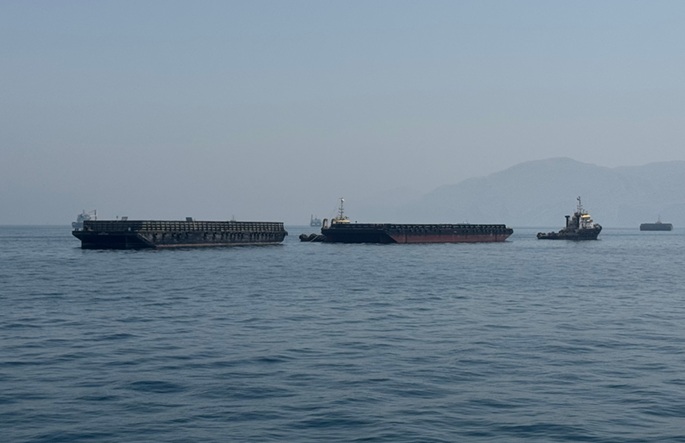
U.S. Central Command (CENTCOM) said on Saturday that it disabled a Gambia-flagged maritime vessel attempting to sail toward an Iranian port on Friday, reported Xinhua.
"CENTCOM forces observed M/V Lian Star transiting international waters toward an Iranian port on the Gulf of Oman and issued more than 20 warnings while informing the vessel it was in violation of the U.S. blockade," according to a statement by CENTCOM on social media.
"A U.S. aircraft disabled the vessel by firing a Hellfire missile into the ship's engine room after Lian Star's crew failed to comply," said CENTCOM's statement. "The ship is no longer transiting to Iran."
CENTCOM said in the statement that the U.S. military has disabled a total of five commercial vessels and "redirected" 116 vessels during the naval blockade.
Meanwhile, the Iranian army said its air defense forces early Saturday shot down a drone belonging to "the United States and Israel" over Iran's southern Qeshm Island.
In a statement published on its website, the army identified the drone as an Aeronautics Defense Orbiter.
According to the statement, the drone was tracked and downed by the army's air defense system operating within the country's integrated joint air defense network.
The semi-official Tasnim news agency, citing a military source, reported that Iran's air defenses on Thursday night intercepted an "invading" U.S. drone near the southern province of Bushehr after firing missiles at it.
Iran warns against US interference in Hormuz management
Iran's Islamic Revolution Guard Corps (IRGC) Navy warned on Saturday that any U.S. interference in the "management" of the Strait of Hormuz would be met with a "strict military response."
According to recordings from a public maritime radio channel provided to Xinhua by crew members aboard vessels stranded near the strategic waterway, the IRGC Navy issued a warning to ships operating in the Persian Gulf and the Gulf of Oman, stating that the Strait of Hormuz remains closed and that transit is permitted only with authorization from the IRGC Navy and through routes designated by the Islamic Republic of Iran.
The warning added that any violations of the regulations would seriously jeopardize maritime security.
In the radio broadcast, the IRGC Navy also stated that any action by the U.S. Navy aimed at interfering in "the management of the Strait of Hormuz or disrupting navigation" would face strict military action.
U.S. President Donald Trump announced on Friday that he would lift the U.S. blockade of Iranian shipping in the Strait of Hormuz.
However, a notice issued on Friday by the Joint Maritime Information Center (JMIC) through the United Kingdom Maritime Trade Operations said that the U.S. blockade of Iranian ports remains in effect and that vessels are prohibited from entering or leaving Iranian ports.
The JMIC, a multinational maritime advisory body operating under a U.S.-led framework, also warned that vessels refusing to comply with blockade instructions could be engaged by U.S. forces, including through actions intended to disable or destroy them.
Recordings from the same public maritime radio channel, provided by seafarers near the Strait of Hormuz, also indicated that a U.S. military aircraft broadcast a warning to a vessel early Saturday, instructing it to turn back immediately and stating that its course was being monitored.
Oman issues maritime alert over suspected floating mine in Hormuz
Oman's Maritime Security Centre on Saturday issued a maritime alert after a floating object suspected to be a mine was sighted west of the Inshore Traffic Zone in the Strait of Hormuz within Omani territorial waters.
In a statement, the centre urged all seafarers, fishermen and vessels operating in the area to exercise the utmost caution while navigating.
The centre advised maritime users to maintain a safe distance from any suspicious objects and immediately report them to the relevant authorities.
The alert came amid heightened security concerns in the Strait of Hormuz, one of the world's most important maritime routes for global energy shipments.
On Feb. 28, Israel and the United States launched joint attacks on Tehran and other Iranian cities, killing Iran's then-Supreme Leader Ali Khamenei, senior commanders, and civilians. Iran responded with waves of missile and drone strikes targeting Israel and U.S. bases and assets in the Middle East.
A ceasefire between the warring parties took effect on April 8, following which a diplomatic process was initiated with Pakistan's mediation between Tehran and Washington to end the war. The two sides are reportedly working to finalize a peace memorandum of understanding.
7 Palestinians killed in Israeli attacks across Gaza
9 killed in shooting in US Pennsylvania
Abbas postpones Palestinian presidential, legislative elections to Sept. 11, 2027
12 killed, 309 injured in attack on Riyadh airport
Opposition leader announces INDIA bloc protest against CEC on Oct 12
Trump suggests ´new President´ for Ukraine, day after diesel deal with Russia

Editor-in-Chief Ofiul Hasnat
Published by Finnish News Network (FNN)
Heporinne 4 B 45
01200 Vantaa, Finland.
E-mails : [email protected]