
Iran says shot down US MQ-9 Reaper, accuses US of ceasefire violation
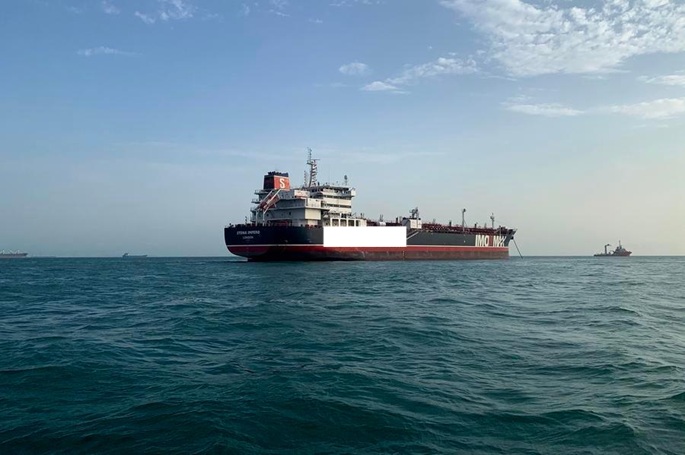
US Navy quietly guides ships transiting Hormuz
Published : 27 May 2026, 03:33
Iran's Foreign Ministry on Tuesday accused the United States of "flagrant violation" of a ceasefire reached between the two countries last month, following U.S. military strikes in southern Iran, reported Xinhua.
The ministry's statement came one day after the U.S. Central Command (CENTCOM) claimed that its forces had struck missile launch sites and mine-laying boats in southern Iran on Monday.
The ministry said that the truce violation committed in Iran's Hormozgan province within the past 48 hours, concurrent with the ongoing Pakistani-mediated diplomatic process between Tehran and Washington, once again revealed the U.S. government's "viciousness and non-commitment to its promises."
The statement added that the U.S. action also demonstrated that Iran's "deep" distrust of the U.S. government is based on a logic and "profound" understanding of its "criminal and despiteful" nature and conduct towards the Iranian people.
The ministry condemned the "aggressive" action and stressed that the U.S. government would bear full responsibility for the consequences.
In a statement on Monday, CENTCOM spokesperson Tim Hawkins said U.S. forces conducted "self-defense" strikes in the Bandar Abbas area, which hosts Iran's main naval base, destroying two vessels of Iran's Islamic Revolution Guard Corps (IRGC) and hitting a surface-to-air missile site.
On Tuesday, the IRGC said that its air defense forces had shot down a U.S. MQ-9 Reaper drone and fired at two other U.S. aircraft, namely an RQ-4 Global Hawk surveillance aircraft and an invading F-35 fighter jet, in Iranian airspace.
In a statement published on its official news outlet Sepah News, the IRGC warned that it reserves the "legitimate and definitive" right to respond to any further U.S. ceasefire violations.
The developments came as a diplomatic process was initiated, mediated by Pakistan, between Tehran and Washington following the April 8 ceasefire to end the war. The two sides are reportedly working to finalize a peace memorandum of understanding.
US Navy quietly guides ships transiting Strait of Hormuz
The U.S. Navy is quietly assisting commercial ships transiting the Strait of Hormuz as the U.S.-Iran negotiations remain uncertain, The Wall Street Journal (WSJ) reported Tuesday, citing U.S. military officials, said Xinhua.
The newspaper later clarified that the U.S. Navy's coordination with commercial ships did not represent a resumption of Project Freedom, a military escort operation announced by U.S. President Donald Trump earlier this month and paused within 48 hours.
A spokesman for the U.S. Central Command confirmed that Washington was not resuming Project Freedom.
A Greek supertanker carrying 2 million barrels of crude oil was guided by the U.S. Navy as it crossed the strategic waterway off the Omani coast, according to the WSJ report.
It added that the tanker had been stranded in the Gulf since early March and is now heading to India to deliver its cargo.
The U.S. Navy plans to assist about a dozen vessels, including supertankers and container ships, in transiting the waterway over the coming days, according to the report.
Regional nations no longer serve as "shields" for US bases: Iran's supreme leader
Iran's Supreme Leader Mojtaba Khamenei has said that the nations and territories in the West Asia region will no longer serve as "shields" for U.S. military bases, adding that "the hands of time will not turn back," the Iranian media reported on Tuesday.
Khamenei made the remarks in a message carried by Iranian media on the Day of Arafah, the second day of the Hajj pilgrimage.
He said that the Muslim world and regional countries have considerable capacities and common interests that will shape the new order and geometry of the region and the world.
Khamenei called on Islamic states to promote friendship and cooperation to advance the Muslim world and resolve its problems.
"The United States, in addition to not having any safe place for malice and establishment of its military bases in the region, is growing more distant from its former status day by day," he said.
Khamenei added that Israel has got close to the end of its "sinister" life, stressing that the future belongs to the Muslim world and modern Islamic civilization.
He noted that Iran managed to make Israel "miserable under its heavy blows, give the aggressive United States a hard slap, and prevent the enemy from forcing it to surrender" during the 12-day war in June last year, stressing that Iran and the resistance groups, especially Hezbollah, achieved victory against the U.S. and Israeli armies, "which were armed to the teeth," during the 40-day war that started in late February.
On Feb. 28, Israel and the United States launched joint attacks on Tehran and other Iranian cities, killing Iran's then-Supreme Leader Ali Khamenei, senior commanders, and civilians. Iran responded with waves of missile and drone strikes targeting Israel and U.S. assets in the Middle East. A ceasefire was achieved between the warring parties on April 8.
Abbas postpones Palestinian presidential, legislative elections to Sept. 11, 2027
Attack on Riyadh int'l airport causes injuries, suspends operations
Opposition leader announces INDIA bloc protest against CEC on Oct 12
Trump suggests ´new President´ for Ukraine, day after diesel deal with Russia
AAP convenor Kejriwal and AISA's Neha Bora held amid protests in India
Iran says hit LPG ship seeking to cross Hormuz

Editor-in-Chief Ofiul Hasnat
Published by Finnish News Network (FNN)
Heporinne 4 B 45
01200 Vantaa, Finland.
E-mails : [email protected]