
Trump says Iran talks ´in final stages´, Iran reviewing US views
Published : 21 May 2026, 03:04
Updated : 21 May 2026, 03:07
U.S. President Donald Trump said on Wednesday that his administration is "in final stages of" peace talks with Iran and is willing to wait a few days for the "right answer," reported Xinhua.
"We're in the final stages of Iran," Trump told reporters. "We'll see what happens."
"We'll either have a deal or we're going to do some things that are a little bit nasty. But hopefully that won't happen," he added.
The president claimed he is in "no hurry" to finalize a peace agreement with Iran, suggesting that he would not consider making a "limited deal" only focused on reopening the Strait of Hormuz.
"We're going to give this one shot," Trump said of a potential deal, ruling out the idea of a partial compromise.
"I'm in no hurry. You never think, 'Oh, the midterms, I'm in a hurry.' I'm in no hurry," Trump said.
The president added that he had a "very good" phone call with Turkish President Recep Tayyip Erdogan earlier on Wednesday. Türkiye is seen as one of key mediators during U.S.-Iran negotiations.
Iran's Islamic Revolution Guard Corps on Wednesday warned that if the U.S. and Israeli aggression against the country is repeated, the war will extend beyond the West Asia region.
On the same day, Iranian Foreign Minister Seyed Abbas Araghchi warned in a post on X that returning to war with Iran will have many more surprises for the United States, citing a recent report by the U.S. Congress that acknowledged the loss of dozens of aircraft.
On Feb. 28, the United States and Israel launched joint attacks on Tehran and several other Iranian cities, killing Iran's then Supreme Leader Ali Khamenei, along with senior military commanders and civilians. Iran responded by launching waves of missile and drone strikes targeting Israeli and U.S. bases and assets in the Middle East.
A ceasefire was reached between the warring parties on April 8, followed by one round of peace talks in Pakistan's capital Islamabad on April 11 and 12, which failed to yield an agreement.
U.S. and Israeli officials have escalated threats of repeating military attacks against Iran over the past few days. Trump on Tuesday claimed Iran's leaders were "begging" to make a deal, warning that a new U.S. attack could take place in the coming days if no agreement is reached.
Meanwhile, Iranian Foreign Ministry spokesman Esmaeil Baghaei said on Wednesday that the exchange of messages between Iran and the United States is continuing through the Pakistani mediator and Tehran is reviewing the latest U.S. views.
In an interview with state-run IRIB TV, Baghaei said messages have been exchanged on several occasions, noting that the Pakistani Interior Minister Mohsin Naqvi's visit to Tehran on Wednesday aims to facilitate the exchange and provide clarification on draft proposals exchanged between the sides.
Baghaei said that Iran is focused on ending the war on all fronts, including Lebanon, with clear demands, including releasing Iranian frozen assets and ending the U.S. "maritime piracy" and hostile actions against Iran's shipping.
He added that Iran has entered the diplomatic process with goodwill and seriousness, but views Washington with deep distrust due to its "very bad" track record over the past 18 months.
Baghaei said that Iran, in cooperation with Oman, seeks to create a mechanism to guarantee "lasting security" in the Strait of Hormuz and is ready to develop protocols for safe maritime traffic in the waterway in coordination with other coastal states.
Citing a source close to Iran's negotiation team, the semi-official Tasnim news agency reported that Washington has sent a new draft proposal to Tehran through Pakistan after Tehran submitted its 14-point proposed plan three days ago.
The mediator is currently in Tehran seeking to bring the two sides' drafts closer, though nothing has been finalized, according to the source.
Also on Wednesday, Iranian President Masoud Pezeshkian said on social media platform X that Iran has consistently honored its commitments and sought to avert war.
"All paths remain open from our side. Forcing Iran to surrender through coercion is nothing but an illusion," Pezeshkian said.
Iran, the United States, and Israel reached a ceasefire on April 8 after 40 days of fighting that started with joint U.S.-Israeli attacks on Tehran and other Iranian cities on Feb. 28.
Following the truce, Iranian and U.S. delegations held one round of negotiations in Pakistan's capital Islamabad on April 11 and 12, which failed to yield an agreement.
Following the eruption of the war, Iran tightened its grip on the Strait of Hormuz, barring passage to vessels belonging to or affiliated with Israel and the United States. After the Islamabad talks collapse, the United States imposed a naval blockade on the strait, preventing ships to and from Iranian ports from transiting the waterway.
Iran, the United States, and Israel reached a ceasefire on April 8 after 40 days of fighting that started with joint U.S.-Israeli attacks on Tehran and other Iranian cities on Feb. 28.
Following the truce, Iranian and U.S. delegations held one round of negotiations in Pakistan's capital Islamabad on April 11 and 12, which failed to yield an agreement.
Following the eruption of the war, Iran tightened its grip on the Strait of Hormuz, barring passage to vessels belonging to or affiliated with Israel and the United States. After the Islamabad talks collapse, the United States imposed a naval blockade on the strait, preventing ships to and from Iranian ports from transiting the waterway.
Iran warns of extending war outside the ME, if faces new military action
The Islamic Revolutionary Guard Corps on Wednesday issued a new statement warning "adversaries" (US and Israel) against any renewed military action targeting Iran, declaring that future conflict could expand beyond West Asia, according to the Iranian state media Islamic Republic of Iran Broadcasting (IRIB), said ANI.
In the official statement, the Islamic Revolutionary Guard Corps (IRGC) said, "If the aggression against Iran is repeated, the war will be extended outside the Middle East region, and our crushing blows will hit you in places you cannot imagine."
The warning came amid heightened regional tensions following recent confrontations involving Iran, the United States and Israel.
The IRGC asserted that Iran had not yet deployed the full extent of its military capabilities during the previous phase of fighting. "Although in the previous round of war, the US-Israel used all their capabilities, we did not use all our capabilities," the statement said.
"But if an action is taken against Iran, Iran's new regional and extra-regional capabilities will be activated."
The IRGC further claimed that the conflict had already spread throughout the region, arguing that Tehran's previous warnings had proven accurate. "As warned before the US aggression against Iran, the war has engulfed the entire region," the statement said.
"Unlike the enemy, Iran's warnings are not empty," the IRGC said. It added, "We warn that any new aggression will activate Iran's extra-regional capabilities."
The IRGC stressed that its military posture would ultimately be demonstrated through direct action rather than rhetoric."We are men of war, and you will see our power on the battlefield, not in empty statements on social media," its official statement said, according to IRIB.
26 ships pass through Hormuz Strait in past 24 hrs
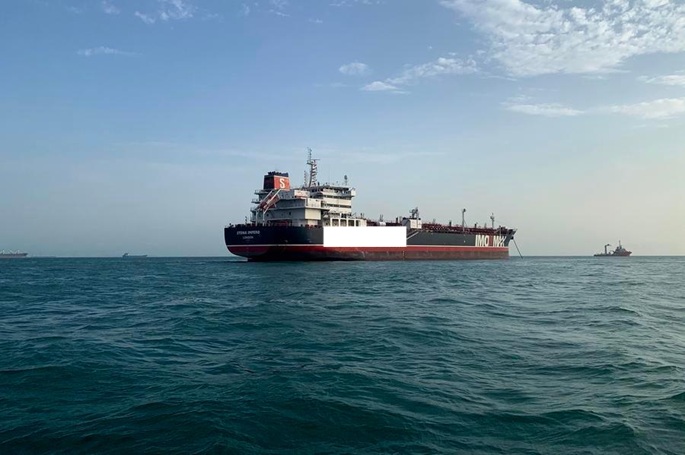
The Navy of Iran's Islamic Revolution Guard Corps (IRGC) said on Wednesday that 26 vessels, including oil tankers as well as container and commercial ships, passed through the Strait of Hormuz within the past 24 hours in coordination with its forces, reported Xinhua.
In a statement published on the IRGC's official news outlet, Sepah News, the Navy noted that it ensured the security of the passing vessels.
It stressed that vessels' passage through the waterway is coordinated with and requires the permission of the IRGC's naval forces.
Also on Wednesday, South Korea's Foreign Ministry said a South Korean oil tanker safely transited the Strait of Hormuz, marking the first passage by a South Korean vessel through the waterway since the U.S.-Israel-Iran war began.
Iran tightened its grip on the Strait of Hormuz beginning Feb. 28, when it barred safe passage to vessels belonging to or affiliated with Israel and the United States following joint strikes on Iranian territory.
The United States has also imposed a naval blockade on the strait, preventing ships traveling to and from Iranian ports from transiting the waterway.
Sporadic clashes erupted between Iran and the United States in and around the Strait of Hormuz after Washington launched Project Freedom earlier this month to guide stranded ships out of the waterway.
Iran witnessing unprecedented epic of resistance against 2 ´global, terrorist armies´: supreme leader
Iran's Supreme Leader Mojtaba Khamenei on Wednesday lauded the nation's "epic and historically unique" resistance against two of the world's "terrorist" armies, namely those of the United States and Israel, during the 40-day war and after that.
In a message carried by Iranian media, Khamenei also commemorated late Iranian President Ebrahim Raisi on the second anniversary of his death.
Khamenei said the reality places a heavier burden of responsibility on the Iranian officials, from the Leader and the heads of the three branches of government to managers at all levels, saying the country is addressing the people's problems and concerns, particularly in the areas of economics and livelihood.
He praised Raisi and the members of his accompanying team, who died in a helicopter crash in northwestern Iran on May 19, 2024.
Khamenei said Raisi was a responsible and popular figure who paid attention to youth and the promotion of justice, as well as to active, interest-based diplomacy.
Also on board Raisi's helicopter at the time of the crash were former Foreign Minister Hossein Amir-Abdollahian and Mohammad Ali Ale-Hashem, the representative of Iran's Supreme Leader to East Azarbaijan.
7 Palestinians killed in Israeli attacks across Gaza
9 killed in shooting in US Pennsylvania
Abbas postpones Palestinian presidential, legislative elections to Sept. 11, 2027
12 killed, 309 injured in attack on Riyadh airport
Opposition leader announces INDIA bloc protest against CEC on Oct 12
Trump suggests ´new President´ for Ukraine, day after diesel deal with Russia

Editor-in-Chief Ofiul Hasnat
Published by Finnish News Network (FNN)
Heporinne 4 B 45
01200 Vantaa, Finland.
E-mails : [email protected]