
Africa's 'cursed' deaf children overcoming prejudice
Published : 12 Dec 2020, 00:41
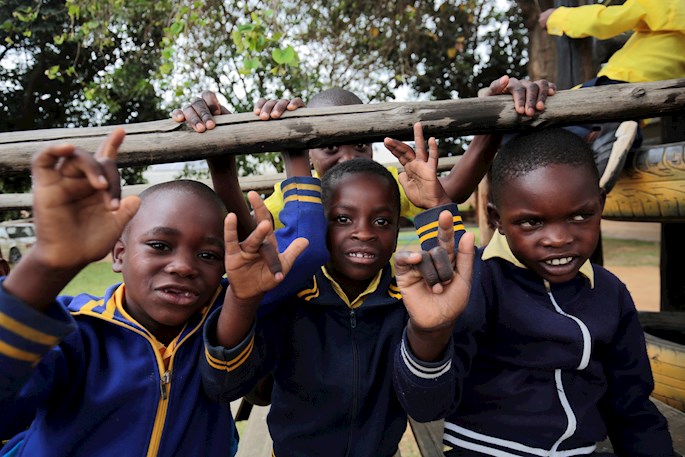
A social stigma and even a witch’s curse - that is how some communities in sub-Saharan Africa view deaf children, a taboo subject that specialized schools are trying to tackle by teaching sign language.
One of those is the Nzeve Centre for Deaf Children in the eastern Zimbabwean city of Mutare, where dozens of schoolchildren are breaking down those barriers and finding self-esteem in the process.
Schools like these are the main hope for children who are hard of hearing in sub-Saharan Africa, a region that is home to some nine million deaf kids, according to the Deaf Child Worldwide NGO.
HARMFUL MISCONCEPTIONS
The lack of awareness of the causes of deafness fuels cultural misconceptions and dangerous and harmful prejudices, such as that the children's mothers were cursed while they were pregnant.
“No postnatal testing is done for deafness when a child is born,” Barbra Nyangairi, executive director of the Zimbabwe Deaf Trust (ZDT), tells Efe.
“Normally it is only recognized later when the child is older. Families face questions like: ‘What did you do?’”
Stigma causes many families to lock their children up at home and, in addition to denying them an education, prevent them from being accepted - or even seen - by the world.
For the past two decades, the Nzeve Center for Deaf Children (Nzeve means “ear” in the local Shona language) has been teaching dozens of children - and their families - to communicate through sign language, thereby empowering the children, who are also taught reading, arithmetic and art.
“As we conduct lessons, the mothers also learn sign language,” says Lyne Dirikwe, family coordinator of the Centre.
Places like Nzeve are helping to break the mold: equipping both deaf children and their parents and siblings with the ability to communicate with one another, and giving the children a sense of self-worth.
Dirikwe admits that there still is social stigma against deafness, but says parents of Nzeve’s pupils are turning into “ambassadors” to dispel these misconceptions.
“They go on parent-to-parent outreach meetings and they conduct deaf awareness and explain that they also are parents of deaf children, so the community understands better,” she says.
"In those communities where they have conducted awareness, discrimination has been reduced,” Dirikwe says.
The most obvious improvements are seen at home - once the children are able to communicate with their surroundings and express their needs and wants - and consequently in their self-esteem.
But sometimes “stigmatization of deafness starts in the home,” says Nyangairi. “They are not considered to be part of the family. Siblings don’t know how to communicate with siblings. They are really left out.”
IMPACT OF COVID
The "new normal" brought about by the coronavirus pandemic has also left its mark on the center, where the idiosyncrasies of sign language make it impossible for students to wear masks in class.
Instead, students wear a clear plastic face shield made by other young people with disabilities who participate in the vocational skills program.
Outside, several round thatched huts display children's paintings with alphabet signs: an open palm indicates the "L" for lemon, a middle finger folded down and held by the thumb is the "K" for kite; and a closed fist represents the "A" for apple.
The cabins were built to accommodate children and parents who came to the center from remote districts, but national confinement stopped classes.
The children "could not be moved. There was no transportation. The regulations of the lockdown meant they had to stay at home," Dirikwe recalls.
The threat of Covid-19 posed another problem: delivering to the young students the public health messages that most Zimbabweans received on the radio or television.
"Of course, parents learn sign language, but with limited vocabulary they cannot explain (the coronavirus) so that the child understands," says the coordinator. To bridge the communication gap, Nzeve staff traveled to the areas where the students were locked down.
BEING WHATEVER THEY WANT TO BE
While this problem is prevalent throughout Africa, some countries deal with their deaf citizens more effectively than others, says Nyangairi.
Zimbabwe’s southern neighbor South Africa has vocational centers for the deaf and a national syllabus for sign language, while Kenya and Uganda have progressive systems to help deaf people.
But many others, including Zimbabwe, lag behind, despite the fact the prevalence of the condition. The most-recent figures from Zimbabwe’s state statistics agency estimates that there are more than 200,000 deaf people in the country.
That is likely an underestimate. In 2000, the year that Nzeve was founded, a survey revealed that up to 135,000 primary school children suffered hearing problems, and that one in every 1,000 suffered profound hearing loss.
Some Zimbabwean state schools are equipped with “resource units” that cater for deaf pupils. In Mutare, where Nzeve is located, there are three such schools in three of the city’s low-income suburbs.
But, Nyangairi says, even within these schools deaf pupils continue to suffer isolation from their peers.
“There is no inclusive education policy. There is no expectation anything can come from a deaf child,” she said. “Right now Zimbabwe has no functional sign language curriculum.”
Schools like Nzeve are helping create a more equal educational sphere to change the way deaf children and young adults perceive themselves through the use of “deaf mentors” who act as role models to overcome the misconception that deaf children won’t amount to anything.
“I’m advising them,” 21-year-old seamstress and former Nzeve pupil, Tadiwa, tells Efe, through a sign language translator.
“I tell them they can be nurses. They can be anything they want.”
Textile factory fire in China's Guangdong kills 8
3 Palestinians killed in Israeli fire across Gaza
3 US media outlets file lawsuit after being barred from entering White House
Norway, Canada to deepen defense cooperation in Arctic
Saudi Arabia's 1st automotive brand CEER debuts EVs
Israeli man killed in West Bank shooting, Palestinian shot dead

Editor-in-Chief Ofiul Hasnat
Published by Finnish News Network (FNN)
Heporinne 4 B 45
01200 Vantaa, Finland.
E-mails : [email protected]