
DK Nejet
Who Is Flying? Automation, Autonomy, and Swarm
Published : 27 Nov 2026, 14:55
Updated : 27 Nov 2026, 18:13
During flight, wind pushes a drone off course. In manual mode, the pilot notices and corrects it. If the drone holds its position on its own, it assesses how far it has drifted and adjusts its movement. The task remains the same; only the performer changes.
At DK Nejet, we are already demonstrating autonomous functions in field conditions. To understand what exactly, it is worth distinguishing three terms often used together: automation, autonomy, and Swarm.
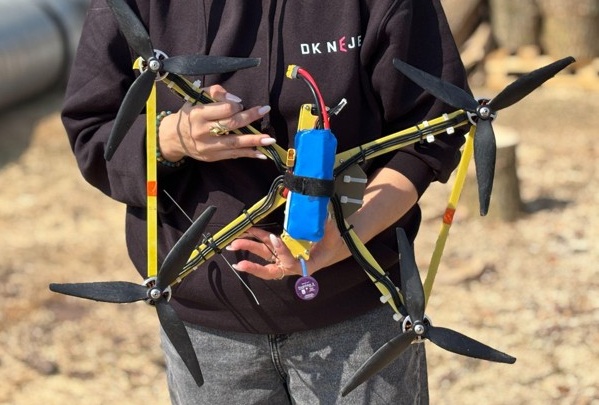
Automation performs an individual action
Automatic takeoff is a simple example: a human gives a command, and the system carries out the required sequence of actions. Thomas Sheridan and Christopher Wickens divided a system’s work into information gathering, analysis, action selection, and execution, and each can be automated to a different degree. So the question “What exactly does the drone do on its own?” says more than the label “automated.”
Autonomy enables task execution without constant control
For us, autonomy begins where a drone uses its own assessment of its state to perform a function without constant manual control. To hold position, for example, it must judge whether it has drifted. One way is optical flow: the camera sees how the image of the surface beneath the drone changes. The U.S. NIST’s ALFUS framework adds that autonomy should be described by naming the function, the conditions, and the operator’s role.
Russia is exploring this technology as well
The adversary uses the same principle. Europe is largely focused on Shaheds, yet our biggest everyday problem is tactical drones such as the Molniya: cheap, numerous, and constantly upgraded. One of the latest upgrades is a computer-vision module that Ukrainian soldiers call the “Ukhylyant” (the Dodger). It “sees” our interceptor, accelerates the drone, and triggers an evasive maneuver, all on its own, autonomously and with no operator involved. By our observations, such drones make up at least 70% of what we shoot down. Yet European air-defense discussions barely mention them, even though an interceptor designed for a non-maneuvering target becomes far less effective against them.
Swarm systems coordinate multiple aircraft
We speak of Swarm when drones coordinate their actions for a shared task: if one changes its trajectory, its neighbors take that into account. Simultaneous takeoff or formation flight alone does not prove this. In a study in Science Robotics, Xin Zhou’s team flew miniature drones in a natural environment. The aircraft plotted trajectories from onboard sensor data and avoided both obstacles and one another.
What DK Nejet is already demonstrating
At the level of an individual aircraft, we demonstrate position holding with wind-drift compensation, automatic takeoff, and target lock. We have also solved Swarmcoordination for a small group: the aircraft coordinate their actions during a shared mission, while the operator can take control at any moment. The autonomy of an individual drone has already moved into the field. Now we are bringing that same independence to the group level.
Oikeiden renkaiden valinta Suomen teille: mitä autoilijan kannattaa ottaa huomioon?
How to Map a Risk-Reward Ratio Before Submitting a Crypto Trade
Mitä vanhentunut LEI-tunnus tarkoittaa suomalaisille yrityksille ja miten sen voi uusia?
From Shipping Offices to Georgian Supper Tables: A 1905 Helsinki Building Finds a New Role
Kuinka kattoremontin kustannuksiin kannattaa varautua eri puolilla Suomea vuosina 2026–2027?
Why Finnish Lapland Is Becoming Europe’s Must-Visit Winter Destination

Editor-in-Chief Ofiul Hasnat
Published by Finnish News Network (FNN)
Heporinne 4 B 45
01200 Vantaa, Finland.
E-mails : [email protected]