
Finland's Remote Work Revolution: Why Distributed Teams Need Enterprise Security
Published : 18 Jun 2025, 12:10
Updated : 18 Jun 2025, 16:19
Finland has quietly become Europe's remote work capital. According to Statistics Finland, 35% of wage and salary earners worked remotely in 2023, with Finland ranking among the top performers when 21% of Finnish workers usually work from home—well above the EU average of 8.9%. But this digital-first approach creates security challenges that many Finnish organizations are still learning to navigate.
As Finnish teams become increasingly distributed across borders and time zones, the casual approach to document sharing that worked in traditional offices has become a significant liability.
The Finnish Remote Work Advantage
Finland's remote work success stems from deep-rooted cultural factors. High trust levels, strong digital literacy, and excellent telecommunications infrastructure created ideal conditions for distributed work long before the pandemic made it necessary elsewhere.
Recent statistics highlight Finland's leadership position:
- 35% of wage and salary earners worked remotely in 2023
- 21% usually work from home vs EU average of 8.9%
- Finland ranks 2nd in Europe for remote work prevalence
- 37% in Helsinki-Uusimaa region work from home, third-highest among EU regions
This transformation accelerated Finnish companies' international expansion. Teams can now include talent from across the Nordics, collaborate with partners in Silicon Valley, and serve clients globally—all while maintaining Finnish operational efficiency.
Security Gaps in Distributed Operations
However, Finland's rapid remote work adoption exposed infrastructure weaknesses that weren't apparent in traditional office environments. When teams worked from the same building, informal document sharing through personal cloud accounts or email attachments seemed efficient. Distributed teams reveal the risks of these practices.
"We discovered our security gaps when a team member in Stockholm couldn't access critical project files because everything was locked in someone's personal Dropbox," explains Marja Korhonen, COO of a Helsinki-based consulting firm. "Suddenly we realized how unprofessional our systems looked to international clients."
This experience reflects broader challenges facing Finnish organizations:
Common Remote Work Security Issues:
- Client documents shared through personal cloud accounts
- No audit trails for sensitive information access
- Password sharing for project collaboration
- Different security standards across team members' locations
- Compliance gaps when working with international partners
International Teams, International Standards
Finnish companies increasingly recruit talent internationally, with remote work enabling access to global expertise without relocation costs. However, international team members often bring expectations shaped by more security-conscious business cultures.
"My previous company in Germany had strict protocols for everything," notes Klaus Weber, a software architect who joined a Finnish startup remotely from Berlin. "Here, they were emailing client contracts as PDF attachments. It felt amateur compared to what I was used to."
These cultural differences become particularly apparent when Finnish companies pursue international business opportunities. Global clients—especially from regulated industries—expect enterprise-grade security regardless of where team members are located.
Professional Infrastructure for Distributed Success
Leading Finnish companies have learned that remote work success requires more than just video conferencing and chat apps. It demands security infrastructure that matches the distributed nature of modern business.
Essential Components of Remote-Ready Security:
- Centralized document repositories with role-based access
- Audit trails showing who accessed what information when
- Time-limited access for external collaborators
- Encrypted communication channels for sensitive discussions
- Automated backup and version control systems
These aren't just security measures—they're productivity tools that make distributed collaboration more effective.
The Nordic Advantage in Secure Remote Work
Finland's position within the Nordic region creates unique opportunities for secure remote collaboration. According to Remote's Life-Work Balance Index, Finland ranks highly for work-life balance with a short average working week (34.43 hours) and generous annual leave (36 days), making it attractive for international remote talent.
Several Finnish companies have capitalized on this Nordic advantage by implementing security infrastructure that enables seamless cross-border collaboration. Data room solutions, for instance, allow Finnish teams to share sensitive documents with Nordic partners while maintaining complete control and audit trails.
"We work with clients across all Nordic countries," explains the CEO of a Finnish management consulting firm. "Having professional document security actually became a competitive advantage—clients trust us with more sensitive projects because they know we handle information properly."
Global Competition Requires Global Standards
As Finnish companies compete internationally, their remote work infrastructure becomes a differentiating factor. Companies with professional-grade security can pursue opportunities that others cannot access.
International clients increasingly audit their vendors' security practices before engaging. Companies that can demonstrate enterprise-grade infrastructure win more business, while those relying on basic consumer tools get disqualified from major opportunities.
Building Remote-First Security Culture
The solution isn't abandoning Finland's collaborative culture—it's upgrading the infrastructure that supports it. Finnish companies can maintain their trust-based approach while implementing systems that protect against distributed risks.
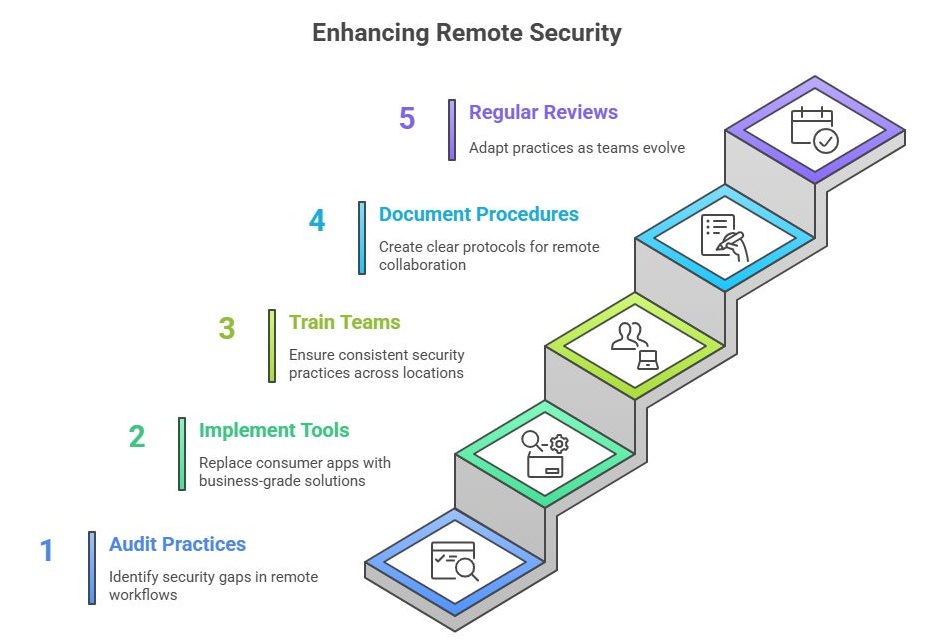 The Business Case for Professional Security
Investing in remote work security infrastructure pays dividends beyond risk reduction. Companies report improved productivity, faster client onboarding, and enhanced ability to attract international talent.
Moreover, professional infrastructure enables new business models. Finnish companies can confidently offer remote services to international clients, knowing their security measures meet global standards.
"Our security upgrade enabled us to expand into the German market," explains a Finnish software development company's founder. "German clients demand strict data handling, and we can now meet those requirements while maintaining our remote-first approach."
Future-Proofing Finnish Remote Work
Finland's remote work leadership position isn't guaranteed. Other European countries are rapidly adopting similar practices while implementing more sophisticated security measures from the start.
To maintain its competitive advantage, Finland needs companies that combine the country's collaborative culture with infrastructure that meets international standards. This means treating security as an enabler of remote work rather than an obstacle to it.
The companies that master this balance—maintaining Finnish efficiency while adopting global security practices—will define the future of Nordic business collaboration.
Taking Action
For Finnish organizations embracing remote work, the message is clear: distributed teams need distributed security. Professional infrastructure isn't about restricting collaboration—it's about enabling it safely across continents.
Finland's remote work revolution has proven the country's innovative capacity. Now Finnish companies must demonstrate the operational sophistication that global business demands.
From Evening News to Live Sport: How Finland Chooses What to Watch
Finland Imported Over 41000 Used Cars Last Year, and the Odometer History Stopped at the Border for Most of Them
Only 16% of Finnish Domains Enforce Strict DMARC Policies
How Consumers Are Moving Beyond Fast Accessories
Morocco, Colombia ties
How to Plan the Perfect All-Inclusive Holiday in Tenerife

Editor-in-Chief Ofiul Hasnat
Published by Finnish News Network (FNN)
Heporinne 4 B 45
01200 Vantaa, Finland.
E-mails : [email protected]