
Morocco highlighted as model for inclusive African development
Published : 25 Nov 2025, 19:24
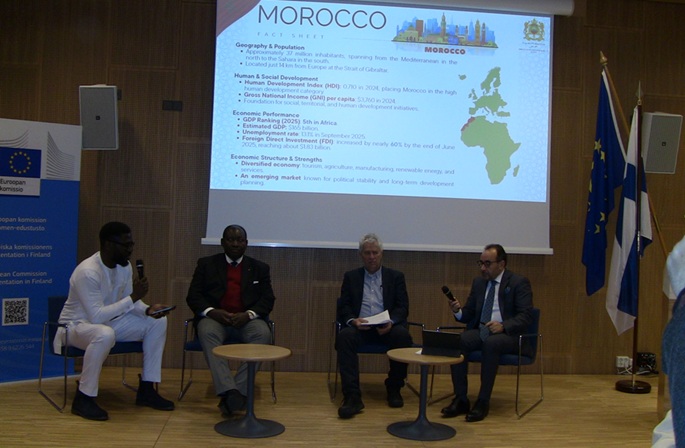
Speakers at a discussion on Monday highlighted policies of the Kingdom of Morocco as a model of sustainable and inclusive progress in Africa.
The Embassy of the Kingdom of Morocco in Helsinki and non-profit organization Think Africa ry held the panel discussion, entitled “Human Development in Africa: Focus on the Moroccan Initiative as a Driver of Inclusive and Sustainable Progress,” at Eurooppasali in Helsinki.
Morocco’s ambassador to Finland Mohamed Achgalou, Senior Advisor at the Finnish Ministry for Foreign Affairs Timo Voipio, and social and public policy researcher at the University of Helsinki Thomas Babila Sama took part in the discussion that Think Africa chairperson Akin Akinsola moderated.
“Morocco’s development vision extends to the entire African continent, aiming to support African integration, promote autonomous development strategies tailored to local contexts, and strengthen shared prosperity across the region,” Achgalou said in his inaugural remarks.
The speakers focused on Morocco’s integration model and contributions to South-South cooperation in the continent, as well as how the African Union could realize its Agenda 2063 that seeks to promote inclusive growth, sustainable development, and regional integration as important pillars of long-term prosperity.
Praising the Moroccan sustainable human development model as a leading example in the continent, they referred to the state-owned phosphate group OCP’s investments in fertilizer production across at least six African countries — Ethiopia, Côte d'Ivoire, Ghana, Rwanda, Senegal, and Nigeria.
The discussants agreed on the importance of South-South knowledge sharing and bilateral cooperation, highlighting how Moroccan public policy reflects these principles in its relations with African partners.
Timo Voipio noted that in the early post-colonial period, the state’s development visions focused on large-scale projects such as infrastructure which did not fully explore its potential.
“By the 1970s, ideas and models of fair trade with Africa began to emerge. As a result, the rural development projects that he worked on prioritized the needs and aspirations of local communities,” he said.
He explained that the biggest disadvantage that underprivileged Africans suffer from lies in the absence of social protection — how society steps in to provide support through the state.
“People have to be healthy and educated enough to participate,” he said, commenting on how to promote human development through inclusive participation.
Terming the developing taxation systems as a cornerstone of social protection, he emphasized the reciprocal relationship that should be ensured between African citizens and the state.
Voipio explained how the Finnish tax administration collaborates with counterpart agencies in several African countries, focusing on providing insights for improvement in customer experience by making taxation more transparent and understandable for citizens.
The speakers stressed that development priorities must be tailored to local contexts to optimize human development.
Voipio said that African nations should focus not on what they lack, but on what they have in assets and strength.
He also said that Finland’s major priority with African partners is to support the development of vocational training to include the skills needed in today’s job market.
“Human development has improved across the continent over the last decade, with more than 90 percent of the population now living in countries that offer better public services, including healthcare and education,” Thomas Babila Sama said.
The researcher also highlighted the vast disparities across Africa reflected in the Human Development Index, which measures life expectancy, education, and the standard of living.
Finnish-Moroccan cooperation was observed during the panel, with at least 35 Finnish companies operating in Morocco.
According to the ambassador, 13 of them have entered directly and others through various partnerships.
Achgalou specified that his country is in discussions with Finland and Estonia on tripartite cooperation projects involving Morocco, either Finland or Estonia, and a third African nation.
He focused on Morocco’s model for domestic and continental integration and said that developments in both human and economic dimensions are closely interlinked.
He said that his country’s New Development Model, launched in 2021, aims to make the country more prosperous, skilled, inclusive, and sustainable by 2035, not only through economic growth but also with a human-centered approach.
“Its goal is to improve the quality of life while positioning Morocco’s economy regionally and continentally as competitive, innovation-driven, and capable of navigating major global transitions, particularly in energy and digital technologies,” Achgalou said.
The diplomat acknowledged persistent challenges to his country’s model, including risks of environmental vulnerabilities such as drought and water scarcity, as well as labor-market issues such as unemployment and low educational attainment.
He said that strategies were being adjusted to address them.
Finnish embassy warns Indians of fake job offers
Finland condoles at quake victims in Colombia
Man held while crossing Finnish border into Russia
8 face arson charges for fire at Helsinki building housing bicycle shop
2 drown in Joensuu, Iisalmi, 2 found dead in Rauma, Pargas
Man dies in police custody in Jyväskylä

Editor-in-Chief Ofiul Hasnat
Published by Finnish News Network (FNN)
Heporinne 4 B 45
01200 Vantaa, Finland.
E-mails : [email protected]