
EU climate package to help Finland achieve climate neutrality
Published : 15 Jul 2021, 00:22
Updated : 15 Jul 2021, 20:01
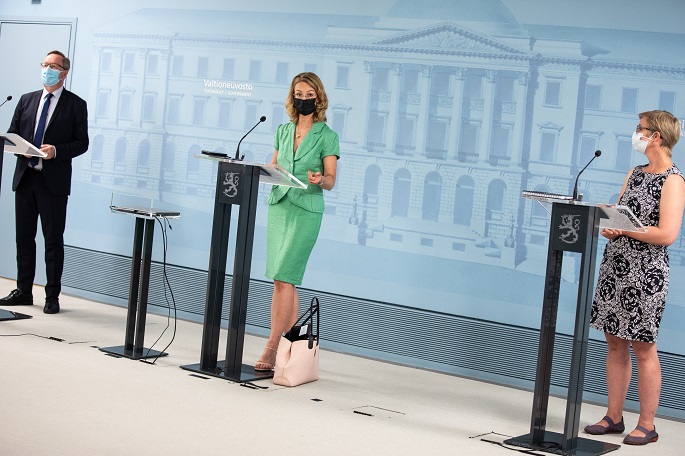
Finland has welcome European Union climate package and said that the effective climate measures will also help the country to achieve its own climate neutrality target.
On Wednesday, the European Commission unveiled a major package of legislative proposals on climate that would reduce the EU’s net emissions by at least 55 per cent by 2030.
The Fit for 55 package contains 13 legislative proposals, eight of which would strengthen existing legislative instruments and five that are completely new regulations, said a government press release.
“The EU climate package is a huge leap towards a climate-sustainable society built on clean transport, sustainable housing and new green jobs. The EU’s effective climate measures will also help us achieve our own climate neutrality target and will level the playing field within the EU. This package will ensure that all sectors in all Member States participate in combating the climate crisis,” said Minister of the Environment and Climate Change Krista Mikkonen.
The legislative proposals cover a wide range of sectors of the economy, including emissions trading reform, burden sharing between countries, energy efficiency, renewable energy, the role of the land use sector and carbon sinks, emission limits for cars, energy taxes and carbon duties.
In the autumn, the Commission will also submit its proposal for revising the Energy Performance of Buildings Directive.
“During the Finnish Presidency, we agreed that the EU would aim for climate neutrality by 2050. Finland has already had a very active influence on the EU’s shared climate policy in general. Our goal is to make the EU the most competitive, socially integrated climate neutral economy in the world. There is still work to be done, but it is great that in the midst of the COVID-19 crisis, the Commission has succeeded in laying this extensive groundwork, which we can now begin negotiating,” said Minister for European Affairs Tytti Tuppurainen.
“In order to achieve the more stringent targets, we need a package that functions well and takes into account the need for major investments in low-carbon solutions and technologies. The industrial and energy sectors require large amounts of capital invested over the longer term. With this in mind, we need predictable regulation and technology-neutral funding. We also have to ensure that citizens are involved and that the changes are perceived as fair,” Minister of Economic Affairs Mika Lintilä said.
Finland will formulate its own positions on each of the thirteen legislative proposals during the autumn, once Parliament has also returned from holiday.
In line with the Commission’s proposal, emissions should be reduced by 61 per cent by 2030 from the 2005 level in the emissions trading sector.
The Commission proposes tightening the target for the emissions trading sector by reducing the amount of annual allowances more swiftly than previously planned, among other measures. At the same time, the free allocation of allowances would be reduced.
“The effectiveness of emissions trading has been improved in recent years, and it is important that we continue to strengthen its impact. The reforms now being proposed are steps in the right direction. At the same time, we need to remember that not all emissions are involved in emissions trading, and we also need robust national plans for climate neutrality,” said Mikkonen.
With the new package, emissions from maritime transport, which are not currently regulated by the EU climate legislation, would also be included in the emissions trading scheme. The goal is for distributors of heating fuels for buildings and fuels for road transport to be included in a separate emissions trading scheme from 2026.
“Winter navigation is an important national issue for Finland as an export country, and we will call attention to it in further discussions on emissions trading in shipping,” Lintilä said.
The development of emissions in non-ETS sectors – agriculture, property-specific heating and transport – is regulated by a burden-sharing agreement that imposes a specific obligation on each EU Member State. As a rule, Member States’ obligations are based on their gross national income.
In its proposal, the Commission has set a target of 50 per cent emission reductions for Finland and five other EU Member States by 2030 compared to the 2005 level. This target will have an impact on the medium-term climate plan and the energy and climate strategy currently under preparation, which are due to be completed in autumn 2021.
The Commission’s proposal includes various flexibilities for promoting the cost-effectiveness of climate policy. The proposal also aims to establish links between sectors to ensure that the targets are met.
The legislative proposals will now be submitted to the European Parliament and the Council for negotiations. The EU Ministers of the Environment will discuss the package for the first time next week at their informal meeting. Due to the number and scope of the legislative proposals, the negotiations are expected to last about two years.
Online illegal wildlife trade poses risks to biodiversity: study
Finland to host Arctic summit of EU leaders in September
Woman killed in road mishap in Helsinki
Man to face charges for hoisting Swastika flag in yard
Belarus to close embassy in Finland
15 to face trial for producing, selling cannabis in Helsinki

Editor-in-Chief Ofiul Hasnat
Published by Finnish News Network (FNN)
Heporinne 4 B 45
01200 Vantaa, Finland.
E-mails : [email protected]