
Merz proposes EU 'associate member' status for Ukraine
Published : 22 May 2026, 00:12
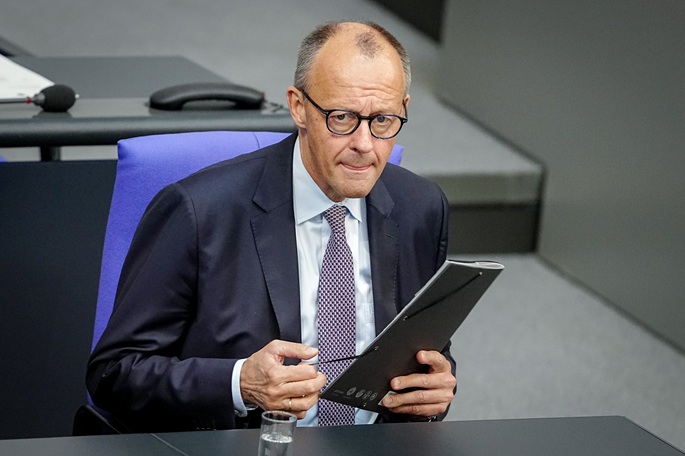
German Chancellor Friedrich Merz has proposed offering Ukraine a new special status as an "associate member" of the European Union in response to Kiev's demand for swift accession, according to a letter seen by dpa on Thursday.
In the letter to EU leaders, Merz advocated immediately integrating Ukraine more closely into the bloc's institutions, while initially withholding full membership and voting rights.
Merz argues that the move is justified by Ukraine's special situation as a country at war and by significant progress in accession talks. The proposal is also intended to help facilitate peace talks initiated by US President Donald Trump, including through a political commitment by EU member states to extend the bloc's mutual defence clause to Ukraine.
The special status would send a strong political signal that Ukraine and its citizens urgently need in their ongoing fight against Russian aggression, according to the letter.
At the same time, Merz considers Ukraine's full accession to the EU in the near future unrealistic.
"It is obvious that we will not be able to complete the accession process shortly," Merz wrote to European Council President António Costa, European Commission President Ursula von der Leyen and Cypriot President Nikos Christodoulides, whose country currently holds the EU presidency.
Merz cited "countless hurdles" and politically difficult ratification procedures in several member states.
The chancellor proposed that the EU negotiate immediately and without delay on all issues relevant to accession. He also called for discussion of "associate membership," which he said could be a decisive step on Ukraine's path to full membership.
"It would not be membership light," he wrote, adding that it would go far beyond the existing association agreement and further accelerate the accession process.
Voting rights to come later
Under Merz’s proposal, Ukraine could attend EU summits and meetings of EU ministers, but without voting rights.
The status could include roles for Kiev as an associate member of the European Commission without portfolio or voting rights, associate member of the European Parliament without voting rights and an associate judge at the European Court of Justice in the form of an "assistant rapporteur."
Merz described the plan as a political solution designed to bring Ukraine "substantially closer to the European Union and its core institutions."
The ongoing accession talks would not be replaced, but promoted and supported, he wrote.
From Merz's perspective, the proposal would not require ratification of an accession treaty under Article 49 of the EU Treaty or treaty changes. Instead, he called for a strong political agreement.
Security guarantee as goal
The letter also included far-reaching proposals concerning security policy.
Merz suggested that Ukraine fully align its foreign and security policy with the EU's. At the same time, member states should make a political commitment to apply the mutual assistance clause under Article 42(7) of the EU Treaty to Ukraine in order to create a substantial security guarantee.
Merz also proposed a fallback mechanism, or alternatively a sunset clause, if Ukraine violates the EU's fundamental values or suffers major setbacks in accession talks.
The chancellor acknowledged that his proposal raises questions of political, technical and legal feasibility. But he argued that these can be resolved if the special status is approached constructively.
For other candidate countries such as Albania, Montenegro and Moldova, Merz did not propose an identical special status, but "innovative solutions" to speed up their accession processes, including privileged access to the single market, closer involvement in EU decision-making and observer status in relevant EU bodies.
Zelenskyy says Starlink and Starshield operations restored
Protests sweep Italian cities, clashes reported
Russian, Ukrainian officials discuss humanitarian mission in Oleshky
410,000 take part in new round of protests across France
Injuries and damage after Germany hit by 1st autumn storm
Russia, Ukraine agree to temporary ceasefire in Oleshky: White House

Editor-in-Chief Ofiul Hasnat
Published by Finnish News Network (FNN)
Heporinne 4 B 45
01200 Vantaa, Finland.
E-mails : [email protected]