
Govt submits 3rd supplementary budget for 2026 to Parliament
Published : 09 Oct 2026, 01:30
Updated : 09 Oct 2026, 01:35
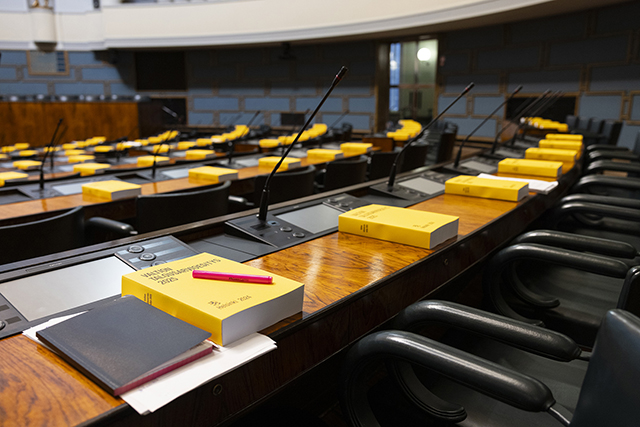
The government on Thursday submitted its third supplementary budget proposal for 2026 to Parliament, said an official press release.
Among other items, the proposal includes expenditure relating to combating African swine fever. The proposal also includes an increase to revenue estimates.
In the third supplementary budget proposal, the appropriation requirement will increase by EUR 139 million, while actual revenue will increase by EUR 585 million. Together, these will reduce the central government’s net borrowing requirement by EUR 446 million.
When taking debt management items into account alongside changes in revenues and appropriations, the central government’s nominal net borrowing in 2026 is estimated to be EUR 13.6 billion. The estimate excludes the non-recurring revenue recognition arising from the dissolution of the National Housing Fund (approximately EUR 2.3 billion), which will have no impact on borrowing.
The government proposed increasing the revenue estimate by EUR 585 million and the tax revenue estimate by EUR 1,058 million. The new estimate is based on the macroeconomic forecast published by the Ministry of Finance in September and the latest accrual data. The proposal includes increases in revenue from earned income and capital income taxes (EUR 316 million), corporate income tax (EUR 221 million), inheritance and gift taxes (EUR 330 million), value-added tax (EUR 294 million) and pharmacy tax (EUR 6 million).
The proposal includes reductions in revenue from excise duties (EUR 108 million) and tax at source on interest (EUR 21 million).
An increase of EUR 438 million is proposed to the estimate of miscellaneous revenue. The proposal includes a EUR 911 million reduction to central government dividend income, capital repayments and revenue from the sale of shares. The reduction is due to timing changes related to the funding of the government’s investment programme.
A total of EUR 3.4 million is proposed for the Finnish Food Authority, the Finnish Wildlife Agency and expenses from veterinary services and animal disease prevention to combat African swine fever.
The proposed increases would be allocated to personnel costs arising from disease prevention, advice, training and the acquisition of traps for hunters and game management associations. It would also be allocated to costs arising from wilderness search and hunting operations and from equipment used to search for dead boars and issue animal disease hazard warnings.
The proposal includes an EUR 80 million budget authority for the procurement of the capacity required for an EU-led AI gigafactory. The aim is for one medium-capacity AI gigafactory to be established in Finland. A business consortium would be selected through a competitive tendering process to construct and maintain the gigafactory.
The proposal includes an increase of EUR 3 million to the Ukraine 2023 budget authority, which is used for procurement to replace defence materiel supplied by Finland to Ukraine. A decrease of approximately EUR 11.6 million is proposed to the budget authority for procurements from domestic industry to meet Ukraine’s needs (UKR 2024), which would be implemented by transferring a corresponding appropriation to item 27.01.66 (Membership fees and financing contributions) due to refunds payable to the European Peace Facility.
The Squadron 2020 procurement authority is proposed to be increased by EUR 152.2 million to cover costs arising from contractual amendments in 2027–2029. An increase of EUR 62 million is proposed to the total amount of the budget authority for defence materiel development (PVKEH 2026). The budget authority is intended for use in 2028–2029. The increases to the Squadron 2020 and PVKEH 2026 budget authorities will be funded by appropriations allocated in connection with the General Government Fiscal Plan approved in the spring of 2026.
The proposal includes EUR 22.7 million in urgent funding for farmers due to specific financial viability challenges arising from the crisis in the Middle East. EUR 5.1 million of this sum is funded by the EU.
The proposal includes a EUR 10 million budget authority for the further planning of the Turku tramway and the modernisation of the Turku public transport corridor in accordance with the agreement on land use, housing and transport between the central government and the City of Turku.
It is proposed that the central government contribute a maximum of EUR 3 million to the core capital of the foundation being established to safeguard the Old Student House’s cultural heritage and use for cultural purposes.
The proposal includes EUR 2.7 million for strengthening research and development activities and research infrastructure at the University of Vaasa.
An increase of EUR 3.9 million is proposed for the Research Council of Finland's budget authority allocated to research in the field of social work. The increase would be implemented as a transfer from the Ministry of Social Affairs and Health's branch.
A net increase of EUR 13 million is proposed to student financial aid. The increase is the result of growth in the number of recipients of study grants and subsidies for school journeys. A reduction of EUR 21.2 million is proposed to government guarantee liability payments for student loans.
The proposal includes an increase of EUR 9 million to be allocated to support under the Act on Improving the Competitiveness of Vessels engaged in Maritime Transport. The revision of the needs assessment is due to changes in the fleet, larger crew complements of larger vessels and higher crew expenses.
It is proposed that the appropriation for the production subsidy for renewable energy be reduced by EUR 11.5 million due to a revised needs assessment.
An increase of EUR 10 million is proposed to reimbursements of costs incurred from the promotion of integration. The increase is a result of a higher than estimated number of beneficiaries of temporary protection and the growth of special costs granted to wellbeing services counties.
A reduction of EUR 50 million is proposed to housing allowance expenditure as a result of changes in the number of beneficiaries.
The proposal includes a reduction of EUR 37 million to the central government’s share of the earnings-related component of unemployment benefits due to a decline in the number of recipients.
A reduction of EUR 100 million is proposed to the central government’s share of the basic security component of unemployment benefits. This change is the result of, among other things, the rising funding responsibility of municipalities as unemployment is prolonged.
An additional EUR 301 million is proposed for the interest paid on central government debt. The interest rate estimate has been revised in accordance with actual interest expenses, actual borrowing and the development of interest rates.
Industrial output drops in Aug from Sept but rises Y-on-Y
US becomes Finland´s largest export partner surpassing Sweden
Nokia to axe 253 jobs in Finland
Work at Google data center sites in Finland ordered to halt
New car registration rises by 16% in Sept
Findata to reduce staff by more than a half due to want of funds

Editor-in-Chief Ofiul Hasnat
Published by Finnish News Network (FNN)
Heporinne 4 B 45
01200 Vantaa, Finland.
E-mails : [email protected]