
Govt warns of recession risk as GDP on wane
Published : 18 Jun 2022, 01:23
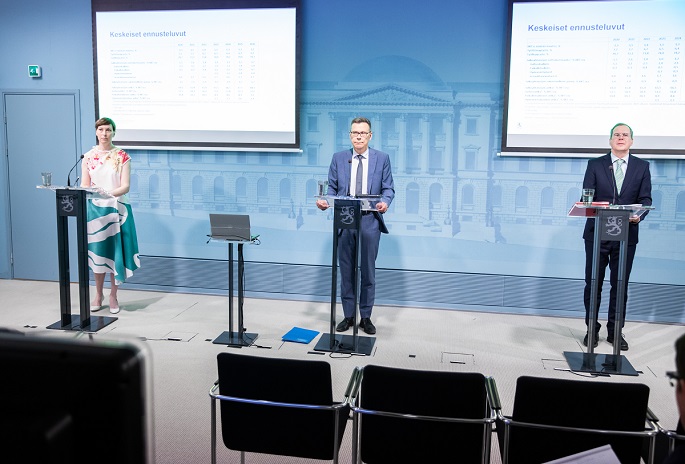
Russia’s invasion of Ukraine, which began in late February, continues and it is overshadowing the economic outlook, estimated the Ministry of Finance in the Economic Survey published on Friday.
Economic growth is slowing and inflation accelerating more than anticipated. Finland’s Gross Domestic Product (GDP) is projected to grow by 1.4% in 2022, by 1.1% in 2023 and by 1.3% in 2024, said the Ministry in a press release referring to the survey.
The possibility that Finland will enter into recession in a , i.e. a situation in which the country’s GDP declines for two consecutive quarters, will increase as the war continues.
“The economy will recover from COVID-19 and also, in time, from the war, but the economic outlook remains subdued. Lifting the economy on to a more favourable and ecologically sustainable growth track that strengthens public finances requires the ability to compete successfully for investments among our peers,” said Director General (Economics Department) of the Ministry Mikko Spolander.
The forecast assumes that the sanctions imposed in early June 2022 will remain in force. In addition, it is assumed that no restrictions that would have economic impacts will be imposed in order to prevent the spread of the COVID-19 pandemic.
The continuation of the war, the rise in energy prices and the consequent acceleration of global inflation overshadow the outlook for the global economy.
Global economic growth will largely slow this year after last year’s rapid growth. The energy market is in a volatile state. The European Union's announcement to withdraw from Russian energy is keeping oil prices high.
The euro area economy is suffering significantly from the war. The near-term outlook is very uncertain, and predictive indicators point to slowing growth. It is assumed that monetary policy will tighten towards the end of the year, and the forecast’s interest rate assumptions have been raised significantly from the previous forecast.
The inflation for 2022 is projected to be on average 5.8%, as measured by the national Consumer Price Index. The rise in prices is still mostly due to the increase in energy prices. There have also been signs of an accelerating increase in food prices. The rise in energy and raw material prices has also begun to be seen in the prices of goods and services.
Private consumption will grow slowly in the coming years. Accelerating inflation is cutting households’ purchasing power and consumption opportunities.
Consumers’ lower confidence in their own financial circumstances may postpone consumption. Employment growth will sustain household incomes, however. Consumption will be supported by the fact that households are hardly saving their income. In 2023, growth in private consumption will slow as employment growth fades.
The large imbalance in general government finances caused by the COVID-19 pandemic decreased sharply last year. General government finances will continue to strengthen this year, fuelled by rapid tax revenue growth and a reduction in the support measures taken due to the COVID-19 pandemic.
The strengthening of general government finances will come to a halt next year, after which the deficit will start to grow as economic and employment growth slow down.
The growth of general government debt in ratio to GDP levelled off in 2021 and the debt ratio will remain broadly unchanged in 2022–2023.
Decreasing deficits and particularly favourable nominal GDP growth are contributing to the temporary stabilisation of the debt ratio. As nominal GDP growth slows and the combined deficit of central government, local government and wellbeing services counties remains substantial, the debt ratio will begin to grow again.
More Finns file debt restructuring petitions in H1
Industrial output drops in May M-on-M but rises Y-on-Y
New car registration rises by 2% in June
Wage, salary drop from last month, increase Y-on-Y in May
Elisa, MTV reach deal to resolve months-long dispute
Finland's share of global exports more than halves since 2002: research

Editor-in-Chief Ofiul Hasnat
Published by Finnish News Network (FNN)
Heporinne 4 B 45
01200 Vantaa, Finland.
E-mails : [email protected]