
COP31 ends without deal, several countries, EU disappointed
Published : 22 Nov 2026, 21:49
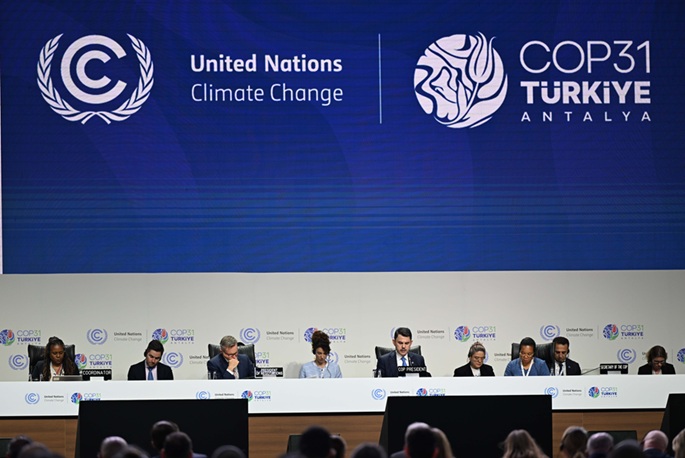
The longest-ever UN Climate Change Conference has failed to agree on a final declaration after several groups of countries, including the EU, denied the final pact presented by the co-chairs, reported dpa.
The inability to find consensus marks a major blow to global efforts to further mitigate global warming, as the planet is experiencing ever-worsening heatwaves, floods and other natural catastrophes.
Major sticking points at the gathering also known as COP31 included a commitment to accelerate global electrification and the disbursement of promised aid funds to developing countries to help them cope with climate change.
Frustration had also been rising among some countries over the latest draft declarations circulated by the COP presidency, which did not explicitly mention plans to phase out fossil fuels, a demand that has faced headwinds from oil-producing nations such as Saudi Arabia.
"It is unconscionable that we would have a climate act that makes no reference to fossil fuel, no reference to transitioning away from fossil fuel either," said Irish Climate Minister Darragh O'Brien, whose country currently holds the rotating EU presidency.
"And it is for that reason, and those reasons, that the European Union strongly objects to this text," O'Brien said.
COP31 President Murat Kurum, environment minister of Turkey, which was hosting this year's talks in the city of Antalya alongside Australia, was forced to admit during the final plenary session on Sunday afternoon that the text for the final declaration would not be able to pass.
Longest COP to date
This year's climate talks, which saw delegates from nearly 200 countries engage in tough negotiations for some two weeks, was marred by efforts of potent oil producers including Saudi Arabia and Russia to reverse previous resolutions.
Discussions were originally due to come to an end on Friday evening, but, like many editions before, the gathering entered into overtime as the struggle to find consensus on the final declaration continued at the weekend.
By Sunday afternoon, COP31 had become the longest-ever UN climate summit, surpassing COP25 held in Madrid in 2019.
A group comprising over 130 countries – including the EU, small island states, African and Latin American states, as well as less developed nations - had worked through the night to come up with a compromise on the final draft.
But as all decisions at the conference require consensus, the opposition of individual states effectively amounts to a veto.
Oil producers accused of blocking progress
German Environment Minister Carsten Schneider earlier also said his country "won't be able to agree" to the current draft of the final declaration, noting that the 10-page document does not provide an "adequate response to the threat posed by the climate crisis; in fact, it takes a step backwards."
"A step backwards from previous decisions on climate action is the last thing Germany can afford; instead, we want to lead the way together with the rest of the world," Schneider said in Antalya.
He accused oil-producing countries of blocking progress, noting that the overwhelming majority of countries were committed to climate action.
"However, some are still making huge profits from oil and gas and are not prepared to scale back their production accordingly or to push forward a clear roadmap for reducing greenhouse gas emissions, particularly in this sector," he said.
The top diplomat for the Marshall Islands, which are under threat from rising sea levels caused by climate change, also rejected the declaration, describing the text as the "worst-possible answer" to the climate crisis which puts the security and future of her country at risk.
But some countries, including China, Pakistan and some African states, lamented that the final declaration had not been adopted, and a representative for Saudi Arabia argued that the Arab countries were responsible for only a very small proportion of greenhouse gases emitted in the past.
He also reiterated support for carbon capture and storage (CCS) to fight climate change, a key demand from fossil fuel-producing countries that others say is sought as an excuse to prolong the use of oil, gas and coal, the main drivers of climate change.
EU Climate Commissioner Wopke Hoekstra directly blamed the oil-producing nations’ strong focus on expensive storage technologies for the failure of the talks.
CCS had, in the negotiations, "[fallen] from the sky... as the new solution to everything," he said. "As if we could forget about fossil fuels and we will just be able to CCS ourselves out of the problem."
The commissioner described the approach as "unacceptable."
Some progress made
It marks the first time that a final document negotiated at the climate talks has not been adopted by the plenary, according to observers.
But environmental campaigners were adamant that the outcome of this year's conference does not necessarily mean failure.
Oxfam's Jan Kowalzig said the refusal by many nations to adopt the final declaration was "a sign that the majority of countries have not allowed themselves to be brought to their knees by those blocking the phase-out of fossil fuels."
However, he stressed that the lack of consensus was also due to the EU’s lack of flexibility on the issue of financial support for poorer countries in dealing with the consequences of climate change, which had prevented the formation of new alliances.
The Antalya summit was dominated by this new approach to climate diplomacy, with several states coming together in alliances to make more rapid progress on specific issues.
This includes a group of some 30 states that presented or announced plans to phase out fossil fuels, as well as an initiative comprising 13 states and the EU that have announced plans to curb the use of sulphur hexafluoride, or SF6, a potent greenhouse gas used in electricity networks around the world.
Dozens of states also backed Turkey's proposal to accelerate electrification, which envisages increasing electricity's share of global final energy consumption from around 23% to 35% by 2035.
Blows to climate action elsewhere
While delegates in Antalya were fighting tooth and nail to advance climate action, efforts to mitigate global warming were weakened elsewhere.
Turkish President Recep Tayyip Erdoğan, whose country hosted the climate talks, announced the discovery and plans to exploit two new oil fields at the start of COP31.
Earlier this week, US President Donald Trump, Russian President Vladimir Putin and Chinese President Xi Jinping agreed to boost crude oil production and delivery during their historic trilateral meeting in Shenzhen.
Climate action efforts were also watered down in the EU, with Brussels announcing on Thursday that the bloc would delay the introduction of climate rules on methane emissions from imported fossil fuels by two years, as it seeks to ease pressure on energy prices and security of supply.
Australian study reveals genetic clues to why ageing raises cancer risk
Iran says targeted US positions at 2 bases in Bahrain with missiles, drones
350,000 families in Gaza Strip left homeless: ministry
FBI's Crime database hit by hackers in 2nd breach in recent months
Vietnam narrows scope of death penalty to 4 offenses
Nordic, African ministers call for closer trade ties, stronger multilateral cooperation

Editor-in-Chief Ofiul Hasnat
Published by Finnish News Network (FNN)
Heporinne 4 B 45
01200 Vantaa, Finland.
E-mails : [email protected]