
Ukraine, Russia, US trilateral talks end without ceasefire deal
Published : 11 Nov 2026, 22:06
Updated : 11 Nov 2026, 22:09
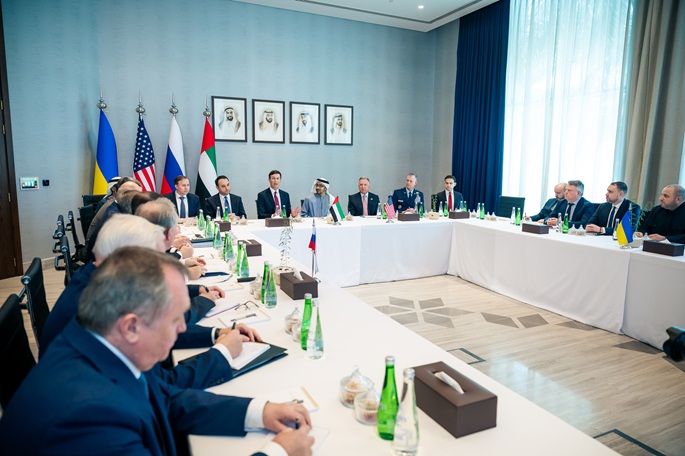
Trilateral talks involving Russia, the United States and Ukraine ended on Wednesday in Abu Dhabi, the capital of the United Arab Emirates (UAE), with Russia and Ukraine reaching an agreement on a "large-scale" prisoner exchange, reported Xinhua.
While the agreement marked a tangible outcome of the two-day discussions, no agreement was announced on a ceasefire, territorial disputes or long-term security guarantees.
What did the two-day talks achieve, and what are the prospects for further negotiations?
WHAT HAPPENED IN ABU DHABI?
Vladimir Medinsky, head of the Russian delegation, said the delegations had discussed humanitarian issues, with the future of European security being a central focus of the U.S.-mediated talks.
He added that the parties had reached understandings on some issues, without providing further details.
Medinsky called for a fair security framework that takes into account the interests of all countries, arguing that the conflict in Ukraine had exposed shortcomings in Europe's security system.
Jared Kushner, a member of the U.S. negotiating team, told reporters that the discussions were thorough and covered all major issues, which he described as a good first step forward.
He noted that the prisoner exchange deal was one of the positive outcomes of the negotiations, with the exact number of prisoners to be finalized on Thursday.
On the Ukrainian side, negotiator David Arakhamia, chairman of the Servant of the People parliamentary faction, a Ukrainian political party, said the talks had generated "good momentum" toward finding a solution to the conflict before the end of the year.
WHAT REMAINS UNRESOLVED?
Although progress was reported on the prisoner exchange, no agreement was announced on a ceasefire, territorial disputes or long-term security guarantees.
Vadim Kozyulin, chief researcher at the Institute of Contemporary International Studies of the Russian Diplomatic Academy, said the parties appeared ready to negotiate but not to make concessions.
He noted that the parties had fundamentally different understandings of security guarantees. While Kyiv seeks firm commitments to protect Ukraine, Moscow insists that Ukraine's security should not come at the expense of Russia's.
Progress would depend on whether they were willing to discuss mutual obligations rather than simply reiterate their own demands, Kozyulin said.
Ahmed Al-Janabi, a UAE political analyst, described the talks as a significant step toward a political settlement, saying they had helped revive diplomatic engagement between Moscow and Kyiv.
He noted that the conflict was rooted partly in competing views over Ukraine's place in Europe's security architecture, its relationship with NATO and territorial disputes with Russia.
Any agreement failing to address the underlying causes of the conflict and provide acceptable security arrangements would remain fragile, said Al-Janabi, adding that a lasting settlement would require mutual concessions and clear guarantees to prevent renewed hostilities.
WHAT COMES NEXT?
Kushner said he and U.S. special envoy Steve Witkoff planned to travel to Moscow for further discussions.
He noted that the two would seek progress in Moscow if Russian President Vladimir Putin agreed to U.S. demands to end the war, and would meet Ukrainian President Volodymyr Zelensky afterward.
Alexey Mukhin, director general of the Centre for Political Information in Moscow, viewed the Abu Dhabi discussions mainly as an opportunity for the sides to assess each other's positions, suggesting that subsequent rounds could prove more productive.
Al-Janabi said future progress would depend on Washington's ability to narrow differences and on Moscow's and Kyiv's willingness to show flexibility, particularly on territorial disputes and security guarantees.
Maintaining dialogue was itself a positive step toward ending the conflict, he added.
US, Israel war crimes backfired at their polls: Iranian President
COP31 delegates call for urgent climate finance, justice for developing nations
Tanker carrying 40,000 tons of Russian diesel stalls en route to US
Israel's new parliament sworn in as opposition moves to take control of key posts
White House opposes effort to impeach Hegseth
Water surge in Malaysia's Selangor leaves 5 dead, 3 missing

Editor-in-Chief Ofiul Hasnat
Published by Finnish News Network (FNN)
Heporinne 4 B 45
01200 Vantaa, Finland.
E-mails : [email protected]