
Canadian PM's "Super Week" turns strategic pivot to Europe
Published : 15 Sep 2026, 19:58
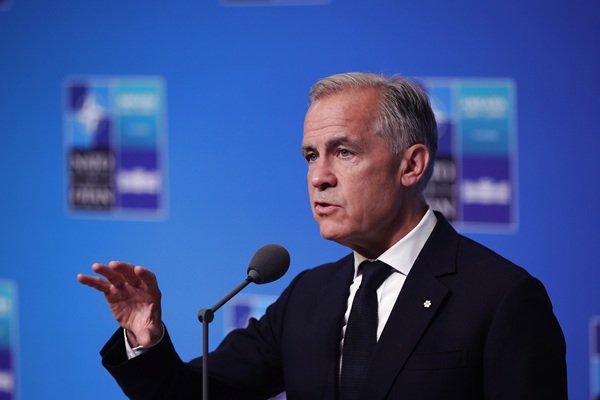
Canadian Prime Minister Mark Carney kicked off an extraordinary week in transatlantic relations on Monday, reported Xinhua.
Carney inaugurated the Canada Investment Summit in Toronto to attract global capital and is set to travel to Europe to address the European Parliament and meet with British and French leaders. These high-profile engagements coincide with the formal implementation of the 50 percent tariffs imposed by the United States on Canadian goods.
This series of events highlights Carney's strategy: boosting domestic economic resilience through foreign direct investment, defending national interests against U.S. tariffs, and deepening diplomatic and security ties with Europe to reduce Canada's long-standing reliance on the American market. TAPPING ASIAN, EUROPEAN MARKETS First announced in April, the Canada Investment Summit was designed to attract fresh capital for national infrastructure projects -- a cornerstone of Carney's strategy to expand economic links with non-U.S. partners.
Speaking on the summit's opening day, Carney described the gathering as part of a broader government roadmap aimed at bringing foreign capital into Canadian manufacturing while bolstering trade with Asia and Europe. "Canada has immense opportunities in both Europe and Asia. And we have not fully realized our potential in these markets," Carney said. The summit aims to mobilize 1 trillion Canadian dollars (about 726 billion U.S. dollars) in total investments over the next five years.
To pitch global investors with roughly 300 business leaders, including executives from the world's largest asset management firms, the Canadian government unveiled a catalog of priority projects spanning energy, critical minerals, advanced technologies and major infrastructure. According to a prospectus disclosed by Canadian media, the package features more than 160 major projects across eight sectors, including 11 conventional energy projects, 31 clean energy projects, 63 mining and metals projects, among others.
Notable projects include a 35 billion-Canadian-dollar oil pipeline extending from Alberta to the Pacific coast and a 28.5 billion-Canadian-dollar liquefied natural gas project in British Columbia, and a 79 billion-Canadian-dollar expansion of the Port of Churchill on Hudson Bay. "We are launching an investment super-cycle that this country needs," Carney said. A report by TD Bank predicted that with the right government execution, Canada could enter an investment "super-cycle" lasting a decade or longer, driving job creation and lifting output per capita by 12,000 Canadian dollars. SEEKING UNIQUE ALLIANCE WITH EUROPE Following the summit in Toronto, Carney will depart for Europe on Tuesday for a three-day visit.
He is set to address the European Parliament in Strasbourg, France, and attend European Commission President Ursula von der Leyen's State of the European Union address, the first non-European leader invited to such an event. Carney will also hold his first bilateral meeting with British Prime Minister Andy Burnham in Liverpool to discuss defense and security, energy transition, AI governance and critical minerals.
On Sunday, he will travel to Saint-Pierre-et-Miquelon, a French archipelago south of the Canadian island of Newfoundland, to meet with French President Emmanuel Macron. Carney and Macron will discuss deepening the Canada-France partnership in strategic sectors, including aerospace, energy and critical minerals, and advanced technologies such as quantum, satellites and supercomputing, according to a press release by Carney's office.
Canada will host the Canada-EU Summit on Oct. 29-30 to sustain momentum in trans-Atlantic cooperation, the office has announced earlier. Although Carney clarified that Canada "is not seeking to join the European Union," the two sides are forging what officials describe as a "unique alliance." At the World Economic Forum in Davos in January, Carney argued that the post-war international order had suffered a "rupture" and called on middle powers to form coalitions of overlapping interests. While his remarks sparked frictions with Washington, they resonated across Europe.
Canada achieved a significant breakthrough earlier this year by becoming the only non-European nation admitted to the EU's Security Action for Europe defense procurement framework, allowing Canadian defense contractors to bid directly on European rearmament contracts. Carney's efforts to strengthen ties with Europe are gaining public support. According to an Abacus Data survey, conducted from Sept. 4 to 9, as many as 80 percent of Canadians say Canada should deepen strategic cooperation with the EU on foreign policy, defence and economic priorities. "Now, Carney was accelerating Canada's pivot to Europe, matchmaking a shotgun marriage to offset the pain of its divorce with America.
In effect, a threat to make Canada the 51st state is pushing America's northern neighbor so close to Europe that leaders have begun to half-in-jest dub it the EU's newest member," said the Wall Street Journal. Trump's tariffs and policies toward NATO and Greenland have accelerated efforts by Canada and Europe to diversify their economic and security ties, the Associated Press (AP) reported, citing Ian Lesser of the German Marshall Fund in Brussels. However, it warned that Carney is carrying to Europe a message that has won praise there but that European governments have been reluctant to follow: Middle powers should be willing to resist economic coercion and walk away from a bad deal.
Analysts pointed out that uncertainty remains over potential retaliatory measures from U.S. President Donald Trump in response to Canada's efforts to pivot away from the U.S.
Iranian security official says no talks with U.S. until conditions met
Netanyahu vows continued Israeli attacks in Lebanon
3 killed, 2 injured in bar shooting in Cameroon
Iran says oil tanker explodes after hitting naval mines in Hormuz
US judge blocks new stay limits for foreign students, journalists
US imposes fresh sanctions on Russia's VTB Bank over alleged ties to Iran

Editor-in-Chief Ofiul Hasnat
Published by Finnish News Network (FNN)
Heporinne 4 B 45
01200 Vantaa, Finland.
E-mails : [email protected]