
SpaceX Falcon 9 upper stage to crash into Moon, posing no danger to Earth
Published : 05 Aug 2026, 03:20
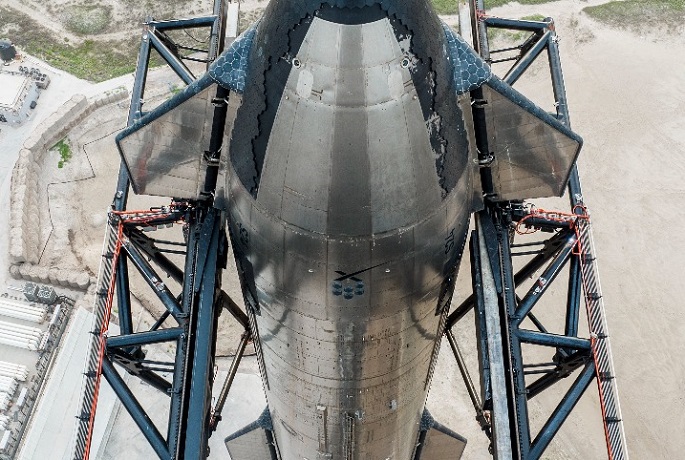
Part of a used SpaceX rocket is expected to crash into the Moon on Wednesday, but the impact poses no danger to Earth, NASA said Tuesday, reported Xinhua.
In a news release posted on its website, NASA said it is using ground-based telescopes and space-based assets to track the used Falcon 9 upper stage from a commercial mission. The roughly 3,900-kilogram part is expected to impact the Moon near the Einstein and Bell craters.
NASA scientists are planning to collect lunar data from the event and refine techniques for tracking objects in space.
On Jan. 15, 2025, SpaceX launched the Falcon 9 rocket and successfully deployed Firefly Aerospace's Blue Ghost 1 lunar lander to the Moon under NASA's Commercial Lunar Payload Services initiative. Solar activity and gravitational forces caused the stage's unplanned return to the Moon. NASA and SpaceX remain in communication about the upper stage and its flight path, according to NASA.
"Because the Moon has no atmosphere to slow incoming objects, it is struck by meteoroids daily. Human-made object impacts are far less common but do occur. The rocket stage is expected to create a crater about 60 feet (about 18 meters) wide and 12 feet deep and throw dust and rock outward as ejecta," said NASA.
For comparison, a meteoroid with the same energy as the upper stage hits the Moon about every six days, so the lunar surface is constantly absorbing impacts with the same force. Despite the disturbance, observing impacts gives scientists valuable insight by revealing how ejecta plumes behave, helping to understand the Moon's geology and refine models that guide future exploration and science missions, the agency explained.
The impact will not be visible to the naked eye on Earth, but NASA said it will attempt to observe it in real time. The Meteoroid Environments Office at the agency's Marshall Space Flight Center in Huntsville will use ground-based telescopes to image the impact.
Additionally, NASA said its Lunar Reconnaissance Orbiter and the ShadowCam instrument aboard South Korea's Korea Pathfinder Lunar Orbiter will look for chances to image the site before and after the impact.
Putin, Pezeshkian discuss enhancing economic cooperation
Anti-migrant protests spark violence, arson in South African cities
Israeli officer killed in Lebanon, Israel kills 5 in Gaza, West Bank
Thai opposition files no-confidence motion against PM, 17 ministers
US launches probe into J-1 visa fraud at 9 top universities
SpaceX Crew-12 mission returns to Earth after nearly 8 months in space

Editor-in-Chief Ofiul Hasnat
Published by Finnish News Network (FNN)
Heporinne 4 B 45
01200 Vantaa, Finland.
E-mails : [email protected]