
Trump says US-Iran talks to begin Monday after shelving planned strike
Iran's president says necessary to make US adhere to MoU
Published : 03 Aug 2026, 02:44
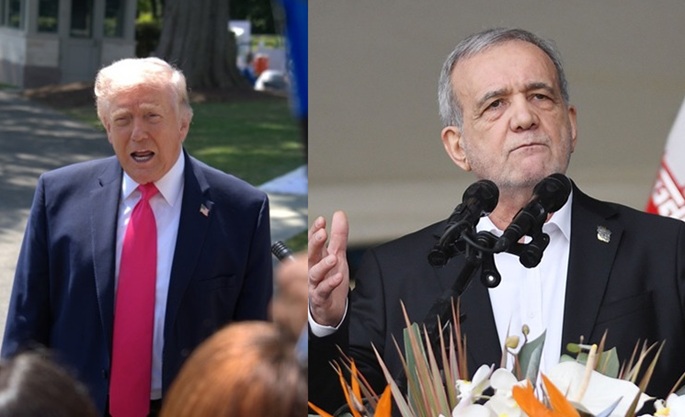
US President Donald Trump on Sunday stated that negotiations with Iran, expected to take place through intermediaries, are scheduled to commence on Monday, reported ANI.
Speaking to reporters on board Air Force One, Trump confirmed that discussion channels were active.
"We are talking to them [the Iranians] in the form of a negotiation; it begins tomorrow afternoon, and we'll see how it goes. I'd love to do that. It'll save a lot of lives, a lot of unnecessary power, to be honest with you. We are ready to go whenever we want. Would I rather make a deal? I'm not looking to kill people, because a lot of people die; we don't want that. So they asked us, Iran specifically, but the other three, they asked us," Trump said.
The US President revealed that diplomatic engagements involving Saudi Arabia, the United Arab Emirates, Qatar and Iran led him to halt what was originally planned as a "massive attack" on Friday.
Trump further indicated that an agreement could be reached regarding the management of the Strait of Hormuz, while asserting that an accord would be established concerning the denuclearisation of Iran.
The sudden turn towards diplomacy comes as mediators race to reactivate a dynamic framework between Washington and Tehran. According to Israeli media reports on Sunday, regional intermediaries are attempting to revive a memorandum of understanding signed last month to ensure the strategic waterway remains open, fee-free, for 60 days.
Iranian state media similarly indicated that discussions between Iran and Oman concerning a joint operational mechanism to govern the maritime corridor were in their final stages.
The initial framework had previously collapsed due to conflicting interpretations, with Trump asserting the passage would remain open permanently, while Tehran maintained the agreement preserved its sovereign control over the trade route.
Behind-the-scenes diplomatic pressure over the weekend played a pivotal role in averting immediate conflict. Qatari officials engaged in intensive talks with Iran, the US and Oman, ultimately informing Trump on Saturday that Tehran had accepted a proposal regarding the strait. Concurrently, Saudi Crown Prince Mohammed bin Salman held a telephone call with Trump to urge against military action.
Following these exchanges, Trump announced on Truth Social that he was halting the planned strikes, citing progress on the shipping route and nuclear discussions. Although no military strikes were recorded overnight into Sunday, Iranian military leaders rejected Trump's characterisation as a "lie", while a source tied to Tehran's delegation told the semi-official Fars News Agency that no formal accord on the strait had yet been reached.
Meanwhile, opinions among Gulf allies remain sharply divided over how Washington should handle Tehran. The Wall Street Journal reported on Sunday that while Saudi Arabia counselled restraint, the United Arab Emirates lobbied Washington for more assertive military action, arguing that the Islamic Revolutionary Guard Corps would not alter its course without direct US force.
Iran's president says necessary to make US adhere to MoU
Iranian President Masoud Pezeshkian said Sunday that Iran must "compel" the United States to remain committed to the peace memorandum of understanding (MoU) signed between the two countries, reported Xinhua.
He made the remarks in a post on social media platform X, saying that there is a consonance among members of Iran's Supreme National Security Council on the MoU.
Pezeshkian said he believes the MoU will be the focal point of Iran's foreign relations in the future.
"We must strive to compel the enemy to adhere to what it has signed. The security of the country, region and our allies will improve with this MoU," he said.
On June 18, Iran and the United States signed the MoU, under which the two countries were scheduled to hold negotiations within a 60-day period to reach a final agreement. However, the talks' fate is hanging in the balance due to the recent escalation between them.
The U.S. military launched multiple waves of strikes against Iranian targets last month, saying they were in response to Iranian attacks on vessels in the Strait of Hormuz and aimed at "degrading Iran's ability to threaten commercial shipping." Iran responded with missile and drone attacks targeting U.S. military bases and facilities in the region.
5 dead, 41 missing after vessel catches fire in Indonesia's Java Sea
14 killed, 26 injured in suicide blast near peace rally in Pakistan
18 killed in Israeli airstrikes on Gaza
Canada's WestJet flight attendants go on strike, prompting flight cancellations
3 killed, 2 wounded in shooting at US Idaho restaurant
6 members of a family killed in lightning strike in Uganda

Editor-in-Chief Ofiul Hasnat
Published by Finnish News Network (FNN)
Heporinne 4 B 45
01200 Vantaa, Finland.
E-mails : [email protected]