
Trump threatens bigger attack
Iran rejects US ceasefire proposal conveyed by Iraqi PM
Published : 25 Jul 2026, 03:01
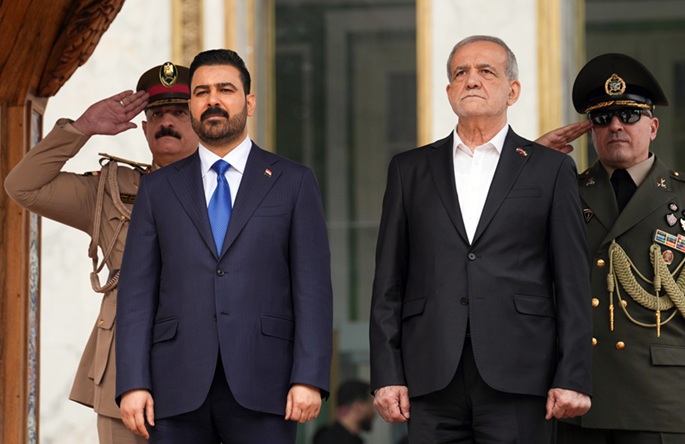
Iran on Thursday (local time) rejected a renewed ceasefire proposal from US President Donald Trump, which was delivered through Iraqi Prime Minister Ali al-Zaidi amid the escalating tensions between Washington and Tehran, The New York Times reported, citing Iranian and Iraqi officials familiar with the matter, reported ANI.
The officials, who spoke to NYT on the condition of anonymity, said al-Zaidi's visit to Tehran came after his recent meeting with Trump at the White House, during which the Iraqi PM presented the proposal by the US president.
The details of the proposed ceasefire agreement were not immediately available.
However, Iranian officials told NYT that the proposal was the only offer currently on the table and indicated that Tehran was not interested in accepting a temporary arrangement that did not resolve the issue of control over the Strait of Hormuz.
According to Iranian media, al-Zaidi travelled to Tehran with a delegation of senior Iraqi officials and held meetings with Iranian President Masoud Pezeshkian, Speaker of Iran's Parliament and top negotiator MB Ghalibaf, and Foreign Minister Abbas Araghchi.
Speaking to state media Islamic Republic of Iran Broadcasting (IRIB) on the sidelines of the Iraqi PM's meeting with Pezeshkian, Araghchi said that it was "natural" for al-Zaidi to convey his "views and perceptions" from his trip to Washington.
"The Iraqi Prime Minister, of course, had a trip to Washington. It is natural that they would convey their views and perceptions from this trip to us, which is normal," the Iranian FM said.
Araghchi further noted that Iran has an issue with the "American approach" in dealing with the Islamic Republic, which he described as "irrational, excessive and hegemonic".
"The problem is the type of American approach, which is the irrational, excessive, and hegemonic approach of this country, which has been confronted by the authoritative approach of the Islamic Republic of Iran," he said.
The rejection of the ceasefire proposal came as Iran and the United States have witnessed a sharp rise in hostilities in recent weeks.
US forces have carried out strikes on Iranian military facilities as well as civilian infrastructure, including railways, airports, bridges and seaports, while Iran has launched ballistic missile and drone attacks against US military targets in West Asia.
Two Iranian officials told NYT that the country's armed forces were preparing for a possible expansion of the conflict if Trump follows through on threats to strike Tehran and critical infrastructure.
The officials said Iran could widen the confrontation across the region, including by targeting Tel Aviv and seeking assistance from its Houthi allies to close the Bab al-Mandab Strait, a strategically important waterway in the Red Sea.
Meanwhile, U.S. President Donald Trump threatened on Thursday to resume major combat operations against Iran with "bigger than ever before" strikes, as the two sides have traded over a dozen consecutive nights of retaliatory strikes, reported Xinhua.
The latest escalation has spilled into surrounding waters and strategic waterways as Houthis, a Yemen-based armed group, launched attacks on Saudi oil tankers in the Red Sea, pushing up the price of Brent crude to 100 U.S. dollars a barrel in trading on Thursday.
THREATS OF MASSIVE ATTACKS
In an interview with Axios on Thursday, Trump said he is seriously considering restarting major combat operations in Iran, including strikes that would be bigger than the "Operation Epic Fury" launched on Feb. 28.
"I am considering a massive attack. Bigger than ever before. I am close to making a decision. We are all set for it," Trump said in the interview, adding that Iran had not "received enough pain yet."
Israel "would join in two minutes if I ask them to," Trump said, admitting there would be "consequences" for Israel if it joined the strikes. Trump did not give a deadline for his decision, according to the report.
The U.S. Central Command said in a post on X early Friday that its forces "successfully completed the 13th straight night of strikes against Iran."
It added that U.S. forces targeted "Iranian military command centers, drone storage facilities, communication networks, coastal surveillance sites, and maritime capabilities to further diminish the threat Iran poses to civilian mariners and commercial vessels transiting the Strait of Hormuz."
In response, Iran launched fresh drone strikes targeting "important" U.S. military facilities in Jordan and Bahrain, according to a statement published by the Iranian Army on Friday.
The army said it struck the U.S. Army's fuel depots, large equipment warehouses and troop accommodation facilities at Shaikh Isa Air Base in Bahrain, as well as aircraft hangars and troop accommodations at al-Azraq Air Base in Jordan.
At least four people were killed, and five others wounded in overnight U.S. missile strikes targeting locations around Iran's southwestern city of Ahvaz in Khuzestan province, the official news agency IRNA reported on Friday.
NEW FRONT ON THE RED SEA
Global markets were rattled following the Red Sea tanker attacks. Brent crude surged to 100 dollars per barrel Thursday morning, its highest level in two months.
The latest flare-up in the conflict followed a Houthi-imposed maritime ban on Saudi-linked shipping, which the group cited as a response to Riyadh's prolonged blockade.
The crisis turned violent Wednesday when a tanker caught fire off the coast of Saudi Arabia after being struck by an unknown projectile, according to the United Kingdom Maritime Trade Operations. The Houthi group confirmed Thursday it had launched military operations targeting two Saudi oil tankers in the Red Sea, claiming the vessels had violated the maritime ban.
Amidst the chaos, Trump, while threatening a return of massive attacks, also warned on Thursday that any future damage to ships, cargo or related property will be paid for using Iranian funds held under U.S. control.
"Please let this statement serve to represent, until further notice, that from this point forth, any and all damages done to Ships, Cargo, or anything related thereto, will be paid for by Iranian Money that the United States has in its possession, and controls," Trump said in a post on Truth Social.
"These damages may be very substantial but, nevertheless, this is the fair and equitable thing to do," Trump wrote.
However, Trump did not specify what types of incidents would qualify for cases to use Iranian assets.
NO END IN SIGHT
According to a report on Thursday by the Wall Street Journal, Trump has grown increasingly impatient with the open-ended conflict.
Some of Trump's advisers, said the report, now worry that the war is consuming his presidency and damaging Republicans' already dim prospects in the coming midterm elections as the war has "resulted in higher prices, falling approval ratings and the deaths of more than a dozen U.S. service members."
The intensifying conflict has met with sharp resistance on Capitol Hill. The U.S. House passed a resolution Thursday to halt military action in Iran, sending a potent warning to Trump for the second time that his support in Congress is eroding as the war drags on.
Lawmakers from both parties have increasingly questioned the administration's endgame. Representative Pramila Jayapal assailed the conflict for having "no mission, no strategy, and no end goal." Some of Trump's advisers have reportedly expressed concern that the war -- marked by rising inflation, falling approval ratings, and over a dozen U.S. combat deaths -- is "consuming" his presidency and dimming Republican prospects for the midterms.
This political friction mirrors the opinions of a skeptical public. As many as 68 percent of U.S. adults said the war with Iran was "not worth fighting," while only 28 percent said it was, according to a poll released by The Washington Post-Ipsos last week.
Saudi vessel sustains minor damage in Red Sea attack
A Saudi-owned vessel sustained minor damage after being targeted in the Red Sea on Friday, the Saudi Press Agency reported, citing an official source at the Kingdom's Transport General Authority.
The source said the vessel, NCC MASA, suffered minor hull damage but continued its voyage after the safety of the ship and all crew members were confirmed.
The source condemned the continued targeting of commercial vessels as a violation of international laws.
The incident came amid escalating tensions between Saudi Arabia and Yemen's Houthi group.
The Houthi group said Thursday it targeted two Saudi oil tankers in the Red Sea, claiming the vessels had violated its recently announced maritime ban on Riyadh. The Saudi Press Agency later confirmed that a Saudi company-owned tanker was hit and caught fire while sailing in the Red Sea.
The Houthis said Friday evening that airstrikes targeted the group-controlled Red Sea port city of Hodeidah.
Putin, Pezeshkian discuss enhancing economic cooperation
Anti-migrant protests spark violence, arson in South African cities
Israeli officer killed in Lebanon, Israel kills 5 in Gaza, West Bank
Thai opposition files no-confidence motion against PM, 17 ministers
US launches probe into J-1 visa fraud at 9 top universities
SpaceX Crew-12 mission returns to Earth after nearly 8 months in space

Editor-in-Chief Ofiul Hasnat
Published by Finnish News Network (FNN)
Heporinne 4 B 45
01200 Vantaa, Finland.
E-mails : [email protected]