
US launches new strikes
US troop killed in Iraq, Iran attacks in Jordan, Kuwait, Bahrain
Published : 20 Jul 2026, 04:25
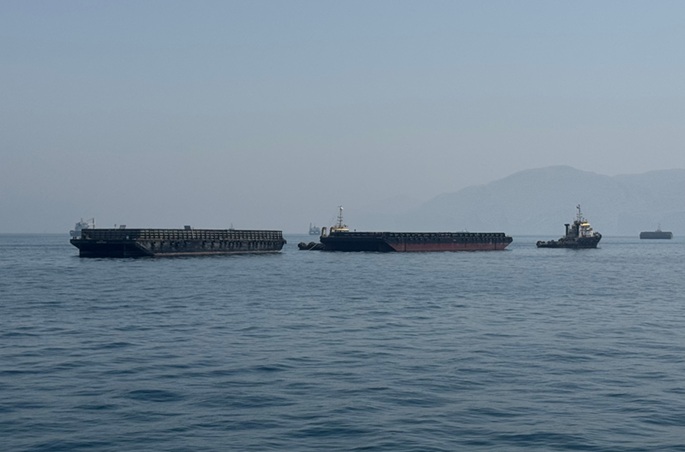
U.S. forces launched a new wave of strikes against Iran on Sunday evening for the ninth consecutive night, according to the U.S. Central Command, reported Xinhua.
The latest strikes began at 7 p.m. ET (2300 GMT) on Sunday, the command said on X.
"The strikes will continue degrading Iranian military capabilities used to attack commercial vessels and civilian mariners transiting the Strait of Hormuz," it said.
As of Sunday, the U.S. military had redirected six commercial vessels and disabled another to ensure compliance as the United States continued to enforce the naval blockade of Iran, the command said.
Meanwhile, a U.S. service member was killed in action in northern Iraq during a controlled detonation of unexploded ordnance from a downed Iranian one-way attack drone on Saturday, the U.S. Central Command (CENTCOM) said on Sunday, reported Xinhua.
A second service member was wounded and continues to receive medical treatment for a minor injury, CENTCOM said on X.
Separately, U.S. military personnel found unidentified remains on Sunday after CENTCOM announced on Saturday the deaths of two U.S. service members and the missing status of one in Jordan following an Iranian attack on Friday.
An examination process to verify the remains is ongoing, CENTCOM said.
In its latest post on X, CENTCOM said that as of Sunday, it had redirected six commercial vessels and disabled one as U.S. forces continue implementing the naval blockade against Iran.
Meanwhile, Jordan, Kuwait and Bahrain reported fresh Iranian attacks on Sunday as renewed U.S.-Iran hostilities spilled into neighboring countries, prompting calls for de-escalation across the Middle East.
Jordan's air defenses intercepted three missiles launched from Iran toward Jordanian territory, while a fourth fell in a remote area in southern Jordan without causing casualties or material damage, state broadcaster Jordan Radio and Television Corporation said on X.
Media reports said the missiles were aimed at U.S. military aircraft stationed in the southern Jordanian coastal city of Aqaba, which directly borders the Israeli city of Eilat.
Following the incident, Israel's Channel 13 News reported that the U.S. military evacuated refueling aircraft from Ramon Airport in southern Israel, about 18 km north of Eilat, after the missile launches toward Jordan.
Israel's state-run Kan TV News said commercial passenger flights at the airport were delayed following the incident.
Earlier in the day, the U.S. Embassy in Amman issued a security alert saying Aqaba's airport and seaport had been evacuated because of a "specific and credible threat," urging Americans to avoid the sites until further notice.
Jordanian authorities later rejected the embassy's claim, saying both facilities were operating normally.
Also on Sunday, Kuwait's Armed Forces said air defenses intercepted hostile ballistic missiles and drones over the country, while another attack struck a power generation and water desalination facility, causing fires and extensive damage.
In a statement posted on X, the Kuwaiti Army said the incoming missiles and drones had been detected and engaged since dawn. It did not specify how many projectiles were involved.
The military accused Iran of continuing to target civilian and vital infrastructure, saying facilities operated by the Ministry of Electricity, Water and Renewable Energy had been hit.
Bahraini authorities also said the country's air defenses intercepted several Iranian aerial attacks.
The expanding hostilities raised fresh concerns across the region and prompted renewed calls for restraint.
Arab League Secretary-General Nabil Fahmy warned of the serious consequences of the ongoing escalation in the region, urging efforts to avoid a renewed cycle of violence.
In a statement, Fahmy called on the United States and Iran to immediately work to de-escalate tensions, noting that continued escalation would only bring further losses to all sides.
He warned of the risk that the situation could spiral out of control, leading to mutual destruction and worsening economic conditions in the region and beyond.
Jordan's Deputy Prime Minister and Minister of Foreign Affairs and Expatriates Ayman Safadi held separate phone talks with his Turkish and Kuwaiti counterparts on the regional escalation and efforts to restore stability.
During his call with Turkish Foreign Minister Hakan Fidan, Safadi stressed the need to end the escalation, implement the U.S.-Iran ceasefire agreement and return to negotiations to reach a comprehensive solution addressing the root causes of tensions, according to a foreign ministry statement.
In his call with Kuwaiti Foreign Minister Sheikh Jarrah Jaber Al-Ahmad Al-Sabah, Safadi expressed Jordan's solidarity with Kuwait and other Gulf Cooperation Council countries in the face of Iranian attacks.
The two sides stressed the importance of dialogue and diplomacy to end the crisis, restore calm and achieve lasting security and stability.
The latest developments came amid heightened tensions in the Middle East as the United States and Iran have traded rounds of attacks. The United States has conducted eight waves of strikes on Iranian targets, while Iran has responded by striking U.S. bases and facilities in several regional countries.
Iran says hit LPG ship seeking to cross Hormuz
EU, China agree to keep bilateral trade ties stable, hold next meeting in March
3 Saudis killed in attacks on Riyadh's King Khalid Int'l Airport
Powerful quake rattles Panama as authorities mobilize response
Trump hails Russia deal to supply diesel amid Zelenskyy’s criticism
US sanctions Int´l Criminal Court

Editor-in-Chief Ofiul Hasnat
Published by Finnish News Network (FNN)
Heporinne 4 B 45
01200 Vantaa, Finland.
E-mails : [email protected]