
2 US troops killed in Jordan in Iranian attacks, US strikes kill 3 in Iran
US-Iran tensions escalate with renewed strikes
Published : 18 Jul 2026, 23:51
U.S. Central Command (CENTCOM) said on Saturday that two U.S. service members in Jordan were killed in Iranian attacks on Friday, reported Xinhua.
"On July 17, two U.S. service members in Jordan were killed in action as U.S. Central Command and partner forces defended against Iranian ballistic missile and drone attacks," the command said in a statement posted on social media platform X, adding that one service member remains missing in action.
CENTCOM said four American service members were medically evacuated to Jordanian hospitals. They have since been discharged, while other personnel treated for minor injuries have returned to duty.
According to data released on Friday by the Defense Casualty Analysis System, a website affiliated with the U.S. Department of Defense, as of July 17, a total of 14 U.S. service members had died and 427 had been injured in military operations against Iran.
Meanwhile, at least three people were killed and eight wounded in overnight strikes by the United States on Iran's southern Hormozgan province, the semi-official Fars news agency reported on Saturday.
Fars cited provincial authorities as saying the Shahid Mirzaei tunnel on the road from the port city of Bandar Abbas to Hajiabad County, and three bridges in the province were struck and blocked.
Power generation installations and water desalination pumps in Bunji village in Jask County were also targeted by U.S. missiles, disrupting potable water and electricity supplies to several villages west of the county, the report said.
Fars reported several other explosions in Hormozgan's other counties as well as the southern provinces of Khuzestan, Fars and Bushehr and the central province of Yazd.
U.S. Central Command said in a post on social media platform X early Saturday Tehran time that its forces had carried out strikes against Iran during the preceding hours, hitting surveillance sites, military logistics infrastructure, underground weapons storage, and maritime capabilities.
"U.S. forces employed fighter aircraft, aerial drones, and warships in addition to other assets," the post said.
US bases in Kuwait, Bahrain, Jordan hit in strikes
The Iranian armed forces announced on Saturday that they had hit U.S. bases in Kuwait, Bahrain and Jordan in waves of retaliatory missile and drone attacks launched earlier in the day.
The Islamic Revolution Guard Corps (IRGC) pointed to the recent U.S. "destructive" attacks against Iranian civilian infrastructure, which resulted in civilian casualties, and warned countries in West Asia hosting U.S. military bases that they would face retaliation.
The IRGC said Saturday that its ground forces targeted the U.S. military support center at Camp Arifjan in Kuwait, killing several U.S. personnel. It also targeted the Ali Al Salem Air Base in Kuwait with drones, destroying a radar, a weapons depot and a hangar of drones.
The IRGC added that its naval forces on Saturday struck a U.S. Navy fuel support pier at Al Ahmadi port and a signal and communications center in Kuwait.
In a separate statement, Iran's army said that it has also hit U.S. headquarters buildings and ammunition depots at Ali Al Salem Air Base, as well as an ammunition depot at Al-Adiri Camp, and several bridges in Kuwait.
In Bahrain, the IRGC said Saturday that it targeted a combat aircraft site at Shaikh Isa Air Base and destroyed a U.S. data center, and struck an aircraft hangar, fuel storage facilities and several bridges.
The IRGC also targeted U.S. fuel depots at the al-Azraq base in Jordan, adding that its naval forces on Friday fired cruise missiles at a "hostile" U.S. vessel north of the Indian Ocean, forcing it to retreat.
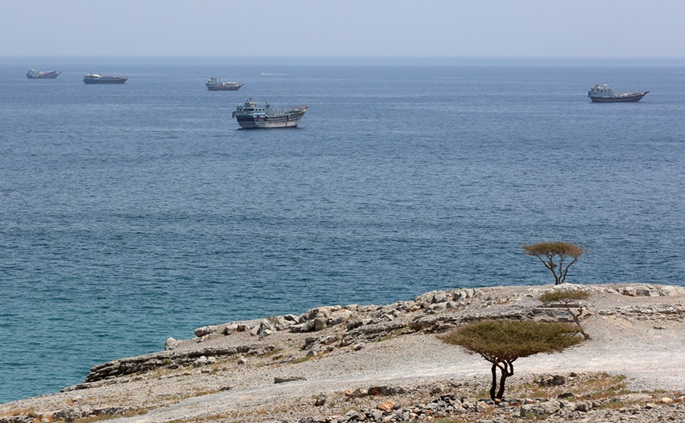
In a statement released early Saturday, the IRGC said two oil tankers attempting to cross the Strait of Hormuz via the mined southern route suffered explosions and caught fire, adding they had been misled by U.S. intelligence agencies.
The IRGC said that the strait remained closed and warned that oil, gas and chemical fertilizer exports would not resume while U.S. attacks continued.
The U.S. Central Command said earlier that its forces had carried out strikes against Iran during the preceding hours, hitting surveillance sites, military logistics infrastructure, underground weapons storage facilities, and maritime capabilities.
US-Iran tensions escalate with renewed strikes
Iran launched renewed attacks on U.S. Gulf allies on Saturday after the U.S. CENTCOM concluded a new round of strikes on Iran overnight.
Iran's semi-official Mehr news agency said that explosions were reported in Bushehr province as well as Hormozgan province's Sirik and Qeshm counties, and the official IRNA news agency said five blasts were heard in Iran's central Yazd province, said Xinhua.
Late on Friday, the U.S. CENTCOM said in a post on social media platform X that U.S. forces ended the seventh consecutive night of strikes against Iran, hitting surveillance sites, military logistics infrastructure, underground weapons storage, and maritime capabilities.
"More than 50,000 American service members are operating across the Middle East and remain vigilant, lethal, and ready," said the statement.
Iran's Islamic Revolutionary Guard Corps said Saturday that it targeted the U.S. naval fuel support pier at Al Ahmadi Port in Kuwait, as well as the U.S. combat aircraft site at Sheikh Isa Air Base in Bahrain.
Jordan's air defense systems downed Iranian missiles, Bahrain intercepted several Iranian aerial attacks, and Kuwait said a fire broke out at a power and water desalination plant after an Iranian attack, according to local media reports on Saturday.
The Guard also said that countries hosting U.S. forces should expect "corresponding responses" if their territory is used for attacks on Iran, according to Iran's semi-official Tasnim news agency.
Iranian Foreign Ministry spokesman Esmail Baghaei wrote on X late on Friday that the Iranian people "are now more determined and united than ever," and fully resolved to make their enemies "bitterly regret this criminal aggression."
Mohsen Rezaei, military adviser to Iran's Supreme Leader Mojtaba Khamenei, warned on Friday that if the United States continues the war against Iran for another two to three days, the country will enter an "offensive and destructive" phase.
He said in an interview with state-run IRIB TV that the policy of "both war and negotiation" has ended, adding that if U.S. attacks continue, Iran's armed forces will no longer limit themselves to retaliatory strikes, and U.S. bases and forces will no longer be safe within any political borders.
Rezaei said Iran has so far exercised restraint to prevent the war from expanding into a broader regional and international crisis, accusing the United States of miscalculating by turning the war into a regional one.
He warned that Iran could deploy additional military capabilities, including ground forces, and the war's scope will expand.
Khamenei says violation of peace MoU proves Trump's signature worthless
Iranian Supreme Leader Mojtaba Khamenei said on Saturday that the U.S. violation of a recently signed peace memorandum of understanding (MoU) with Iran once again proved that U.S. President Donald Trump's signature is worthless and invalid, according to Iranian media.
He made the remarks in a message to the Iranian people carried by Iranian media, in which he addressed the country's important issues.
Khamenei said the frequent U.S. violations of the MoU, which was signed by Iran's President Masoud Pezeshkian and Trump on June 18, "once again proved to everyone the fact that how worthless and invalid the U.S. president's signature is."
The United States had "once again revealed its true and unmasked face," he said, noting that "this dark experience of crime and breach of promises is another solid proof of the U.S. lying and its illogical, unreliable, and evil nature."
Khamenei warned that if the United States continued what he described as warmongering and sought to impose heavier costs, it should expect "unforgettable lessons" from Iran and the resistance front.
The remarks came amid heightened regional tensions despite the MoU, under which the United States and Iran were expected to hold negotiations within 60 days toward a final agreement.
The United States has conducted multiple rounds of strikes against Iran in recent days, while Iran has responded by launching retaliatory attacks on U.S. bases and facilities in the region.
Earlier on Saturday, Iranian Deputy Foreign Minister for Legal and International Affairs Kazem Gharibabadi said Iran has ceased fulfilling its obligations under the MoU with the United States, accusing Washington of violating its commitments under the deal.
Iran says another oil tanker caught fire east of Hormuz Strait
Strikes hit Yemen's Aden airport; Saudi-led coalition intercepts drones, missiles
Mauritius proposes law amendment to allow nationwide curfew
Trump’s green card crackdown could drive tech talent out of US: Microsoft President
Katie Zacharia out as WH press secretary just 5 days after appointment
Death toll from Tropical Storm Rachel rises to 8 in northwestern Mexico

Editor-in-Chief Ofiul Hasnat
Published by Finnish News Network (FNN)
Heporinne 4 B 45
01200 Vantaa, Finland.
E-mails : [email protected]