
US resumes port blockade
Several killed in US strikes, Iran attacks on US bases
Published : 14 Jul 2026, 01:16
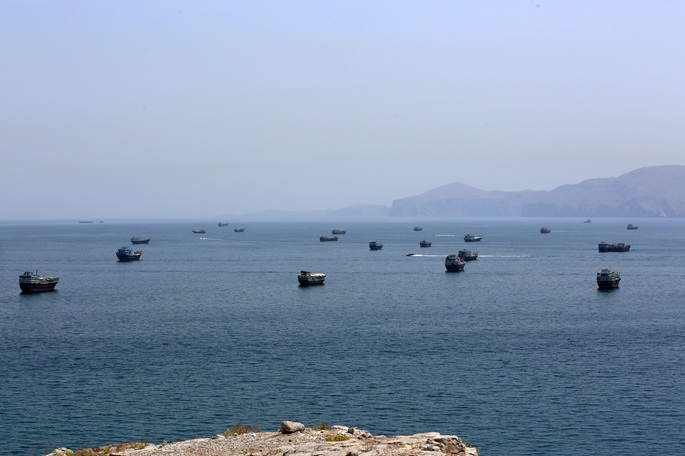
The U.S. Central Command (CENTCOM) will resume blockading maritime traffic entering and exiting Iranian ports on Tuesday, the command said Monday, reported Xinhua.
"The resumption of the U.S. blockade against Iran follows the initial implementation from April 13 to June 18," CENTCOM said in a post on X. "CENTCOM forces redirected more than 140 compliant vessels, disabled nine non-compliant ships, and allowed over 50 commercial vessels supporting humanitarian aid to pass through the blockade during the two-month period."
Earlier Monday, U.S. President Donald Trump said on social media that the United States was reinstating a naval blockade on Iran in the Strait of Hormuz and would impose a 20 percent toll on all cargo shipped through the strategic waterway.
Trump formally notified Congress on Friday that the United States had resumed military operations against Iran, U.S. media reported Monday.
Meanwhile, several people have been killed in a fresh round of U.S. strikes targeting different areas in Iran, Iranian media reported on Monday, citing local officials.
At least two were killed and three others wounded in a U.S. strike on the southwestern Abadan County, Khuzestan province, on Monday afternoon, the semi-official Fars news agency reported.
Three locations in the county were hit by U.S. projectiles at 13:45 local time (1015 GMT), Valiollah Hayati, Khuzestan's deputy governor for security and law enforcement affairs, was quoted as saying.
Earlier in the day, Hayati said at least one person was killed and four others were wounded in an overnight U.S. strike on Bandar-e Mahshahr County in Khuzestan, as a U.S. projectile struck an agriculture water pumping station, the official news agency IRNA reported. The victim has been identified as the facility's guard.
Meanwhile, IRNA cited Akbar Salehi, Isfahan province's deputy governor for security affairs, as saying that an overnight U.S. attack killed at least one person and left seven others wounded in the province.
The attack, carried out in the wee hours of Monday, targeted a military center in the Nain County, the official said.
The semi-official Mehr news agency, citing local sources, reported that explosions were also heard at noon on Monday around the port city of Bandar Abbas and Qeshm Island in Iran's southern province of Hormozgan.
The United States has launched a series of strikes on Iran in the past week, citing Tehran's attacks on ships seeking to transit the Strait of Hormuz using a U.S.-backed Omani route. Iran responded by targeting U.S. military bases in neighboring countries.
Iran conducts retaliatory raids on U.S. bases in Gulf states
Iranian armed forces said they made missile and drone strikes against U.S. bases in Jordan, Bahrain, Kuwait and Oman early Monday, in retaliation for fresh U.S. attacks on southern Iran.
Iran's Islamic Revolution Guard Corps (IRGC) said the U.S. army on Sunday night once again raided Iranian coastal army bases "in an act of aggression" after the IRGC stopped two "violating" ships in the Strait of Hormuz, according to IRGC statements published on its official news outlet Sepah News.
In response to the U.S. strikes, it said, Iranian forces hit and set on fire several large missile silos and fuel storage tanks at the Prince Hassan Air Base in Jordan in a missile and drone attack, and struck the Shaikh Isa Air Base in Bahrain, destroying the U.S. command and control center, helicopter overhaul and maintenance centers and a Boeing P-8 Poseidon aircraft hangar at the base.
According to the IRGC, its forces also struck fuel storage facilities and a Patriot air defense system belonging to the United States at the Ali Al Salem Air Base in Kuwait, as well as a U.S. solid-state phased-array radar system at the Ahmad al-Jaber Air Base in the same Arab state.
It said they also targeted a U.S. army base, home to surface-to-surface missiles in Kuwait, and demolished two M142 high mobility artillery rocket systems as well as missile silos there.
The IRGC said it also hit the U.S. army's facilities and infrastructure at the Juffair base in Bahrain, as well as an FPS radar system and a vessel detection radar in Oman.
It said the sole way to open the Strait of Hormuz for passage by vessels is to end the "aggressive" U.S. army interventions in the waterway and respect coastal countries' sovereignty.
In addition, the Iranian army said in a statement that its forces targeted a U.S. army center in Kuwait in a drone attack early Monday.
The army said its air defense on Monday intercepted a LUCAS drone belonging to the "enemy" over Iran's southern port city of Bandar Abbas.
U.S. Central Command has said that its forces completed a new wave of offensive strikes against Iran, hitting targets at multiple locations with precision weapons to degrade Iran's ability to attack international shipping through the Strait of Hormuz.
It listed the targets as Iranian military air-defense systems, coastal radar sites, missile and drone capabilities, and small boats.
Meanwhile, on Monday, Iran's foreign ministry strongly condemned the U.S. "aggressive" attacks against the country in the past 24 hours, stressing that the attacks are in "flagrant violation" of the fundamental principles of the UN Charter and pose serious threats to international peace and security.
It also denounced the U.S. "clear interference" in Iran's enforcement of necessary arrangements in the Strait of Hormuz, saying that such interference has made the waterway insecure and disrupted international shipping.
In a phone interview with Fox News on Monday, U.S. President Donald Trump said that his country would "keep the strait" and "probably run it." He also threatened further military strikes against Iran, accusing Tehran of violating the ceasefire agreement.
In response, a spokesman for Iran's Khatam al-Anbiya Central Headquarters said Tehran would not allow Washington to interfere in the management of the strait, warning Gulf countries that any cooperation with the United States would be considered "an act of war."
On Feb. 28, the United States and Israel launched military strikes on Iran. In response, Iran tightened its grip on the Strait of Hormuz and barred passage of vessels belonging to or affiliated with Israel and the United States.
In mid-June, Iran and the United States signed a memorandum of understanding aimed at ending the war on all fronts, including Lebanon. However, the two sides have traded fresh attacks since then.
Iran says hit LPG ship seeking to cross Hormuz
EU, China agree to keep bilateral trade ties stable, hold next meeting in March
3 Saudis killed in attacks on Riyadh's King Khalid Int'l Airport
Powerful quake rattles Panama as authorities mobilize response
Trump hails Russia deal to supply diesel amid Zelenskyy’s criticism
US sanctions on ICC draw criticism from UN, member states

Editor-in-Chief Ofiul Hasnat
Published by Finnish News Network (FNN)
Heporinne 4 B 45
01200 Vantaa, Finland.
E-mails : [email protected]