
US for war money from Arab
Trump threatens Iran to reach deal, Iran rejects ´unrealistic´ truce plan
Published : 31 Mar 2026, 01:35
Updated : 31 Mar 2026, 01:52
U.S. President Donald Trump threatened on Monday to "completely obliterate" all of Iran's electric generating plants, oil wells, and Kharg Island if a deal is not reached shortly, reported Xinhua.
In a post on Truth Social, he also said that the United States is in serious discussions with Iran to end military operations there.
Sunday marks the one-month milestone in the U.S.-Israeli war with Iran. Despite earlier reports of potential U.S.-Iran talks to end hostilities, no substantive progress has emerged. Continued strikes and military reinforcement in the Middle East are further dampening hope for a swift de-escalation.
Meanwhile, Iranian Foreign Ministry spokesman Esmaeil Baghaei said on Monday the recent truce plan proposed by the United States contains "very excessive, unrealistic and unreasonable" demands.
He made the remarks at a weekly press conference in Tehran while elaborating on the U.S.-proposed 15-point plan delivered to Iran via intermediaries to end the ongoing conflict in the Middle East.
Unlike the United States, "which constantly changes its positions, and whose officials make and demonstrate contradictory remarks and behaviors," Iran's stance towards relevant issues has been completely clear from the beginning, Baghaei said.
He added, "We know very well what our desired framework is. As I mentioned earlier, the materials that have been conveyed to us under various titles such as the '15-point plan' mainly include very excessive, unrealistic, and unreasonable demands."
Baghaei stressed that "up to this moment, we have had no direct negotiation with the United States." He noted that since the last round of negotiations with the United States in Geneva on Feb. 26, Iran has received messages through certain intermediaries, including Pakistan, which contained the U.S. willingness and request for negotiations.
Iran has not participated in meetings held by Pakistan with the participation of neighboring states, he said.
Iran will announce its conclusion about the plan through an appropriate way in due course, Baghaei added.
Meanwhile, Iran's President Masoud Pezeshkian said Monday that any decision to end the war will be based solely on preconditions that protect the nation's dignity, security, and interests.
Speaking at a cabinet meeting, Pezeshkian addressed the country's "sensitive" circumstances amid U.S. and Israeli attacks, emphasizing that maintaining consistent and effective public services is a key pillar of national stability until ultimate victory is achieved, according to a statement from his office.
He praised the Iranian armed forces for their bravery in defending the country and safeguarding its territorial integrity and sovereignty.
In recent days, U.S. President Donald Trump claimed that Iran is negotiating with the United States and seeking a deal to end the war.
On Wednesday, Iranian Foreign Minister Seyed Abbas Araghchi said that messages were exchanged between Iran and the United States through intermediaries over the past few days, but no negotiations have taken place.
Meanwhile, White House Press Secretary Karoline Leavitt said on Monday that Trump "would be quite interested" in calling on Arab countries to help pay for the costs related to the ongoing U.S.-Israeli war against Iran.
"I won't get ahead of him (Trump) on that," Leavitt said at a White House press briefing. "But certainly it's an idea that I know that he has and something that I think you'll hear more from him on."
Pentagon officials told the U.S. Congress earlier this month that the Trump administration spent more than 11.3 billion U.S. dollars in the first six days of its war against Iran.
The figure does not include battle damage and replacement of losses, which likely costs the Pentagon roughly 1.4 billion dollars to 2.9 billion dollars over the first three weeks of the war, according to a Wall Street Journal report, quoting Elaine McCusker, former Pentagon budget official who has been tracking the cost for the American Enterprise Institute.
Israel's Haifa oil refinery hit by rocket from Lebanon
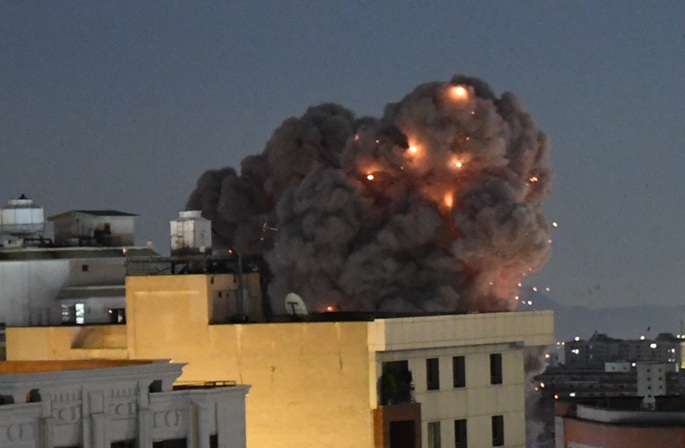
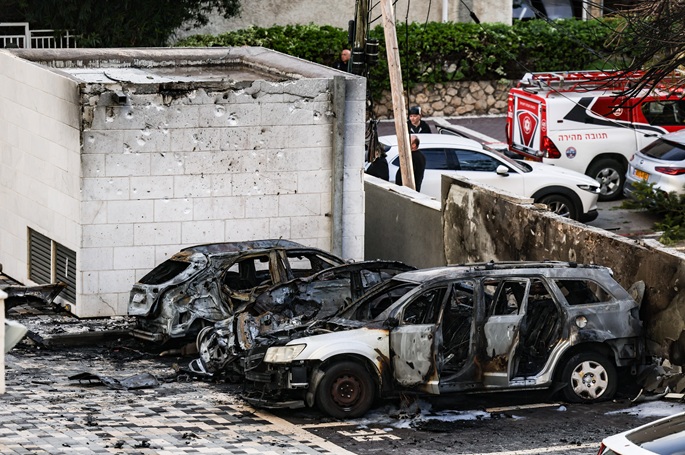
An oil refinery in the northern Israeli city of Haifa was struck by a rocket fired by Hezbollah in Lebanon on Monday, Israeli authorities and media said, reported Xinhua.
A fire broke out and a large plume of black smoke was seen rising above a structure following the strike.
The Fire and Rescue Services said that there was no leakage of hazardous materials.
Israel's state-owned Kan TV news reported that the rocket hit an oil tanker and an industrial structure.
The military confirmed that a barrage of about 10 rockets was fired by Hezbollah before noon, activating sirens in the Haifa area as well as some regions along the coast of central Israel.
Hits and damage were also reported in Shfaram in the Galilee and Kiryat Ata near Haifa, where the attack caused temporary power cuts.
It was the second direct hit on the oil refinery complex during the ongoing monthlong Middle East conflict. On March 19, a missile from Iran struck the complex, causing damage.
Iranian aircraft hit in US strike at Mashhad airport
An aircraft belonging to Mahan Air was reportedly struck during a United States airstrike at Mashhad Airport in Iran, disrupting a planned humanitarian mission to India, according to Iranian sources, reported ANI.
The aircraft, stationed at Mashhad International Airport, was scheduled to fly to New Delhi as part of a humanitarian aid operation. "Mahan Air aircraft was hit by the US in an airstrike at Mashhad Airport. The plane was reportedly scheduled to fly to Delhi for humanitarian aid," Iran sources said.
According to reports, the aircraft was expected to arrive in New Delhi in the coming days to facilitate the transport of humanitarian supplies, including medicines. The disruption has raised fresh concerns over the safety of civilian and aid-linked aviation operations in the region amid escalating geopolitical tensions.
The incident comes at a time when Iran has been coordinating humanitarian shipments with India. Earlier this month, India dispatched aid consignments to Iran, underlining what New Delhi described as long-standing civilisational and humanitarian ties between the two countries.
While there has been no immediate official confirmation from the United States regarding the reported strike, the development is likely to further strain already tense relations between Washington and Tehran. The two nations have had a long history of friction, particularly over Iran's regional activities and military capabilities.
Mahan Air, one of Iran's largest private carriers, has frequently been at the centre of international scrutiny. The airline has been under US sanctions for years, with Washington alleging links to Iran's Islamic Revolutionary Guard Corps (IRGC) and accusing it of transporting personnel and equipment linked to regional conflicts.
Past incidents involving the airline have also drawn global attention. In previous years, tensions between US forces and Iranian aviation have led to aerial encounters, further highlighting the risks faced by civilian aircraft operating in conflict-prone airspaces.
The reported strike at Mashhad adds to a series of incidents targeting aviation infrastructure in Iran during ongoing regional hostilities. Earlier conflicts have also seen damage to aircraft at Iranian airports, raising alarm over the vulnerability of civilian aviation assets in such environments.
As details continue to emerge, the situation remains fluid, with the potential for diplomatic fallout and broader implications for humanitarian logistics and regional stability.
1 killed, 17 wounded in Israeli airstrike in Beirut
An Israeli airstrike Monday on the Rihab area in Beirut's southern suburbs killed one person and wounded 17 others, according to Lebanon's Health Ministry, reported Xinhua.
In a statement, the ministry said the wounded included 10 Lebanese and six Syrians, among them four children, as well as a woman of Kenyan nationality.
Israel carried out two airstrikes on Beirut's southern suburbs on Monday, after issuing warnings urging residents to evacuate the area.
Cross-border fighting has continued along the Lebanon-Israel border since March 2, when Hezbollah launched rockets toward Israel for the first time since a ceasefire took effect on Nov. 27, 2024, triggering intensified Israeli airstrikes across southern and eastern Lebanon.
NATO intercepts Iranian ballistic missile over Turkish airspace
A ballistic missile launched from Iran was intercepted by NATO air and missile defense systems in the eastern Mediterranean after entering Turkish airspace on Monday, Türkiye's Defense Ministry said. It was the fourth such interception, the ministry said.
In a statement posted on social media, the ministry said "necessary measures are being taken decisively" to protect the country's territory and airspace, adding that developments in the region were being closely monitored.
The interception follows similar incidents earlier this month amid heightened regional tensions. Iran's new supreme leader, Mojtaba Khamenei, said previously that attacks on Türkiye and Oman were not carried out by Iranian armed forces or the "resistance front," and blamed Israeli deception.
Iran's parliament starts process to adopt plan on Hormuz management
Iran's parliament has kicked off a process to approve a plan to exercise smart management over the Strait of Hormuz, the semi-official Tasnim news agency reported Monday, said Xinhua.
Abbas Goudarzi, spokesman for the Iranian parliament's presiding board, said the new plan has been added to the legislature's agenda after gathering over 250 signatures from the members of parliament (MPs). Parliament has 290 seats in total.
He said the plan aims to enhance the waterway's security and collect tolls from vessels in the local currency, the rial.
On Sunday, senior MP Alireza Salimi said the double-urgency plan has four main objectives: ensuring shipping security, charging environmental polluters, collecting fees for guidance services, and establishing a regional development fund.
The development came with Iran's tight control over the Strait of Hormuz, where it has, since late last month, barred passage for vessels linked to Israel, the United States and their allies.
Iran criticizes Europe for silence over attacks on Iranian people
Iranian Foreign Minister Seyed Abbas Araghchi on Monday accused some European countries of remaining silent about "brutal attacks against the Iranian people" while focusing only on the conflict's economic impact.
Araghchi spoke by phone with French Foreign Minister Jean-Noel Barrot to discuss the fallout from recent U.S.-Israeli strikes on Iran and rising regional tensions, according to a statement from Iran's Foreign Ministry.
He warned that Iran would continue defensive operations, including strikes on U.S. and Israeli military bases in regional countries, and cautioned that any provocative moves in the Strait of Hormuz, including at the United Nations, could escalate the crisis further.
Barrot reaffirmed France's opposition to attacks on civilian targets and called for stronger diplomatic efforts to end the war and restore regional stability, also expressing concern over tensions across West Asia, including in Lebanon, according to the Iranian statement.
The ministers also discussed bilateral consular matters and agreed to continue diplomatic engagement.
Iran executes 2 over "terrorist" acts
Iran on Monday executed two members of the Mujahedin-e Khalq Organization (MKO), designated by Iran as a terrorist group, for committing "multiple terror acts" in Tehran, Iran's official media reported.
The MKO members, identified as Akbar Daneshvarkar and Mohammad Taqavi Sangdehi, were hanged after the Supreme Court of Iran upheld their death sentences, according to the Mizan news agency, affiliated with Iran's judiciary.
During the deadly "riots" in Iran in January, the MKO contacted the two convicts, plotting to confront Iran's security forces, the report said.
According to Mizan, Sangdehi was involved in identifying Iran's sensitive locations and plotting operations against various centers and institutions.
Daneshvarkar had also taken part in recent "riots," devising tactics against Iran's military and law enforcement forces, the report said.
Iran accuses the MKO of having assassinated tens of thousands of Iranian citizens.
U.S.-Israel-Iran war in numbers
It has been over a month since the United States and Israel launched military strikes on Iran. During this period, the conflict has spread across multiple countries, with its effects reverberating far beyond the immediate battlefield, said Xinhua.
Here are some key figures:
MORE THAN 10 COUNTRIES IMPACTED
On Feb. 28, the United States and Israel launched large-scale military operations against Iran. Iran responded with strikes on Israeli targets and U.S. bases across the region. The fighting has directly affected more than 10 countries, including Lebanon, Yemen, the United Arab Emirates, Qatar, Saudi Arabia, Kuwait, Jordan, Bahrain, Oman, and Iraq.
Analysts warn that if the conflict drags on, more countries, including in Europe and Ukraine, could be drawn in.
OVER 24,000 CASUALTIES IN IRAN
Iranian officials said U.S.-Israeli attacks have killed at least 1,750 people and wounded 22,800 in Iran, damaged more than 81,000 civilian facilities, and displaced about 3.5 million people.
On Friday, Foreign Minister Seyed Abbas Araghchi said more than 600 schools were damaged, and over 1,000 teachers and students were killed or injured. On Saturday, the Health Ministry said the attacks had killed more than 230 children and injured about 1,800 others.
MORE THAN 10,000 IRANIAN SITES TARGETED
Meanwhile, the United States said its forces had struck more than 10,000 Iranian military sites, while Israel's military said it had hit over 3,000 Iran-related targets.
NEARLY 90 WAVES OF IRANIAN RETALIATION
Iran said on Monday that it had carried out 87 waves of attacks against U.S. and Israeli targets under its "True Promise 4" operation.
AT LEAST 13 U.S. SOLDIERS KILLED, 17 REGIONAL BASES HIT
U.S. media reported 13 American service members killed in operations against Iran. A U.S. Central Command spokesperson said on March 16 that more than 200 troops were injured in seven Middle Eastern countries since the start of the U.S.-Israeli attacks, including 10 severely wounded.
The New York Times reported earlier this month that at least 17 U.S. bases and facilities were damaged in Iranian counterattacks.
AT LEAST 20 DEAD, OVER 5,000 INJURED IN ISRAEL
According to Israel's Ministry of Health and emergency services, Iranian attacks have killed at least 20 people in Israel and injured over 5,000 as of Saturday.
MORE THAN 50,000 U.S. TROOPERS IN REGION
The United States has been sending military reinforcements to the Middle East. According to U.S. media, once all reinforcements arrive, American forces in the Middle East will number around 50,000.
95% DROP IN STRAIT OF HORMUZ TRAFFIC
Data from trade intelligence firm Kpler shows that between March 1 and March 23, only 144 commercial vessels passed through the Strait of Hormuz, a 95 percent drop compared with pre-conflict levels.
Israel passes controversial death penalty bill targeting West Bank Palestinians
2 UN peacekeepers killed, 2 wounded in explosion in Lebanese
74 killed in attack at South Sudan gold mine
Trump could effectively lose presidency in attrition war with Iran: Ex WH war advisor
Indonesia confirms peacekeeper killed in Lebanon
Sachs takes dig at Witkoff, Kushner, says 'Gangsters' are running US politics

Editor-in-Chief Ofiul Hasnat
Published by Finnish News Network (FNN)
Heporinne 4 B 45
01200 Vantaa, Finland.
E-mails : [email protected]
To Editor: [email protected]