
Trump claims major points of deal with Iran, Tehran denies contact
Published : 23 Mar 2026, 23:53
Updated : 24 Mar 2026, 00:42
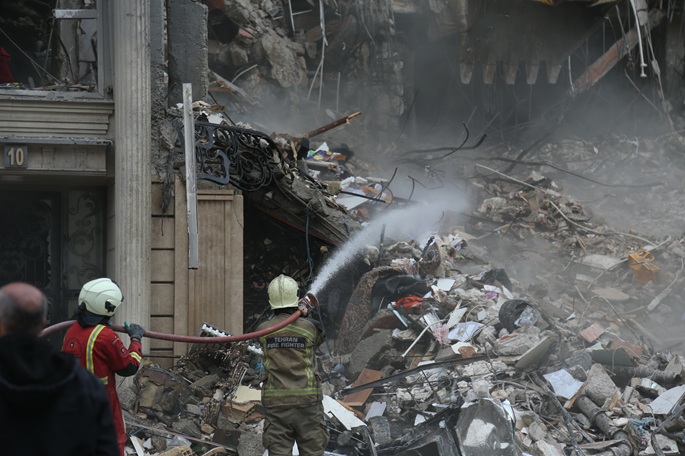
US President Donald Trump said Monday that Washington had reached "major points of agreement" with Iran and was in contact with "a top person," even as Tehran denied any direct or indirect communication with the United States, reported Xinhua.
Trump told reporters the two sides were "going to get together" by phone later and warned it would "keep bombing" if negotiations fail.
Earlier in the day, Trump said he has ordered a five-day delay of planned strikes on Iranian power plants and energy facilities, citing what he described as "very good and productive conversations" over the past two days aimed at easing tensions in the Middle East.
Iran, however, rejected the claim. The semi-official Fars news agency reported that there had been no direct or indirect contact with Trump, while the foreign ministry said his remarks were "part of efforts to reduce energy prices and buy time" for military plans.
The semi-official Tasnim news agency, citing a senior security official, said Washington stepped back from attacking critical infrastructure after Iran's military threats became credible.
The conflicting accounts followed Trump's recent shift in tone. Days earlier, he said there was "nobody to talk to" after weeks of U.S.-Israeli strikes that he said had decimated Iran's leadership.
On Saturday, he issued a 48-hour ultimatum demanding Iran reopen the Strait of Hormuz, warning of sweeping strikes, while Tehran signalled it would retaliate across the region if attacked.
Meanwhile, Israeli Prime Minister Benjamin Netanyahu said on Monday that Israel will leverage its attacks on Iran to ensure any potential diplomatic agreement protects its "vital interests."
Following a phone call with U.S. President Donald Trump, Netanyahu issued a video statement, saying Trump believes there is an opportunity to "leverage the tremendous achievements" of the joint U.S.-Israeli attack on Iran in order to "realize the objectives of the war through an agreement."
"We will safeguard our vital interests in any situation," he said.
However, Netanyahu emphasized that Israeli military strikes against Iran and Hezbollah in Lebanon are continuing simultaneously. Shortly after Trump announced that negotiations were underway to end the regional conflict, the Israeli military said in a statement that it launched a new series of airstrikes on Tehran. It also blew another bridge on Monday over the Litani River in southern Lebanon, claiming that Hezbollah used it to transport weapons and its members.
"We are crushing the missile and nuclear programs, and we continue to strike Hezbollah hard," Netanyahu said, adding that two more Iranian nuclear scientists were recently killed.
The comments followed Trump's announcement that Washington and Tehran were in contact to end the war. He added that planned U.S. strikes on Iranian power infrastructure would be delayed for five days following "productive conversations" with Tehran. Iran denies any talks with the United States, calling them "meaningless."
Pentagon weighs deploying airborne troops into Iran
The Pentagon is weighing a possible deployment of airborne troops to support military operations in Iran, The New York Times reported Monday, citing senior defense officials, said Xinhua.
The combat forces would come from the U.S. Army's 82nd Airborne Division's "Immediate Response Force," a brigade of about 3,000 soldiers capable of deploying anywhere in the world within 18 hours, said the report, noting that so far nothing had been ordered by the Pentagon or the U.S. Central Command.
These forces could be used to seize Kharg Island, Iran's main oil export hub, according to the report.
Another option being considered, should U.S. President Donald Trump authorize U.S. troops to seize the island, is an attack by about 2,500 troops from the 31st Marine Expeditionary Unit, which is on its way to the Middle East, said the report, citing officials speaking on condition of anonymity.
The "Immediate Response Force," or ready brigade, has deployed on short notice several times in recent years, said the report.
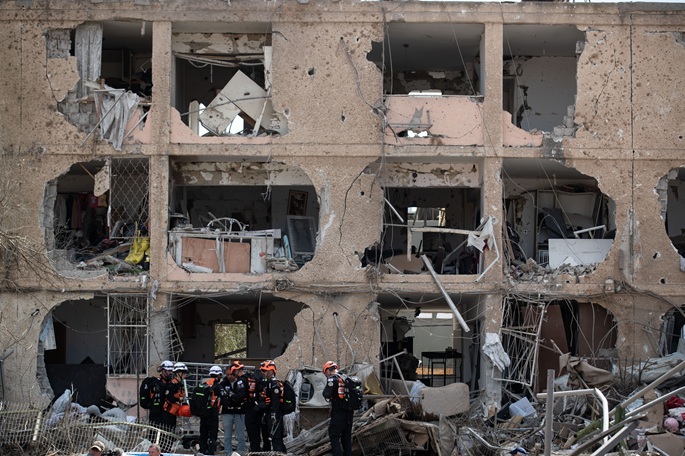
Iran warns to lay naval mines in Gulf
Iran's Defense Council has warned that the country will lay naval mines in the Gulf if the United States and Israel launch any attack on its coasts or islands, the semi-official Fars news agency reported on Monday.
"Any attempt by the enemies to attack Iranian coasts or islands will naturally and based on common military practices cause Iran to lay various types of naval mines, including the floating ones that can be laid from the coasts, in all access routes and communication lines in the Gulf and the coasts," the report said.
The council said that in that case, the entire Gulf would effectively mirror the Strait of Hormuz situation for a long time, and the waterway would be practically blocked, a responsibility to be borne by the threatening party.
The only way for the non-hostile states' vessels to pass through the Strait of Hormuz is through coordination with Iran, it added.
In response to the U.S. threat of attacking Iran's power plants and energy infrastructure in case the Strait of Hormuz is not opened, the council reaffirmed its commitment to immediately give a "decisive and devastating" response to any such strikes.
In response to the U.S. threat to attack Iran's power plants and energy infrastructure if the Strait of Hormuz is not opened, the council reaffirmed its commitment to respond decisively and devastatingly to any such strikes.
Meanwhile, Iranian Foreign Ministry spokesman Esmaeil Baghaei condemned as "false flag storylines" Israel's claim that Iran has targeted the Diego Garcia island in the Indian Ocean with ballistic missiles.
He made the remarks on X, citing North Atlantic Treaty Organization (NATO) Secretary-General Mark Rutte, who said the alliance "cannot confirm Israel's claim that missiles targeting Diego Garcia were Iranian intercontinental ballistic missiles."
"That even the NATO secretary-general declines to endorse Israel's most recent disinformation speaks volumes: the world has grown thoroughly exhausted with these tired and discredited 'false flag' storylines," Baghaei said.
Citing a U.S. official, CNN claimed that Iran launched two intermediate-range ballistic missiles on Friday at Diego Garcia, a joint U.S.-British military base located over 3,000 km off the Iranian coasts, saying the launch "has renewed questions about Tehran's military capabilities and how far its missiles can reach."
On Feb. 28, Israel and the United States launched joint attacks on Tehran and several other Iranian cities, killing Iran's Supreme Leader Ali Khamenei, along with senior military commanders and civilians. Iran responded by launching waves of missile and drone strikes targeting Israel and U.S. bases and assets in the Middle East.
Israeli civilian killed by friendly fire near Lebanon border
An Israeli civilian was killed by Israeli artillery fire near the Israel-Lebanon border on Sunday, not by a Hezbollah rocket as initially reported, the military said on Monday.
Israel initially blamed a Hezbollah rocket attack for the killing.
Initial findings indicate the man, Ofer Moskovitz, was mistakenly hit by artillery fire aimed in support of troops near the border, the military said in a statement.
"The artillery fire was carried out at an incorrect angle and did not follow required protocols. As a result, five artillery shells were fired at the Misgav Am ridge instead of toward the enemy target," it said.
"This is a very severe incident. Ofer Moskovitz was killed by our own forces' fire during an operation whose entire purpose was to protect civilians," Northern Command chief Rafi Milo, who led the inquiry, said.
Moskovitz is the first civilian killed in cross-border fire between Israel and Hezbollah since the war with Iran began on Feb. 28.
Israeli airstrike on apartment in SE Beirut kills 1
One person was killed in an Israeli airstrike on an apartment of a residential building in the Hazmieh area, southeast of Beirut, on Monday afternoon, according to Lebanon's Public Health Ministry and official National News Agency (NNA).
Hazmieh Mayor Jean Asmar, who inspected the site, said the rest of the building's residents are safe, though the strike caused significant material damage.
Meanwhile, Israeli army spokesperson Avichay Adraee said on social media platform X that the Israel Defense Forces attacked a saboteur from the Quds Force unit in Beirut shortly before the airstrike.
Also on Monday, Lebanese media and security source said Israeli warplanes destroyed al-Dalafa Bridge, one of Lebanon's largest bridges, over the Litani River in eastern Lebanon.
Earlier in the day, the NNA reported that Israeli warplanes destroyed the Arzi bridge over the Litani River in southern Lebanon.
Meanwhile, the United Nations Interim Force in Lebanon (UNIFIL) said its headquarters in the southern town of Naqoura came under gunfire and was hit by shrapnel and projectile fragments, forcing peacekeepers to remain in shelters. UNIFIL said it believes the projectile was fired by a non-state actor.
On March 2, Hezbollah said it launched rockets from Lebanon toward Israel, the first such attack since a ceasefire was declared on Nov. 27, 2024. Israel subsequently launched a military campaign against the group, including intensive airstrikes on areas in southern and eastern Lebanon, as well as Beirut's southern suburbs.
The total death toll from Israeli airstrikes on Lebanon since March 2 has risen to 1,039, with 2,876 people injured, Lebanon's Public Health Ministry said Monday.
Israeli army seizes strategic hill, destroys key bridges in Lebanon
The Israeli army took control early Monday of a strategic hill in southern Lebanon and destroyed a key bridge over the Litani River, according to Lebanese security sources and official media.
The hill, al-Nabi Oweida, rises about 820 meters above sea level and is located west of Marjeyoun in the eastern border sector, about four kilometers north of the Lebanon-Israel border.
A Lebanese security source told Xinhua that the hill directly overlooks the Litani River and several towns in the Nabatieh area, making it strategically important amid ongoing field escalation.
Meanwhile, Israeli warplanes on Monday destroyed the Arzi bridge over the Litani River in southern Lebanon, according to Lebanon's official National News Agency (NNA).
The Arzi bridge, administratively linked to Sidon, connects the village of Arzi and nearby communities to the coastal highway, serving as a key link between southern areas such as Tyre and Sidon on the one hand, and Beirut and central Lebanon on the other.
Also on Monday, a shell fell on the headquarters of the United Nations Interim Force in Lebanon in the southern city of Tyre, causing material damage but no injuries among international peacekeepers, according to NNA.
Hezbollah entered the confrontation on March 2 by launching rockets from southern Lebanon toward Israel for the first time since a ceasefire reached on Nov. 27, 2024, prompting Israel to intensify its military campaign and carry out airstrikes targeting multiple areas across Lebanon.
Iraqi paramilitary bases attacked by U.S.-Israeli airstrikes
Iraq's paramilitary Popular Mobilization Forces (PMF) said on Monday that U.S.-Israeli airstrikes attacked two of its bases, without causing casualties.
Two PMF statements said that its units of the 15th Brigade and 27th Brigade suffered from U.S.-Israeli airstrikes, resulting in no casualties but material losses.
Over the past few days, dozens of PMF members have been killed in what the group claimed were U.S.-Israeli operations.
Separately, a security source, speaking on condition of anonymity, told Xinhua that the air defense system shot down a booby-trapped drone near Erbil International Airport in Iraq's semi-autonomous Kurdistan region without causing any casualties.
The attacks came amid heightened regional tensions following joint U.S.-Israeli strikes on Iran starting on Feb. 28, to which Iran and its regional allies have responded with attacks on Israeli and U.S. interests across the Middle East.
Houthis claim missile, drone attacks on Saudi airports, energy facilities
US accepts some of Iran's conditions, status of others remains unclear: official
Trump announces Russia-Ukraine ´energy ceasefire, ´ Zelensky says unaware of deal
139 migrants dead after boat capsizes off Djibouti coast
Landslide-dam breach likely triggered flash floods in Nepal
Arab nations, Türkiye, Israel condemn Houthi attack on Riyadh airport

Editor-in-Chief Ofiul Hasnat
Published by Finnish News Network (FNN)
Heporinne 4 B 45
01200 Vantaa, Finland.
E-mails : [email protected]