
Maduro decries his abduction as UN meeting slams US intervention
Published : 06 Jan 2026, 14:20
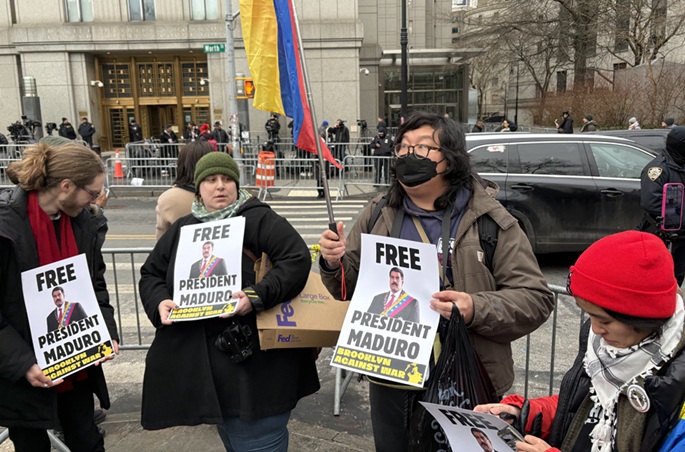
While the UN Security Council in midtown Manhattan echoed with denunciations from U.S. allies and foes alike over Washington's "crime of aggression" against Venezuela, a few kilometers south, Venezuelan President Nicolas Maduro and his wife were being arraigned at a federal court Monday morning, reported Xinhua.
Pleading not guilty to all four charges in his first U.S. courtroom appearance, Maduro told the judge he had been "kidnapped" in the U.S. raid on Caracas, a "military abduction" that his lawyer argued raised questions over its legality.
In an operation that unfolded swiftly on Saturday, Maduro and his wife, Cilia Flores, were seized in a large-scale U.S. military strike in the dead of night, flown out of Venezuela, and put in custody in the Metropolitan Detention Center in Brooklyn.
On the same day, the Justice Department unsealed an indictment against Maduro and five others, including his wife and son.
Arriving in a helicopter on Monday, Maduro and Flores were seen escorted onto an armored van bound for the courthouse, flanked by Drug Enforcement Administration (DEA) agents, handcuffed.
Bandages were observed on Flores' forehead during the proceedings. Her attorney, Mark Donnelly, told U.S. District Judge Alvin Hellerstein his client had sustained "significant injuries during her abduction" and suggested she may have a fracture or severe bruising on her ribs and would need a physical evaluation.
"I am innocent. I am not guilty. I am a decent man. I am still president of my country," Maduro said through an interpreter, before being cut off by the judge. "I am a prisoner of war," he added.
Outside the court hundreds of protesters had gathered, waving banners that read "Free Maduro," "USA hands off Venezuela," and chanting "No blood for oil, hands off Venezuelan soil!"
"The charges are completely outrageous," Sydney Loving, one of the protesters, told Xinhua. "We're against any intervention like that on a sovereign nation."
"To kidnap a president of another country is absolutely crossing a red line. It definitely violates international law," she said.
At the very moment Maduro was being arraigned, Venezuelan UN ambassador Samuel Moncada said at an emergency meeting of the Security Council that the U.S. aggression had subjected Venezuela to an "illegitimate armed attack," putting not only the country's sovereignty at stake but also "the credibility of international law" and the authority of the UN.
Warning that tolerating the "kidnapping of a head of state" and attacks on civilians would signal that "the law is optional," Moncada said the U.S. actions were "driven by Venezuela's natural resources and geopolitical position."
Referring to "oil" roughly 20 times in his remarks following Saturday's operation, U.S. President Donald Trump told NBC News on Monday that Washington may subsidize oil companies to rebuild Venezuela's energy infrastructure, noting that such a project could take less than 18 months.
He added that he regarded himself as effectively in charge of Venezuela, noting that the country would not hold new elections within the next 30 days.
Ernesto Soberon Guzman, Cuba's permanent representative to the UN, said the kidnapping of Maduro is driven by a quest for "control over Venezuela's land and natural resources," calling it "imperialist and fascist aggression," and demanded the immediate release of Maduro and his wife.
Accusing the United States of unilateral coercive measures, "economic asphyxiation" and maritime terrorism, he said Washington's "hegemonic and criminal plans" for Venezuela have produced serious and unpredictable consequences for regional stability.
Long-time U.S. ally France also criticized the operation, highlighting that it undermined international rules and norms.
"The military operation which has led to the capture of Nicholas Maduro runs counter to the principle of peaceful dispute resolution and runs counter to the principle of non-use of force," said France's Deputy UN Ambassador Jay Dharmadhikari. He added that a permanent member of the Council flouting international law and the UN charter "chips away at the very foundation of the international order."
Other Latin American countries also voiced their condemnation.
Celso Amorim, chief advisor to Brazilian President Luiz Inacio Lula da Silva, said in a recent interview that "the most serious thing to me is that this return to interventionism isn't even disguised."
"There isn't even a, let's say, 'No, we went there to defend democracy.' There is an objective that is obviously economic," he said.
Mexican President Claudia Sheinbaum said Monday that no nation can impose its will on other countries, and does not have the right to their resources. "Latin American history is clear and overwhelming. Intervention has never brought democracy, never has generated wellbeing, nor lasting stability," she said.
"Only the people can build their own future, decide their path, exercise sovereignty over their natural resources, and freely define their form of government," she said. "Each nation has the inalienable right to decide its political, economic, and social model, free from external pressure."
Houthis claim missile, drone attacks on Saudi airports, energy facilities
US accepts some of Iran's conditions, status of others remains unclear: official
Trump announces Russia-Ukraine ´energy ceasefire, ´ Zelensky says unaware of deal
139 migrants dead after boat capsizes off Djibouti coast
Landslide-dam breach likely triggered flash floods in Nepal
Arab nations, Türkiye, Israel condemn Houthi attack on Riyadh airport

Editor-in-Chief Ofiul Hasnat
Published by Finnish News Network (FNN)
Heporinne 4 B 45
01200 Vantaa, Finland.
E-mails : [email protected]