
Palestine rejects
Netanyahu unveils plan for post-war Gaza
Published : 24 Feb 2024, 01:08
Updated : 24 Feb 2024, 01:27
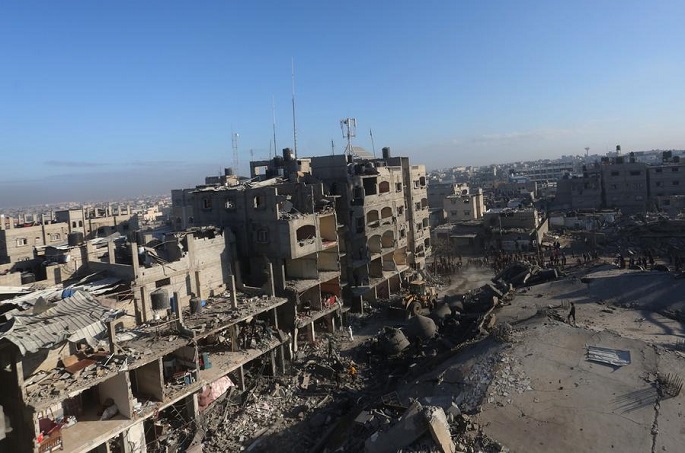
Israeli Prime Minister Benjamin Netanyahu has unveiled his post-war strategy for Gaza, the first since the Israel-Hamas conflict broke out in October last year, involving a continuous military presence in the Palestinian enclave and the replacement of Hamas, his office said in a statement on Friday, reported Xinhua.
The document, presented by Netanyahu to members of his security cabinet on Thursday, outlines principles regarding the management of the Gaza Strip after the conflict.
The plan aims to install "local officials" unaffiliated with attacks against Israelis to administer services in the Palestinian enclave instead of Hamas. "As far as possible, the civil administration and responsibility for the public order in the Gaza Strip will be based on locals with administrative experience," the document read.
The reconstruction of Gaza, following Israeli bombardments that devastated much of its infrastructure and buildings, would begin only after the demilitarization and "deradicalization" of Gaza, as outlined in the plan. The reconstruction would be financed and carried out by countries deemed "acceptable by Israel."
The plan calls for tightening Israel's security grip on Gaza. Under the proposed plan, Israel will "maintain operational freedom of military actions throughout the Gaza Strip, without time constraints," to prevent the resurgence of hostilities from the Palestinian enclave.
A "security buffer zone," inaccessible to Palestinians, would be established on Gaza territory, according to the plan. Israeli media reports indicated that Israeli forces have already begun demolishing buildings, greenhouses, and agricultural fields in the northern Gaza Strip to clear the ground for the creation of this zone.
Along the Gaza-Egypt border, Israel will have its presence to thwart smuggling, according to the plan.
Defying international calls for Palestinian statehood after the war, the plan shows Israel plans to maintain "security control" over the entire West Bank and the Gaza Strip.
Less than one-and-a-half pages long, the document was published four-and-a-half months after Israel launched its retaliatory war against Hamas in Gaza in response to the movement's deadly surprise attack on southern Israel on Oct. 7, 2023.
Meanwhile, the Palestinian Ministry of Foreign Affairs and Expatriates announced on Friday its rejection of Israeli Prime Minister Benjamin Netanyahu's post-war plan for the Gaza Strip.
The plan is an official recognition "of the reoccupation of the Gaza Strip, and Israel's imposition of control over it to prolong the war against our people, and an attempt to gain more time to implement the displacement plan," the ministry said in a statement.
Moreover, the plan is "a blatant maneuver to oppose and thwart international efforts to link ceasefire agreements and the release of prisoners and hostages with resolving the conflict and materializing a Palestinian state on the ground," said the statement.
Netanyahu presented the plan to his security cabinet on Thursday night, which outlined principles regarding the management of the Gaza Strip after the conflict.
The plan calls for tightening Israel's security grip on Gaza. Under the proposed plan, Israel will "maintain operational freedom of military actions throughout the Gaza Strip, without time constraints," to prevent the resurgence of hostilities from the Palestinian enclave.
Defying international calls for Palestinian statehood after the war, the plan shows Israel plans to maintain "security control" over the entire West Bank and the Gaza Strip.
"Netanyahu's principles explain the reason for his hostility and exclusion of the legitimate Palestinian authority, and reveal his rejection of the Palestinian state and political solutions to the conflict," the ministry added.
The Palestinian ministry urged the U.S. administration and the international community to quickly recognize the Palestinian state and support its full membership in the United Nations, and to begin international arrangements to hold a peace conference that "leads to an end of the (Israeli) occupation and enables our people to exercise their right to self-determination freely."
Trump terms ´no swap´ release of US citizen Stephen Hubbard from Russia ´unprecedented´
´First time in long time, we're maybe close to deal´: Trump on Ukraine war
Indonesia battles forest fires across 1,000 hectares outside priority provinces
1st Russian tanker carrying 40,000 tons of diesel to depart in 2-3 days: Putin
Ground fighting in Yemen intensifies as 2 killed in drone strike on Saudi field
Netflix Q3 net profit rises nearly 44%

Editor-in-Chief Ofiul Hasnat
Published by Finnish News Network (FNN)
Heporinne 4 B 45
01200 Vantaa, Finland.
E-mails : [email protected]