
A female referee's long sprint toward a World Cup dream
Published : 26 Jun 2026, 11:17
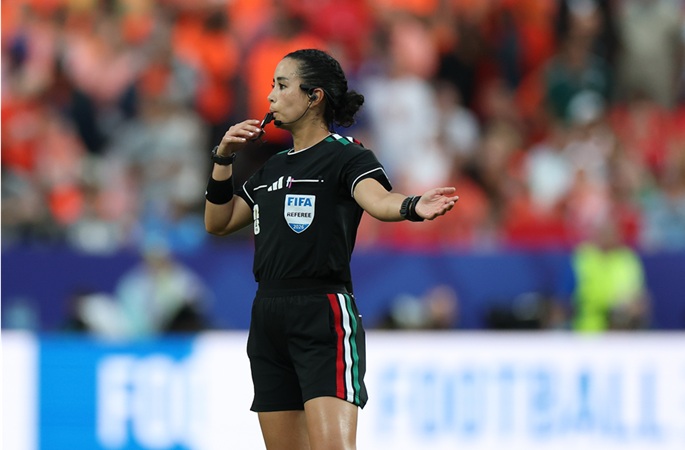
For most of Thursday afternoon (US local time), a severe thunderstorm alert hung over Kansas City Stadium, threatening to wash away the build-up to the Group F match between Tunisia and the Netherlands.
A little more than an hour before kickoff, the warning was canceled. The clouds thinned, the light softened, and by the time the teams walked out, the only thing electric inside the venue was the crowd.
At the center of it all was Katia Itzel Garcia, the 33-year-old Mexican referee about to become the third woman to take charge of a men's World Cup match.
Dressed in black and wearing a quiet, concentrated expression, Garcia strode onto the grass and, with the opening whistle, joined a short but growing lineage that includes France's Stephanie Frappart and the United States' Tori Penso, both of whom had already refereed matches earlier in this tournament.
For Garcia, however, the Kansas City night was less a finish line than another step on a path cleared by those before her.
"Today I can only feel immense joy at being the first Mexican female referee to participate in a men's World Cup," Garcia had told the university magazine Gaceta UNAM in April, soon after FIFA unveiled its list of officials.
"I feel grateful, first to my family, who have helped me reach this moment, and also to the referees who came before me, because it's not just me; there are many behind me who pushed so that I could be where my colleagues and I are today."
Long before a World Cup badge was sewn onto her shirt, Garcia was shaped by the National Autonomous University of Mexico (UNAM), where she earned a degree in Political Science and Public Administration from the Faculty of Political and Social Sciences and later enrolled in the Faculty of Law.
She still remembers the rhythm of those years: morning classes, training sessions at University City's Field 1, afternoon lectures and long conversations that stretched into the night.
"What UNAM has instilled in me as a university student, among other things, is the ability to remain firm and strong in my goals and objectives," she told Gaceta UNAM.
"I acquired discipline, shared my worldview, and developed a critical perspective on other viewpoints. I learned to stand firm in my values and ideals, and to strive to achieve my dreams and objectives."
That same drive carried her into the women's football team, where she won a gold medal at the 2016 National University Games and collected two silvers before her ambitions began to shift toward refereeing.
Garcia's path to the World Cup started in the amateur ranks in 2015. She made her professional debut as an assistant referee in 2017 and, a year later, took charge of her first Liga MX Femenil match.
From there, she climbed through Mexico's youth leagues, the second-division Liga de Expansion MX and the top-flight women's game, often as the only woman in the room.
In March 2024, she broke a two-decade barrier by officiating a Liga MX men's match, calmly managing a top-division clash between Pachuca and Queretaro. By then, she had already been a FIFA international referee since 2019, and her passport was filling with assignments: the 2023 Women's World Cup, the 2024 Paris Olympics, the 2024 CONCACAF Women's Gold Cup, the 2025 CONCACAF Gold Cup and the 2025 FIFA U20 World Cup, among others.
Sitting with students at her old Faculty of Political and Social Sciences in April, Garcia drew a line between her academic training and the role she performs on the pitch.
"Politics is about making decisions according to the scenarios it faces," she told UNAM Global Magazine. "In a game, you have two teams trying to win, two competing spheres, and the referee must apply the rules so that the dispute takes place within the bounds of legality."
It is a framework that suits a job where every sprint requires judgment and every whistle is scrutinized by players, coaches, supporters and millions watching from afar, yet executed alone.
The challenges have never been purely physical, though the demands are steep. A referee covers roughly 11.5 kilometers per match, often in a sprint.
"I've faced many challenges, one of them being to match the physical demands of men," Garcia admitted to Gaceta UNAM. "Another is dealing with a culture that is still not entirely ready to see women in all areas, not just refereeing."
The numbers underline the scale of that challenge. When Garcia started, there were about 30 professional female referees in Mexico. By early 2026, that figure had grown past 100, but still accounted for less than 10 percent of the total.
Every barrier she breaks, Garcia has said, is also a door opened for the next woman who wants to wear the badge.
In February, months before the world turned its eyes to Kansas City, Garcia had already made history by officiating the first FIFA Women's Champions Cup final. Asked by FIFA what that moment meant, she framed it as a collective achievement.
"I feel honored to be a part of this incredible history. This isn't just about me, it also includes all the other female referees that were a part of this tournament."
The message she wanted to send to young girls watching from the stands and on screens was direct.
"I think that girls being able to see that women can be anywhere gives them the message that they can dream about anything, and that they can achieve whatever they want in their lives," she told FIFA. "It's also a new way of being involved in this beautiful game of football, as a referee."
Back in Kansas City on Thursday, the match itself unfolded without the drama of the pre-match weather. Garcia moved across the turf with economy and control, trusting her legs, her reading of the game and the long road that had brought her there.
The university student who once dreamed of playing at the World University Games had reached a far bigger stage, in a role no Mexican woman had filled before.
Her advice to those who might follow, given to FIFA earlier this year, captured why she believes the pursuit is worth it.
"It is a great opportunity to fulfill their dreams, to experience what we love so much, which is football, and that there are other paths to do that, and being a referee is definitely one of them."
Norris beats Antonelli to win dramatic F1 Dutch GP
Brown, Olise score as Bayern edge Dortmund in Super Cup
35 police officers injured in violence at German Cup match
Messi fined by MLS for on-field altercation with Philadelphia Union's Sullivan
Frankfurt demolish St Tönis 11-0, Stuttgart beat Rostock
Argentina players, staff banned for clash after WC final match

Editor-in-Chief Ofiul Hasnat
Published by Finnish News Network (FNN)
Heporinne 4 B 45
01200 Vantaa, Finland.
E-mails : [email protected]