
Morocco’s transitional justice experience focused at Helsinki Conference on Peace and Mediation
Published : 12 Nov 2026, 15:10
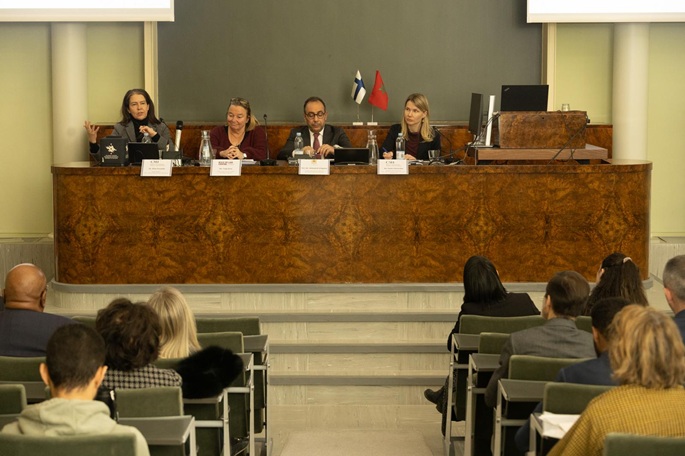
Morocco’s experience in transitional justice and national reconciliation took centre stage at an international conference held on Tuesday at the University of Helsinki, highlighting the Kingdom’s contribution to global discussions on human rights, mediation and sustainable peace.
Organised by the Embassy of the Kingdom of Morocco in Finland, in partnership with the CMI – Martti Ahtisaari Peace Foundation and the Rule of Law Centre at the University of Helsinki, with the participation of the Finnish Ministry for Foreign Affairs, the conference, entitled “Transitional Justice and Mediation,” brought together diplomats, Finnish officials, academics, civil society representatives and experts in human rights and peacebuilding.
The event provided an opportunity to explore Morocco’s approach to addressing past human rights violations and advancing national reconciliation, while examining the broader relationship between transitional justice, mediation and conflict prevention.
Addressing the gathering, Morocco’s Ambassador to Finland, Mohamed Achgalou, presented the Kingdom’s transitional justice experience, undertaken under the leadership of His Majesty King Mohammed VI, highlighting the establishment of the Equity and Reconciliation Commission (IER) in 2004 as a landmark step in acknowledging past human rights violations, rehabilitating victims and providing individual and community reparations.
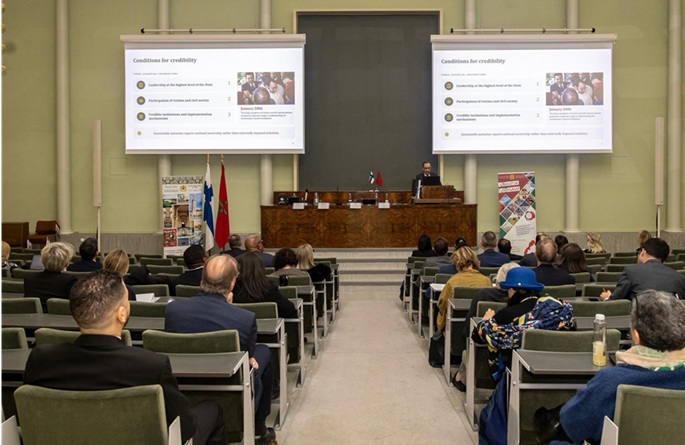
The Ambassador emphasised the importance of political will, national ownership and civil society engagement in advancing reconciliation and institutional reform. He also stressed that transitional justice should be viewed as a continuous process, extending beyond addressing past violations to strengthening the rule of law, rebuilding public trust and preventing future abuses.
The conference featured contributions from Tanja Leikas-Botta, Director for Human Rights Policy at Finland’s Ministry for Foreign Affairs, Tuija Brax, Director of the Rule of Law Centre at the University of Helsinki, and Elisa Tarnaala, Senior Adviser at the CMI – Martti Ahtisaari Peace Foundation.
Discussions highlighted the growing importance of transitional justice in a world facing renewed conflicts and political instability, underlining that sustainable peace cannot be taken for granted and that rebuilding trust between citizens and institutions remains essential to lasting reconciliation.
Particular attention was given to the complementarity between transitional justice and peace mediation, with participants exploring how accountability, truth-seeking, reconciliation and institutional reforms can reinforce mediation efforts before, during and after political transitions.
The exchanges also underscored the limitations of applying standardised international frameworks across different national contexts. Experiences from countries including South Africa, Libya, Côte d’Ivoire and Yemen illustrated the need for flexible, nationally owned approaches that take into account distinct political, legal and institutional realities.
Another central theme was the role of women, civil society organisations and community leaders in building inclusive and sustainable peace. Participants stressed the importance of preserving open civic space and ensuring that reconciliation processes extend beyond government institutions to involve the wider population.
The discussions further examined the close relationship between human rights, the rule of law and peacebuilding, as well as the importance of institutional reforms in preventing future crises. Particular reference was made to European integration processes involving Ukraine and the Western Balkans.
The conference also addressed the challenges of coordination and information-sharing among international organisations, including the United Nations, the European Union, the African Union and the OECD, highlighting the need for stronger cooperation between actors involved in mediation, transitional justice and civilian crisis management.
Finland to fund €37.3m to support Ukraine’s reconstruction
Govt to amend laws regarding assigning conscripts abroad
1 held for entering Finland crossing Russian border
Finland stiffens visa restrictions for Russian athletes
Finland to test emergency warning system on Nov 24
E-scooter injuries drop in Helsinki in Jan-Aug

Editor-in-Chief Ofiul Hasnat
Published by Finnish News Network (FNN)
Heporinne 4 B 45
01200 Vantaa, Finland.
E-mails : [email protected]