
Govt moves to tighten driving licence criteria for young people
Published : 19 Feb 2026, 23:57
Updated : 20 Feb 2026, 00:01
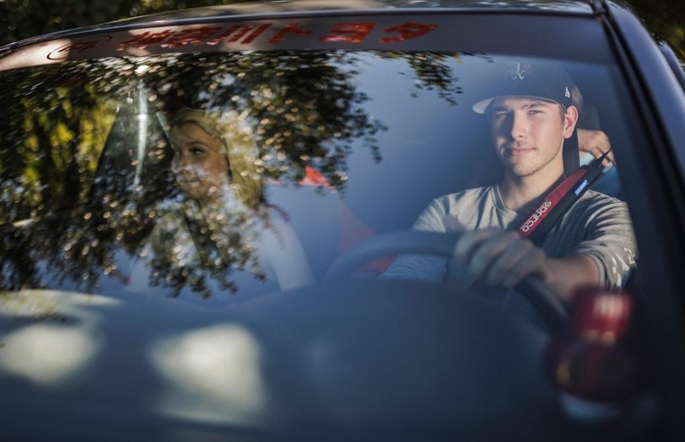
The government on Thursday submitted a proposal to the Parliament to amend the Driving Licence Act with the view to improve traffic safety for young drivers, said the Ministry of Transport and Communications in a press release.
The proposal would clarify and partly tighten the conditions under which a 17-year-old may obtain a passenger car driving licence through an exemption procedure.
At the same time, driving a vehicle requiring a passenger car licence would be prohibited for 17‑year‑old drivers at night.
According to the proposal, a young person would need to travel at least four times per week, for example to attend a leisure activity or school. At present, there is no clear definition of regularity.
The one-way distance, for example to a leisure activity, would need to be at least seven kilometres on foot if public transport is unavailable, or at least 90 minutes by public transport.
Currently, the requirement for a one-way distance is five kilometres on foot or one hour by public transport. A parent or other person who has custody of the young person would confirm the information.
According to the proposal, the supporting documents for demonstrating the mobility need would be defined more precisely than at present. For example, a student could prove the need to travel with a certificate of attendance from the education provider, and a working young person with an employment contract of at least two months.
Currently, shorter contracts have been sufficient to obtain an exemption. For leisure activities, the need would be demonstrated with a certificate from a sports federation for competitive training or from an education provider for attending basic education in the arts.
An exemption would no longer be granted if the young person is, or has been, disqualified or temporarily disqualified from driving. Currently, an exemption can be granted despite a driving disqualification, but the young person may only take the driving test and obtain a licence once the disqualification has expired.
The proposal also prohibited 17‑year‑olds from driving vehicles requiring a passenger car driving licence at night between 00.00 and 5.00.
Breaching the ban could result in a fine and a driving disqualification. To enable monitoring, a 17-year-old driver would need to display a special underage driver sign on their vehicle. Failure to display the sign could result in a EUR 100 traffic penalty fee. Failure to carry the exemption decision while driving could result in a EUR 40 traffic penalty fee.
The government proposed increasing the requirements for mandatory risk recognition training for those obtaining a passenger car licence. The training would be extended by three theory lessons and one driving lesson. Up to half of the driving component of the risk recognition training, two and a half hours, could be completed using a simulator.
Mandatory training for new drivers who have been disqualified from driving would be expanded to cover moped, light quadricycle and tractor categories, in addition to motorcycle and passenger car categories.
The requirement would also apply to drivers temporarily disqualified by the police in the same licence categories. A candidate who commits fraud in the theory test could be prohibited from taking the test again for six months.
The proposal would also remove the current requirement to return an expired driving licence to the authorities. In future, licence holders could destroy their expired licence themselves, saving costs.
Parliament will first hold a referral debate on the government proposal in a plenary session. The proposal will then proceed to a committee reading. Following the committee report, the debate will continue in a plenary session.
Most of the legislative amendments are scheduled to enter into force on 29 May 2026.
The amendments concerning risk recognition training should enter into force on 1 October 2026.
“Traffic safety in Finland has developed in a positive direction, but we are still clearly behind countries such as Sweden and Norway. What concerns us most are young drivers, who remain overrepresented in accident statistics. This government proposal will help ensure that new drivers have better knowledge, skills and attitudes for safe driving. One of our aims is that everyone returns home safely, no matter the journey,” said Minister of Transport and Communications Lulu Ranne in the press release.
8 face arson charges for fire at Helsinki building hosting bicycle shop
2 drown in Joensuu, Iisalmi, 2 found dead in Rauma, Pargas
Man dies in police custody in Jyväskylä
Human trafficking network organises illegal entry of dozens of migrants into Finland
Finnish Border Guard supports Estonian border security
17 employees face trial for violation of company business secret

Editor-in-Chief Ofiul Hasnat
Published by Finnish News Network (FNN)
Heporinne 4 B 45
01200 Vantaa, Finland.
E-mails : [email protected]