
Govt to reform home care, housing services for elderly people
Published : 10 Dec 2021, 01:21
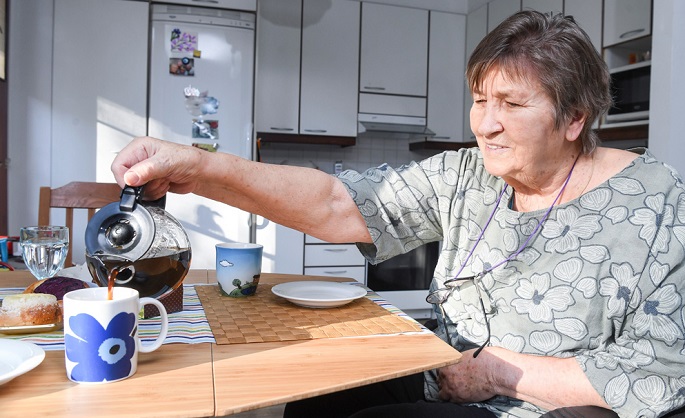
The government has taken an initiative to reform the home care and housing services for the elderly people with the view to improve particularly the sufficiency and quality of services provided to older people at home, said the Ministry of Social Affairs and Health in a press release on Thursday.
The second phase of the reform concerning services for older people will proceed to Parliament for consideration.
The proposal builds on the first phase of the legislative reform on services for older people, which laid down provisions on staffing levels in 24-hour care, for example.
The proposed acts are scheduled to enter into force on 1 January 2023 simultaneously with the health and social services reform.
The aim of the reform is to ensure that older people can live in their homes safely and have the services their need provided at home.
In future, the services provided at home would include home care with home nursing appropriate to the client’s needs, separate support services and the proposed new care alarm services.
The care alarm services would include providing safety aids to clients, responding to alerts 24 hours a day, assessing the need for assistance and providing care workers to help clients.
Home care would be provided according to people’s needs at all times of the day, even at night time.
To strengthen the resources of home care, it is proposed that provisions be laid down on the planning of house calls and the utilisation of technology in home care.
It is further proposed that provisions be laid down on securing adequate staffing levels in home care and on measures to address labour shortage. Measures should be taken immediately to respond to insufficient personnel resources. The sufficiency of personnel resources should also be monitored continuously through self-monitoring.
The concept of home services would only apply to services for families with children, and provisions on the right of families with children would be laid down in a separate section.
The content of services and the requirements for receiving services would not be changed. The amendment would emphasise the right of families with children to this service.
The housing services would include temporary and supported housing, and the provisions on them would remain unchanged in terms of their content. In addition, the housing services would include communal housing and 24-hour service housing.
Communal housing would replace the current ordinary service housing. A client would be offered accommodation in an accessible and safe housing unit, and they should have the opportunity to live in an apartment that meets their needs and to participate in activities that promote social interaction.
Services would be provided separately as home care services and other services provided at home in accordance with the client’s needs. Services could be delivered partly or in full by the unit’s own personnel or they could be provided by one or more external service providers, either private or public.
Twenty four-hour service housing and services would be organised in the same way as in the current service housing with 24-hour assistance. Personnel would be available around the clock, and the statutory staffing levels would be complied with in services for older people.
Apartments would meet clients’ needs in the same way as in communal housing. As before, 24-hour service housing would include full board in addition to nursing and care.
Communal housing and 24-hour service housing could be provided in facilities that belong to the same building complex and that include also ordinary apartments. The aim is that clients could get services at home without having to move when their service needs change.
The long-term institutional care for older people would be abolished by the end of 2027. A sufficient transition period will ensure that there is enough time to introduce services to replace long-term institutional care. Those clients who would still be in long-term institutional care within social welfare at the beginning of 2028 would, as a rule, be transferred to 24-hour service housing that is comparable to the current service housing with 24-hour assistance.
Online illegal wildlife trade poses risks to biodiversity: study
Finland to host Arctic summit of EU leaders in September
Woman killed in road mishap in Helsinki
Man to face charges for hoisting Swastika flag in yard
Belarus to close embassy in Finland
15 to face trial for producing, selling cannabis in Helsinki

Editor-in-Chief Ofiul Hasnat
Published by Finnish News Network (FNN)
Heporinne 4 B 45
01200 Vantaa, Finland.
E-mails : [email protected]