
Niinistö expresses concern at Belarus situation, US-China tension
Published : 25 Aug 2020, 20:59
Updated : 26 Aug 2020, 00:47
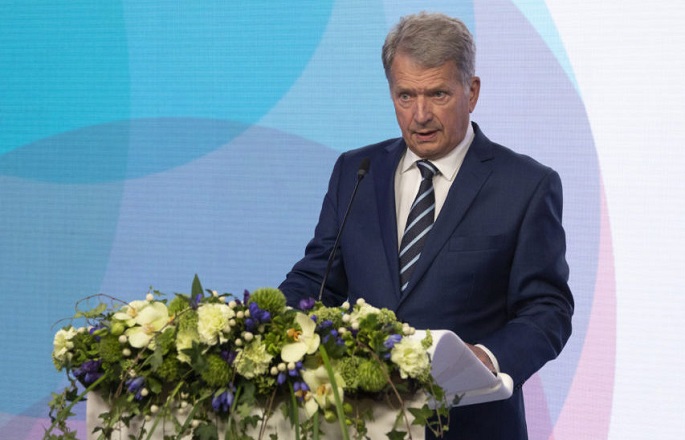
President Sauli Niinistö on Tuesday expressed concern at the situation of Belarus following the controversial presidential elections, which failed to meet international criteria and urged for peaceful solution of the crisis though dialogue.
Speaking at the Ambassadors’ Conference in Helsinki, he also mentioned that the growing tension between the United States of America and China is becoming increasingly visible.
“In recent weeks, we have followed the heated situation in Belarus with great concern. Due to reasons attributable to Belarus, the country’s presidential elections at the beginning of August were not observed by the OSCE. They failed to meet the international criteria in other respects as well. This started a dangerous circle. When the trust in the system collapses, the security may also be at risk,” said the president.
He also said that the way in which demonstrators have been showing their discontent in Belarus has been touching and impressive.
“They have given no reason for aggression. For this reason as well, it has been incomprehensible that they have been subjected to acts of violence, arrests and threats. We can only hope that the way forward can be found in a peaceful manner, through a national dialogue,” Niinistö said, adding that artificial geopolitical arguments do nothing to help in finding a solution to the situation in Belarus.
He said dangerous signs of such approaches have also been heard.
“Therefore, I consider the kind of statements important in which both the EU and Russia have underscored the need for internal dialogue in Belarus and encouraged the parties to engage in such dialogue. Perhaps we could find a valuable, constructive role for the OSCE in supporting such a process,” he said pointing out that he discussed with both German Chancellor Merkel and President Putin a few days ago.
Focusing on the global power competition, he said the great-power competition is accelerating and the rules-based system and the institutions and treaties that form its foundations are being tested at an increasing intensity.
“Worldwide, it is primarily a question of the confrontation between the United States and China – in terms of diplomacy and rhetoric, the economy and technology. This growing tension between the two great powers is becoming increasingly visible to us as well,” said the president, adding that still, from the Finnish and European perspective, seeing it as bipolarity is a rather simplistic way of thinking.
“For us, it is also of great significance where Russia places itself in this setting,” he said.
Terming a neutral position as important, he said the worst-case scenario would be that Europe would have to choose sides between the great powers one issue at a time.
“This would be the worst option, which we must not allow to happen. A much better alternative is a strong Europe, one among the great powers, which can make its own decisions independently: at its own initiative, and not only forced into choosing its side by outsiders. In that case, natural allies can also be found,” Niinistö added.
If the United States continues to withdraw and China continues to increase its presence, it cannot but affect the contents of cooperation as well, he said, adding that new areas of focus emerge, old ones are left aside.
As far as Russia is concerned, he said it should also be remembered that the competition between the two great powers poses a similar question to the EU and Russia.
The European Union is an essential frame of reference for Finland, also in terms of foreign and security policy. Globally, the EU distinctly represents matters we see as valuable: democracy, rule of law, multilateral rules-based system, and compliance with agreements.
“For us, the unwavering EU supporters, it is important that we can maintain our trust in the European Union to be true to its word,” said the president.
He also expressed concern at the tensions building up within the UN. In the Security Council, the latest example of this is the dispute about the sanctions against Iran.
“Earlier this year, both Russia and France made their own P5 initiatives to have a summit organised between the five permanent members of the Security Council. We have many good reasons to hope for a better dialogue between the heads of state of the P5. Nuclear weapons and arms control in general are among the most important of these reasons. If these nuclear powers fail to find mutual understanding and trust, even what remains of the agreement system that controls the weapons of mass destruction is at threat. It would be essential for the P5 countries to find each other even outside the arms control issues to ensure the operability of the UN system,” said Niinistö.
IAEA team visits Finland to evaluate radiation emergency preparedness
Finland to redefine ties with Russia after Ukraine war ends: Stubb
Birth rate remains lower than death in Finland in Jan-July period
Online illegal wildlife trade poses risks to biodiversity: study
Finland to host Arctic summit of EU leaders in September
Woman killed in road mishap in Helsinki

Editor-in-Chief Ofiul Hasnat
Published by Finnish News Network (FNN)
Heporinne 4 B 45
01200 Vantaa, Finland.
E-mails : [email protected]