
Coalition of the Willing kicks off first military exercises in Poland
Published : 09 Nov 2026, 23:45
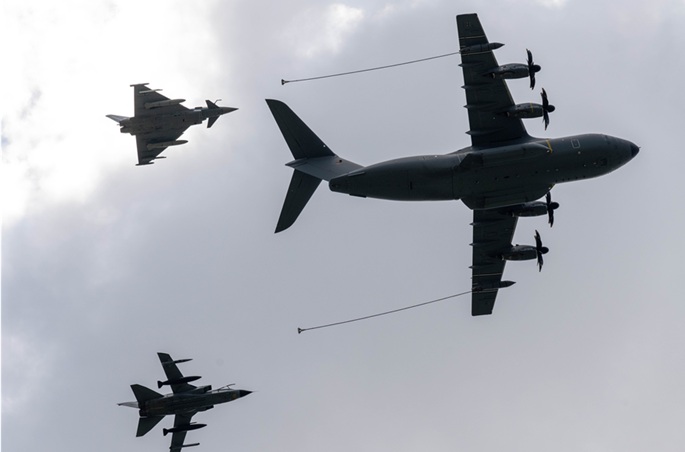
The "Coalition of the Willing" is launching its first military exercise aimed at supporting Ukraine in a future post-war period on Monday, drawing sharp criticism from Russia.
Around 2,800 soldiers from 11 countries are involved in the exercise, which is designed to test how lasting peace can be secured after a ceasefire to end the war is successfully negotiated.
The exercise, named Koalicja 2026 (Coalition 2026), is taking place in Poland, in the airspace above Romania and in the western Black Sea. Led by France and Britain, it is due to run until November 22.
The Coalition of the Willing was formed in early 2025 to support Ukraine. The decision to set up the multinational force was then taken in December at a Ukraine summit in Berlin.
According to the UK, the exercise is set to simulate the deployment of troops and the transport of supplies such as food and fuel.
Germany's Bundeswehr is set to take part in the exercise with about 10 staff officers, tanker aircraft and logistics support. Britain plans to deploy about 300 military personnel and several fighter jets.
France will contribute some 1,000 soldiers, according to army figures, as well as drone defence systems and short-range surveillance drones.
The other participating countries are Belgium, Estonia, Lithuania, the Netherlands, Poland, Spain and Sweden. About 35 countries are part of the broader Coalition of the Willing. Ukraine has been defending itself against Russia's full-scale invasion for more than four and a half years.
Russia accuses coalition of preparing for war
The exercise has met with sharp criticism in Moscow. Sergei Shoigu, secretary of the Russian National Security Council on Monday accused the alliance of preparing for war with Russia.
"The exercises are not so much defensive in nature as they are offensive," Russia's Interfax news agency reported Shoigu as saying on the sidelines of a meeting in Moscow.
Russia has consistently emphasized that it would not agree to the deployment of troops from NATO countries in Ukraine, with Foreign Ministry spokeswoman Maria Zakharova saying this would be considered a "de facto military intervention" serving to deliberately create "additional threats to Russia's security."
Shoigu also lamented that the manoeuvres were being organized under the pretext of an alleged threat from Russia. At the same time, he noted, NATO is advancing ever further eastwards, closer to the Russian border.
He reiterated his criticism of Europe's militarization and increased defence spending, claiming that Europeans were being frightened by an alleged Russian threat.
"This undoubtedly serves to divert attention from everything that is happening in those countries, from the negative developments that can be observed in Europe - in France, Germany and Poland," Shoigu said.
Shoigu served as Russian defence minister from 2012 to 2024, and was therefore in office at the time of the Russian invasion. Long before the invasion began, he had criticized NATO member states for repeatedly holding military manoeuvres in Ukraine. Russia cites Ukraine's aspirations to join NATO as one of the reasons for the war.
German teenager suspected of plotting mosque attack using 3D printer
EU seeks to curb use of potent greenhouse gas in power grids at COP31
Spanish train drivers hold large-scale strike over rail safety
Russian passenger plane lands in Turkey after bomb threat
German city weighs legal action over Tokio Hotel pyrotechnics row
Germany rejects US criticism of Ukraine strikes on Russia as 'stupid'

Editor-in-Chief Ofiul Hasnat
Published by Finnish News Network (FNN)
Heporinne 4 B 45
01200 Vantaa, Finland.
E-mails : [email protected]