
Europe welcomes Democrats' win, but sees little relief ahead
Published : 05 Nov 2026, 07:18
Updated : 05 Nov 2026, 07:24
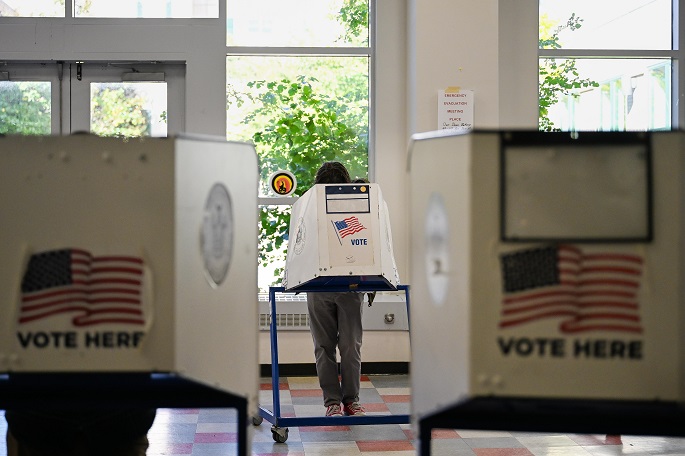
European leaders have responded cautiously to the Democrats' sweeping victory in the U.S. midterm elections, welcoming the results while warning that they are unlikely to ease transatlantic tensions, reported Xinhua.
U.S. President Donald Trump, who is to be weakened domestically, could become even more "aggressive and unpredictable" on trade, foreign policy and security, leaving Europe facing continued uncertainty over U.S. tariffs, NATO commitments and support for Ukraine, analysts have cautioned.
In the U.S. midterm elections on Tuesday, Democrats regained control of the House of Representatives and the Senate, as well as several governorships.
European Commissioner for Trade and Economic Security Maros Sefcovic struck a cautious tone following the results, saying the EU respected the democratic will expressed by American voters and continued to regard the United States as a close ally and partner. "We will continue our contacts," he added.
Reactions among EU member states ranged from celebration to a more measured assessment of the elections' implications. Spanish Prime Minister Pedro Sanchez wrote on X that American voters had voted "against hatred," "against sexism" and "against climate denial and the privileges of the elites." French Foreign Minister Jean-Noel Barrot, meanwhile, stressed that the result did not alter the "urgent and vital necessity" of building a stronger, more prosperous and more democratic Europe.
Germany struck a more pragmatic note. Metin Hakverdi, Chancellor Friedrich Merz's coordinator for transatlantic cooperation, told DPA that "America has chosen change," but cautioned that Trump would continue to play a decisive role in foreign policy. Germany, he added, "must not restrict our contacts to individual political camps."
British Prime Minister Andy Burnham also pointed to an opportunity for renewed international cooperation, particularly on the cost-of-living crisis. Speaking to reporters on Wednesday at the Commonwealth summit in Antigua and Barbuda, he said Trump's acceptance of the midterm results offered a chance for the world to unite, stressing that no country could tackle rising living costs alone.
However, analysts warned that the elections were unlikely to ease the structural pressures facing Europe. If Congress constrains Trump on domestic policy, they argued, he could seek to reassert his authority in foreign, trade and security policy, areas where the president enjoys greater room for manoeuvre.
Wolfgang Ischinger, chairman of the Munich Security Conference, urged Europeans not to mistake the results for a reprieve. "We need to brace ourselves for not more harmonious transatlantic relations but more acrimony and even more Trump demands on Europe," he warned.
Peter Filzmaier, a political scientist at the University of Graz, told Austrian public broadcaster ORF that even a hostile Congress would not fundamentally alter Trump's foreign policy approach. With the president retaining significant executive powers, "the basic policy line of the White House on foreign policy and transatlantic relations is unlikely to change in the short term," he said. Instead, Washington could descend into "deadlock and paralysis" while pressure on Europe remained unchanged.
"For Europe, the most difficult two years of his second term may only be beginning now," wrote Josef Braml, European director of the Trilateral Commission, in an Euronews commentary.
Concerns extend beyond political rhetoric to concrete security implications. Five NATO diplomats told Politico that a weakened Trump could withdraw thousands more U.S. troops from Europe. A Pentagon force-posture review, due by December, has already raised concerns about the potential scale of such a reduction. Washington could also cut its contributions to NATO's common funding and restrict the NATO-backed PURL weapons procurement scheme for Ukraine.
Joern Fleck, senior director of the Europe Center at the Atlantic Council, told Serbia's N1 television that Europe could face "divergent policy signals" from a Democratic-controlled Congress and a Trump White House. While lawmakers may pursue legislation, congressional oversight and visits to reassure allies over NATO and Ukraine, the president could continue his existing course "with even greater determination."
The outlook for trade is similarly uncertain. Economists see little prospect that the midterm results will bring relief from U.S. tariffs. Achim Wambach, president of the ZEW economic research institute, argued that Democratic control of Congress would "probably not bring a fundamental return to free trade." Trump's tariffs rely on executive authority rather than congressional approval, meaning Democrats could intensify oversight but could not unilaterally dismantle them.
Clemens Fuest, president of the Ifo Institute in Munich, also warned that a president with less room for manoeuvre at home might actually resort to tariffs "more than before" as an instrument of foreign policy.
"Europe seems to have realized that a fundamentally different relationship with the United States is needed," said Jack Thompson, a lecturer in American studies at the University of Amsterdam, adding that Europe has limited capacity to prevent such a shift.
Danish students protest over proposed grant cuts
Eurozone inflation rises to 4% in October
Swedish central bank raises key rate for first time since 2023
Spain seeks EU help to investigate deadly rail crash
German auto supplier Schaeffler plans 3,460 job cuts in Europe
Zelensky pays surprise visit to Berlin ahead of Abu Dhabi talks

Editor-in-Chief Ofiul Hasnat
Published by Finnish News Network (FNN)
Heporinne 4 B 45
01200 Vantaa, Finland.
E-mails : [email protected]