
German-French rover set for October launch on journey to Mars moon
Published : 31 Aug 2026, 23:30
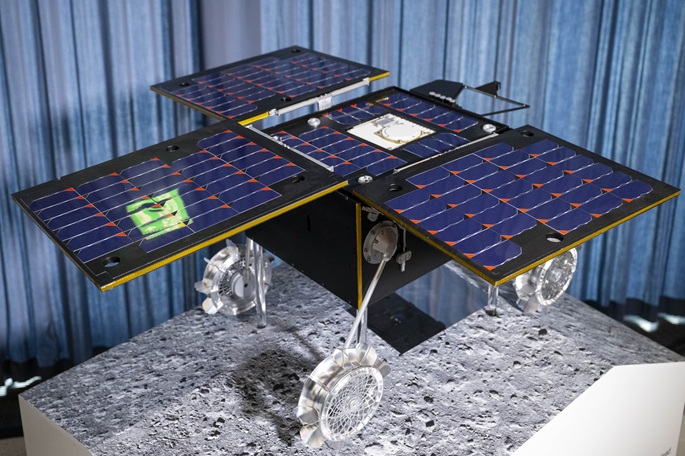
A Japanese space probe carrying a German-French rover is set to begin its journey to Mars in October, with the rover eventually due to become the first to explore the surface of one of the planet's moons.
Japan's Martian Moons eXploration (MMX) mission is currently scheduled to launch on October 19, the German Aerospace Centre (DLR) said on Monday, citing plans by the Japan Aerospace Exploration Agency.
The launch window runs until November 7.
As part of the mission, the German-French rover Idefix is due to land on the Martian moon Phobos in 2029. A return capsule is then to bring samples from Phobos back to Earth in 2031 - the first samples ever returned from the Martian system.
Idefix is expected to explore the moon's surface for around 100 days.
"Our rover Idefix and the MMX spacecraft of our Japanese partners will begin their journey to the Martian system as one unit," DLR project manager Markus Grebenstein and Julien Baroukh, project manager at French space agency CNES, said in a joint statement.
Their paths will separate only once they reach Phobos. "There, Idefix will make history - as the first rover ever to leave tracks on a Martian moon."
The rover takes its name from Idefix, the small white dog in the French "Asterix" comics, who is known as Dogmatix in English.
Rover the size of a drinks crate
One of Idefix's distinctive features is its compact design. The rover is about the size of a drinks crate and weighs around 25 kilograms, but still contains essentially all the components of a fully fledged scientific rover, according to the DLR.
Because of its low weight and Phobos' weak gravity, Idefix will be able to land directly on the moon without the assistance of a landing vehicle.
The MMX probe is expected to reach Mars in 2027 after a journey of around a year and enter orbit around the planet. In 2029, the spacecraft is due to release Idefix from a height of about 40 metres above Phobos, allowing it to free-fall to the surface.
Once it has landed, the rover will right itself autonomously before beginning its mission.
Phobos and Deimos are the only moons in the inner solar system apart from Earth's moon. Both are much smaller than Earth's moon and are irregularly shaped rather than spherical. Phobos measures just under 27 kilometres at its widest point, while Deimos is around 15 kilometres across.
Temperatures on Phobos range from around minus 170 degrees Celsius to 70 degrees Celsius.
The mission is intended to help scientists determine whether Phobos and Deimos are captured asteroids or were formed from debris thrown into space by a massive impact on Mars.
Macron calls for halt to demonstrations in coming days
2 killed, 34 injured in Russian attacks on Ukraine
Germany arrests Ukrainian for spying on defence production for Russia
Merz pledges support for EU accession of West Balkan states
Macron vows to prevent riots at fresh protests scheduled for Saturday
EU should open markets, avoid trade war while protect industries: Merz

Editor-in-Chief Ofiul Hasnat
Published by Finnish News Network (FNN)
Heporinne 4 B 45
01200 Vantaa, Finland.
E-mails : [email protected]