
Opposition Tisza wins
Orban admits defeat in Hungarian parliamentary elections
Published : 12 Apr 2026, 23:22
Updated : 13 Apr 2026, 01:42
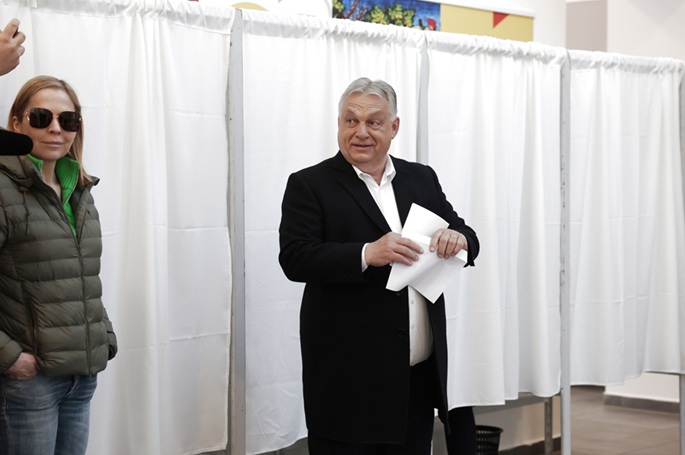
Hungary's opposition party Tisza, led by Peter Magyar, defeated Prime Minister Viktor Orban's ruling coalition by securing a majority in Sunday's parliamentary elections, according to preliminary results released by the National Election Office (NEO), reported Xinhua.
With 98.13 percent of votes counted by the NEO, Tisza had won 53.62 percent of the vote and was projected to win 138 of the 199 parliament seats, exceeding the two-thirds threshold. Orban's ruling Fidesz-KDNP alliance received 37.79 percent and was projected to win 55 seats.
The far-right Our Homeland Movement won 5.89 percent and is projected to take 6 seats. Other parties failed to clear the 5-percent threshold required to enter parliament.
Preliminary statistics showed that turnout reached about 77.8 percent among roughly 8.1 million eligible voters, marking a record high.
On social media, Hungarian President Tamas Sulyok expressed his congratulations to "the winning party of the elections and to all the candidates of the parliament."
Addressing supporters in Budapest, 45-year-old Magyar hailed his party's "decisive victory," saying it was a win seen "from every Hungarian window." He added that Hungary will once again be a strong ally in the European Union and NATO.
Orban, 62, conceded defeat. "The election results, though not yet final, are clear and understandable; for us, they are painful but unambiguous," he told reporters, adding: "We have not been entrusted with the responsibility and opportunity to govern. I congratulated the winning party."
The victory of the center-right Tisza party signals the imminent end of Orban's 16 consecutive years in power. Orban served as Hungary's prime minister from 1998 to 2002 and has remained in office since returning to power in 2010.
During the campaign, Tisza focused on anti-corruption and institutional reform, calling for the restoration of the rule of law and transparent governance. It also advocated repairing relations with the European Union and urged Hungarians to unite in building a sovereign, civic, modern and European Hungary.
Under Hungary's electoral law, parliamentary elections are held every four years. Hungary's parliament has 199 seats, including 106 elected directly in single-member constituencies and 93 allocated among parties that enter parliament.
1,000 detained as protests explode into clashes in France
Zelenskyy says Starlink and Starshield operations restored
Protests sweep Italian cities, clashes reported
Russian, Ukrainian officials discuss humanitarian mission in Oleshky
410,000 take part in new round of protests across France
Injuries and damage after Germany hit by 1st autumn storm

Editor-in-Chief Ofiul Hasnat
Published by Finnish News Network (FNN)
Heporinne 4 B 45
01200 Vantaa, Finland.
E-mails : [email protected]