
German sex workers curate art exhibition about their business
Published : 05 Apr 2026, 22:11
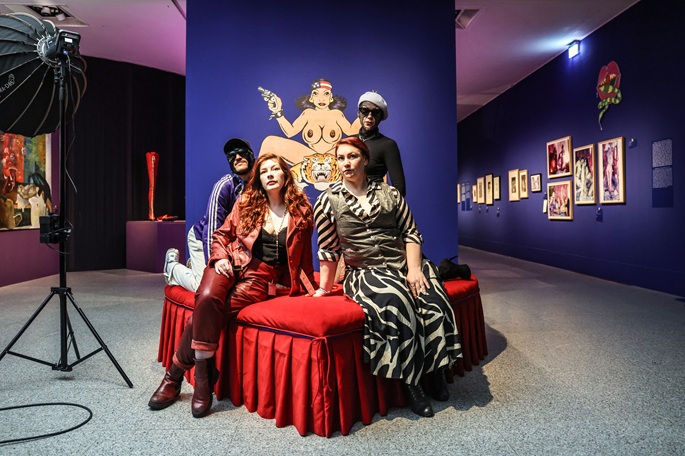
A history of sex work takes us from the dusty streets of ancient Athens to patronage at the Paris Opera centuries later. Head to Bonn for a story of sex work told by the women involved.
"I’m really very happy to see all these stories from sex workers brought together on such a major national stage," says sex worker Rori about a new show at a major gallery in Bonn.
She was among the sex workers who helped curate the exhibition at the Bundeskunsthalle, which gives visitors an inside look at an industry whose history is often told from an outsider's perspective.
A collective of sex workers engaged in research for the show that presents art, cultural history, and archival material.
The history of sex work can be traced from well before ancient times to the present day, and tells us much about a society's prevailing image of humanity, its values and where the power lay.
Starting out from the dusty streets of ancient Athens, where prostitutes are said to have worn sandals that left a footprint bearing the inscription "Follow me," the show explores art, cultural history and socio-political issues.
Art and eroticism were often closely intertwined. Later, in the 19th century, wealthy patrons of the Paris Opera reportedly expected "favours" in return for their patronage.
In the visual arts, prostitutes, courtesans and nude dancers long played primarily a motif role, at best perceived as muses - but here, we see the creative and artistic role that sex workers also play.
To tell a cultural history of sex work means entering a territory permeated by moralizing and highly political discourses.
Media and popular culture all too readily resort to one-dimensional stereotypes when portraying sex workers. But the term "sex work" focuses on the aspect of gainful employment and detaches it from a fixed identity.
Thanks to its creation together with sex workers, the exhibition offers historical and contemporary insights into sex work including perspectives on labour and human rights.
This history of sex work shows the interplay of liberalization and restriction - with a stark example being the liberal Berlin of the Golden Twenties, a period of cultural flourishing and social freedom, followed by the deadly rise of National Socialism.
In 1942, on the orders of SS chief Heinrich Himmler, one of the main architects of the Holocaust, brothels were established in several concentration camps. Women volunteered for this because they were promised better living conditions and early release. But this chapter has long gone untold so as not to protect the prisoners, whose decision to use their sexuality to survive was stigmatised.
Much of the show looks at life after 1945. In the 1980s, we hear about how conservatives called AIDS "God’s punishment" for both homosexuality and prostitution. We see a poster from California which recommended marital fidelity as a protective measure against the disease, still fatal at the time.
But at the same time, the 1980s were also the time when the first autonomous projects by sex workers were established in Berlin and Frankfurt to represent their interests.
The sex workers involved in the exhibition were intended to provide an insider’s perspective, said Eva Kraus, director of the Bundeskunsthalle. The fact that sex workers had been engaged in creative work even earlier is demonstrated, for example, by their influence on fashion trends, according to Johanna Adam, curator at the Bundeskunsthalle.
"It’s incredible how many sex workers have contributed here," Rori told dpa. "I hope we can do something to change the current discourse."
As in many places, in Germany, sex workers' views are often not heard at all, even in debates about the Prostitution Act.
But the industry encompasses a very broad spectrum, ranging from victims to women working entirely on their own terms, with most falling somewhere in between - showed in a highly nuanced and compelling terms by the exhibition.
The show runs from now on to October 25, 2026.
1,000 detained as protests explode into clashes in France
Zelenskyy says Starlink and Starshield operations restored
Protests sweep Italian cities, clashes reported
Russian, Ukrainian officials discuss humanitarian mission in Oleshky
410,000 take part in new round of protests across France
Injuries and damage after Germany hit by 1st autumn storm

Editor-in-Chief Ofiul Hasnat
Published by Finnish News Network (FNN)
Heporinne 4 B 45
01200 Vantaa, Finland.
E-mails : [email protected]