
Merz urges Europe to step up and learn 'language of power politics'
Published : 30 Jan 2026, 01:17
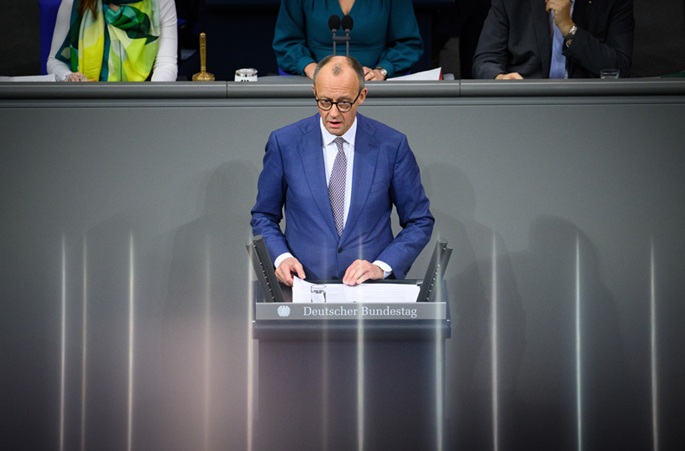
German Chancellor Friedrich Merz on Thursday called on fellow European leaders to unite and assert themselves as an independent force in a new world order that is increasingly dominated by the United States, China and other power players, reported dpa.
Europe is an "alternative to imperialism and autocracy in the world," Merz said in parliament as he delivered a speech on foreign policy a week after US President Donald Trump softened his rhetoric over his ambitions to acquire Greenland.
"We have something to offer our partners around the world, both economically and, above all, in terms of values," Merz said.
Merz said Europe needs to find a way to become a dominant player again to assert itself amid the rapidly changing order that has gone haywire since Trump took office for a second term a little over a year ago.
Europeans will only be able to implement their ideas "if we ourselves learn to speak the language of power politics," Merz told lawmakers.
"There is a harsh wind blowing in this world, and we will feel its effects for the foreseeable future," he said.
However, the changes could also present opportunities for a Europe that acts on the basis of the rule of law and is committed to international cooperation, the German leader noted.
In order for Europe to assert itself, the continent must take charge of its own security and expand its defence capabilities, boost economic competitiveness to keep up with the US and China and act as a united front.
Touching on Trump's bid to acquire Greenland, Merz praised the united response by European NATO allies.
Trump walked back threats to impose tariffs in the dispute or even acquire the Danish-owned territory by force after European nations threatened countertariffs.
This experience briefly allowed Europeans to feel "the joy of self-respect," Merz said, adding that "this newfound self-confidence" must now be used to tackle further issues.
The chancellor's address echoed his speech at the World Economic Forum in Davos last week, where he stressed that the world has entered "a time of great power politics" and is no longer "a cozy place."
Merz, who has sought to deal with Trump using a mix of flattery and caution, sharply criticized the US president's recent controversial statements on the role of NATO troops in Afghanistan.
"We will not allow this mission, which we also carried out in the interests of our ally, the United States, to be disparaged and belittled today," Merz said, taking a much tougher tone towards Trump.
Last week, Trump claimed that the US had never "needed" NATO support during the 2001 invasion of Afghanistan, which was launched to oust the Taliban in response to the September 11 attacks.
In an interview with Fox News, Trump suggested several other NATO countries had sent troops to Afghanistan, but "they stayed a little back, a little off the front lines."
Merz highlighted the 59 German soldiers who were killed in Afghanistan, as well as more than 100 who were severely injured during the mission.
"I would rather say to our soldiers on deployment and at their bases: your service has been and continues to be valuable," Merz said. "It stands for our freedom and for peace in the world."
Established alliances should not be jeopardized lightly, the chancellor said, stressing that Germany would not let itself be dominated by the US.
"As democracies, we are partners and allies, not subordinates," he said. While a hand would always be extended towards Washington, this must be the guiding principle, he added.
Amid this shifting world order, Germany aims to be "part of a dynamic, agile network of sovereign states that want to continue to adhere to a rules-based order."
Merz spoke out in favour of free trade and against tariffs, "because we know from experience that only open markets and free trade are the right way to achieve prosperity and security for the nation."
Against this background, he hailed the importance of the new EU-Mercosur trade deal with Argentina, Brazil, Paraguay and Uruguay as well as the bloc's plans to conclude a trade agreement with India.
Serbia's Vucic concedes election defeat as student-led movement claims victory
Protesters resume demonstration in Portugal after crackdown
Protesters enter Rome's Colosseum during nationwide demo in Italy
5,000 caught drinking at German train stations in week despite new ban
Germany to provide aircraft, officers for Ukraine coalition exercise
Battle over Berlin housing expropriation plans escalates

Editor-in-Chief Ofiul Hasnat
Published by Finnish News Network (FNN)
Heporinne 4 B 45
01200 Vantaa, Finland.
E-mails : [email protected]