
Estonian local elections voting proceed quietly
Published : 15 Oct 2017, 21:24
Updated : 16 Oct 2017, 01:00
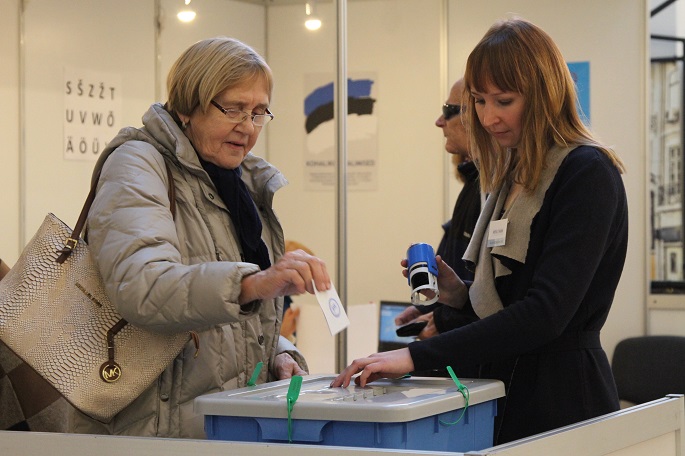
Majority of Estonian registered voters were expected to go to the polling stations on Sunday to elect 79 local councils.
Opening from 9 a.m. local time (0600 GMT) to 8 p.m. local time (1700 GMT), the polling station at the Tallinn city office building near the Freedom Square was quiet with few voters in the morning, while the one at Solaris shopping mall at city center received more voters.
After casting his vote, a gentleman, who said he is a lawyer and his wife, a psychologist, told Xinhua "Voting is not the best way to express democracy, but up till now the best".
The couple, who preferred to be anonymous, also noted that they chose to elect the candidate on the basis of the overall policy, not out of concern of specific sectors.
The Estonian registered voters totalled more than 1.1 million and 1,729 local council members will be elected at 557 polling stations out of 11,804 candidates, Priit Vinkel, head of State Electoral Office, said at a seminar on Saturday night.
In 2017 local elections, advance voting stated on Oct. 5 and ended on Oct. 11 when E-voting or internet voting also ended as a part of advance voting, attracting 306,508 voters, up from 265,208 in last local elections in 2013.
Among them, there were 120,474 voters in voting districts, down from 131,400 in 2013, and 186,034 E-voters, up from 133,808 in 2013 to make a new record since the first-ever pan-national internet voting in October 2005, official statistics showed.
Voters in advance voting accounted for 27.8 percent of the total registered voters in 2017, against the 24.4 percent in 2013.
Firstly, internet voting is regarded as a progress, and secondly it is good for government budget calculation and relocation as the system needs cooperation and support from government ministries and institutions, said Tarvi Martens, Head of I-voting of the State Electoral Office,
Led by Chairman Meelis Eerik, the Estonian National Electoral Committee exercises oversight, hears complaints and verifies national election results.
The 2017 local council election is the first time in Estonian election history 16-17 years old young people can vote, with more than 24,000 new voters.
Center Party, the main party of the Estonian ruling coalition, is expected to win Tallinn, the capital of Estonia, and form a coalition with Social Democrats.
Reform Party, the main opposition party, is poised to win Tartu, the second largest city in Estonia, and Parnu in southwest of Estonia and form coalitions there, according to Andreas Kaju, who introduced the trends and notes of the 2017 local elections.
Preliminary results of the local elections will be announced about at midnight of the election day.
Estonian Defense Minister quits over audit findings
Ulle Madise elected Estonian president
Germany rejects Putin's claims that drone evidence was 'fabricated'
Police probe door opening on German train travelling at 200 km/h
2 injured in explosion near central station in Germany's Augsburg
12 killed in Kiev, suburb in Russian drone-missile attack

Editor-in-Chief Ofiul Hasnat
Published by Finnish News Network (FNN)
Heporinne 4 B 45
01200 Vantaa, Finland.
E-mails : [email protected]