
European countries report surging COVID cases fueled by Omicron
Published : 28 Dec 2021, 02:40
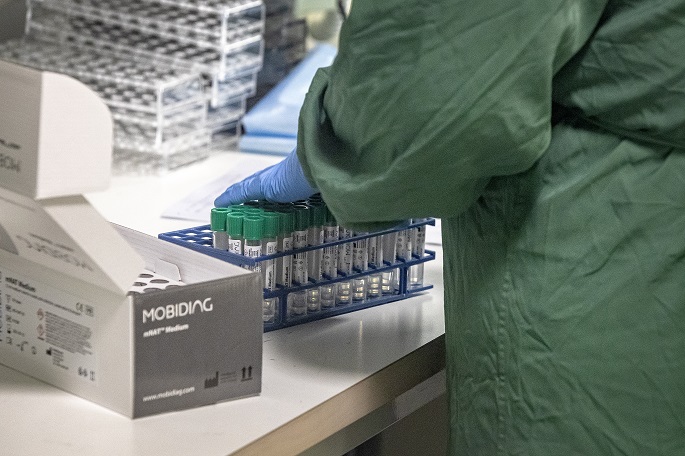
COVID-19 cases have surged in Europe over the Christmas holiday, with several countries reporting a significant percentage of infections caused by the highly-contagious Omicron coronavirus variant, reported Xinhua.
SURGING INFECTIONS
The Omicron variant now accounts for 60 percent of coronavirus infections in Belgium, Emmanuel Andre, a professor of medicine at the Catholic University of Louvain, said in a tweet on Monday. Before the weekend, it accounted for 41 percent, according to local media.
Britain reported 98,515 cases in the last 24 hours, according to official figures released Monday. According to the statistics, 45,307 daily cases were due to Omicron, raising its total to 159,932.
France on Christmas day reported 104,611 new cases, the highest daily number since the outbreak of the pandemic in the country.
In neighboring Spain, the Health Ministry reported that the 14-day COVID-19 incidence in the country rose to 1,206.21 cases per 100,000 people after the four-day period ending Dec. 26, the highest ever recorded in Spain since the start of the pandemic. During the period, the ministry registered 214,619 new infections.
Based on preliminary data from Dec. 6 to 12, about 47 percent of samples analyzed were Omicron, according to the ministry. Some regions are already reporting higher figures, such as Madrid, where the strain accounts for 80 percent of infections.
Omicron has homogenized the situation across Europe -- and in a bad way. Jose Martinez Olmos, a professor from the Andalusian Public Health School, explained: "Before Omicron, what made Spain different from other countries was the better vaccination coverage and greater tendency to be outside due to the climate, but now, with this variant, infections are the same."
The European Centre for Disease Prevention and Control said on Dec. 15 that based on modeling predictions and depending on the growth advantage and level of immune escape, Omicron is likely to become the dominant variant in the EU/EEA within the first two months of 2022.
NEW MEASURES
To curb the spread of COVID-19 during the new year festivities, France's Prime Minister Jean Castex and Minister of Health Olivier Veran announced on Monday a series of measures, calling on French citizens to respect preventive measures during celebrations.
Castex said that there will be no curfew in the country for New Year's Eve. However, for three weeks after Jan. 3, indoor activities will be limited to 2,000 people and outdoor events to 5,000 people, and standing concerts will be prohibited. From January, people will be mandated to work from home three days per week.
Castex also said that vaccines were effective in preventing severe COVID-19-related outcomes and urged people to get vaccinated. He said that people can now receive a COVID-19 booster shot three months after their initial jabs, reducing the guideline of four months to better fight the Omicron variant.
In Germany, the federal and state governments agreed before Christmas to limit private gatherings from Dec. 28, allowing a maximum of 10 people to take part, even if they are all vaccinated or recovered. Some federal states have brought the rules into effect earlier on Monday than planned, and have also imposed further, stricter rules against the pandemic.
Vaccination in Germany continued to advance during the Christmas holiday. Health Minister Karl Lauterbach called on people to accelerate vaccination, with the goal of "enabling us to significantly reduce the number of hospital admissions due to the Omicron variant."
Also on Monday, Greece's Health Minister Thanos Plevris announced stronger anti-virus measures as the daily number of new infections surged to an all-time high of 9,284 in the country.
The government decided that the mandatory use of KN95 or FFP2 type face masks or double surgical masks in stores and on public transport will also apply to other crowded public spaces, both indoors and outdoors, as well as for workers in catering, as of Jan. 3 until Jan. 16.
Under the new rules, up to 50 percent of employees in both the public and the private sectors should work from home. The country's catering and event venues will have to close by 12 midnight. Spectators at sports events will be limited to ten percent of stadium capacity, not exceeding 1,000 people.
12 killed in Ukrainian drone attack in Russia, fighter jet crashes in Ukraine
Rhine could be split in 2 for shipping amid record low water levels
1st Lufthansa Jet with Starlink Wi-Fi next week
Man held after 3 pedestrians hit by car in Britain
Shots fired in Berlin amid rise in gun crime in German capital
Drone explodes after crossing into Bulgaria from Romania: PM

Editor-in-Chief Ofiul Hasnat
Published by Finnish News Network (FNN)
Heporinne 4 B 45
01200 Vantaa, Finland.
E-mails : [email protected]