
Weak Turkish currency puts indebted companies at risk
Published : 03 Nov 2020, 20:32
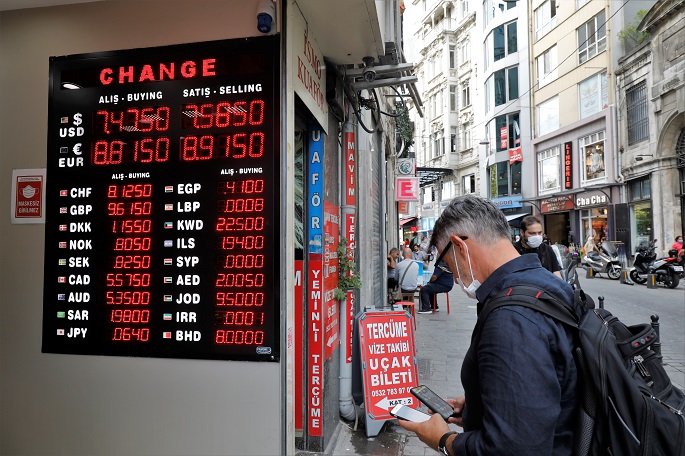
The depreciation of lira has put Turkish companies saddled with billions of U.S. dollars of debt at risk, while the government is stepping up efforts to protect them from a weak currency and the COVID-19 pandemic.
Turkey's ruling Justice and Development Party (AKP) has presented to the parliament a draft law giving President Recep Tayyip Erdogan the authority to lower the corporate tax by up to 5 percent points.
The bill, which will be discussed soon by lawmakers, also includes new measures allowing assets to be brought into the country from abroad without facing taxation, a move that would ease the hand of the Ankara government facing financial woes.
Meanwhile, the corporate tax will be lowered from the previous set level of 20 percent and applied between 15 percent and 18 percent, Turkish press reported.
The move aims to support smaller companies hit by falling demands during the coronavirus pandemic and revive the economy.
The planned measure on asset purchase would allow people to bring into the country money, gold, foreign exchange, securities and other capital market instruments without paying taxes in a bid to strengthen a volatile financial system.
Turkish companies face great challenges in light of a weakening currency, which has lost 30 percent of its value against the U.S. dollar this year. So, rescheduling their debts would prevent them from the risk of bankruptcy.
Ayhan Atli, the co-owner of a medium-sized printing company in capital Ankara, has a bank loan agreement in dollars and is troubled by the loss of the lira's value.
"We have a loan in dollars, but we sell our products in liras, and so monthly repayments plus interests have become very difficult. We are afraid to default our payments," he told Xinhua, noting that the more the lira depreciates, the more expensive the foreign currency loan becomes to repay.
The businessman is hopeful that the tax amnesty bill would provide some relief.
The lira hit an all-time low on Monday, trading at 8.41 against one dollar.
Since a currency meltdown in 2018, Turkish companies have reduced their foreign-denominated debt which is still nevertheless very substantial.
The outstanding foreign borrowing dropped to 167.1 billion dollars in the first three months of the year from 179.5 billion dollars at the end of 2019, the Turkish Central Bank said in a report in late August.
But the cost of the debt is increasing sharply in lira as the currency hits new lows against the dollar and other foreign currencies.
Economists predict that the coming period may witness more companies announcing their inability to pay their scheduled debts.
Mahfi Egilmez, economist and former Turkish Treasury advisor, highlighted in his blog the dramatic consequences of the decline of the lira on the balance sheets on indebted businesses.
"A company which had one million dollars of debt a year ago had to buy one dollar for 5.95 lira, while he has to buy a dollar for 8.34 (on Oct. 30) to repay the same loan. The company's debt has risen by 40 percent on a lira basis," he said.
"If the company failed to increase its income at least by 40 percent in the same period (something which is impossible apart from a few exceptions), chances of this business to remain afloat is slim," the economist remarked.
Amid long-standing economic woes worsened by the pandemic, Erdogan said on Oct. 31 that his nation is waging an "economic liberation war" against the interest rates, inflation and exchange rates.
"Our response to those who work to besiege our country in the economic sphere is a new war of economic liberation," Erdogan said, addressing supporters in the eastern city of Van.
He said the government has carried out a "grand structural change," urging citizens to be "a little bit more patient."
Wildfire in eastern Netherlands remains out of control
Britain enacts tobacco law to create smoke-free generation
Rising prices push Germans to cut spending: poll
EU preliminarily finds Meta in breach of digital rules over underage users
Man suspected of spying for Russia detained in Berlin
British PM not to face probe over Mandelson issue

Editor-in-Chief Ofiul Hasnat
Published by Finnish News Network (FNN)
Heporinne 4 B 45
01200 Vantaa, Finland.
E-mails : [email protected]
To Editor: [email protected]